Kirjojen hintavertailu. Mukana 11 699 587 kirjaa ja 12 kauppaa.

Kirjahaku

Etsi kirjoja tekijän nimen, kirjan nimen tai ISBN:n perusteella.

5 kirjaa tekijältä David M. Levy

How the Dismal Science Got Its Name

How the Dismal Science Got Its Name

David M. Levy

The University of Michigan Press
2002
nidottu
It is widely asserted that the Victorian sages attacked classical economics from a humanistic or egalitarian perspective, calling it "the dismal science," and that their attack is relevant to modern discussions of market society. David M. Levy here demonstrates that these assertions are simply false: political economy became "dismal" because Carlyle, Ruskin, and Dickens were horrified at the idea that systems of slavery were being replaced by systems in which individuals were allowed to choose their own paths in life. At a minimum, they argued, "we" white people ought to be directing the lives of "them," people of color. Economists of the time argued, on the other hand, that people of color were to be protected by the rule of law--hence the moniker "the dismal science." A startling image from 1893, which is reproduced in full color on this book's jacket, shows Ruskin killing someone who appears to be nonwhite. A close look reveals that the victim is reading "The Dismal Science." Levy discusses this image at length and also includes in his text weblinks to Carlyle's "Occasional Discourse on the Negro Question" and to Mill's response, demonstrating that these are central documents in British classical economics. He explains Adam Smith's egalitarian foundations, contrasting Smith's approach to the hierarchical alternative proposed by Carlyle. Levy also examines various visual representations of this debate and provides an illuminating discussion of Smith's "katallactics," the science of exchange, comparing it with the foundations of modern neoclassical economics. How the Dismal Science Got Its Name also introduces the notion of "rational choice scholarship" to explain how attacks on market economics from a context in which racial slavery was idealized have been interpreted as attacks on market economics from a humanistic or egalitarian context. Thus it will greatly appeal to economists, political scientists, philosophers, students of Victorian literature, and historians. David M. Levy is Associate Professor of Economics and Research Associate, Center for Study of Public Choice, George Mason University.

The Tabernacle––Shadows of the Messiah – Its Sacrifices, Services, and Priesthood
The Tabernacle dominates fifty chapters in the Old Testament, while all of creation requires only two. Yet attaining an understanding of the design and significance of God's first house among His people gets scant attention in most churches today. A proper understanding of the Tabernacle provides a graphic understanding of God's redemptive program. It clearly pictures sinful man, holy God, and the incredible price required to bring the two together. A grasp of the Tabernacle's sacrifices, services, and priesthood is prerequisite to a proper understanding of more than half the book of Hebrews, and countless other New Testament passages. While numerous books have been written on the Tabernacle, most focus on its services, virtually omitting the priesthood and the various sacrifices. Newer Tabernacle books are often sketchy in their content, overly fanciful in their typology, and include exaggerated anti-types of Christ that the text never intended. David M. Levy provides a resource equally helpful for those with little Bible knowledge and those with many years of personal Bible study, promising to challenge the reader with the significance of the Tabernacle.
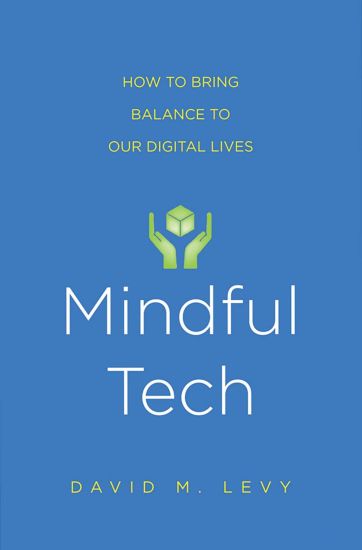
Mindful Tech

Mindful Tech

David M. Levy

Yale University Press
2017
pokkari
Through a series of lucid and engaging exercises, readers are invited to discover healthier and more effective digital practices From email to smart phones, and from social media to Google searches, digital technologies have transformed the way we learn, entertain ourselves, socialize, and work. Despite their usefulness, these technologies have often led to information overload, stress, and distraction. In recent years many of us have begun to look at the pluses and minuses of our online lives and to ask how we might more skillfully use the tools we’ve developed. David M. Levy, who has lived his life between the “fast world” of high tech and the “slow world” of contemplation, offers a welcome guide to being more relaxed, attentive, and emotionally balanced, and more effective, while online. In a series of exercises carefully designed to help readers observe and reflect on their own use, Levy has readers watch themselves closely while emailing and while multitasking, and also to experiment with unplugging for a specified period. Never prescriptive, the book opens up new avenues for self-inquiry and will allow readers—in the workplace, in the classroom, and in the privacy of their homes—to make meaningful and powerful changes.