Kirjojen hintavertailu. Mukana 11 448 166 kirjaa ja 12 kauppaa.

Kirjahaku

Etsi kirjoja tekijän nimen, kirjan nimen tai ISBN:n perusteella.

8 kirjaa tekijältä David M. O'Brien

Supreme Court Watch 2015

Supreme Court Watch 2015

David M. O'Brien

WW Norton Co
2018
nidottu
Each annual edition of Supreme Court Watch offers narratives and analyses of legal disputes, political battles, and social confrontations as they unfold before the Supreme Court. Included are numerous excerpts from the justices’ opinions and dissents on the most influential cases of the past term, as well as a preview of the cases awaiting the Court in the forthcoming term.
Supreme Court Watch 2003

Supreme Court Watch 2003

David M. O'Brien

W. W. Norton Company
2003
nidottu
Each annual edition of Supreme Court Watch o ffers students narratives and analyses of legal disputes, political battles, and social confrontations as they unfold before the Supreme Court. Included in Supreme Court Watch 2003 are numerous excerpts from the justices' opinions and dissents on the Court's most influential cases of the past two terms, as well as a running preview of the cases awaiting the Court in the forthcoming 2003-2004 term. The Watch is an ideal supplement to the author's two-volume casebook, Constitutional Law and Politics, and serves as an excellent addition to other books for courses on law, legal studies, and the judiciary.
Supreme Court Watch 2002

Supreme Court Watch 2002

David M. O'Brien

W. W. Norton Company
2002
nidottu
Each annual edition of Supreme Court Watch offers students narratives and analyses of legal disputes, political battles, and social confrontations as they unfold before the Supreme Court. Also included are numerous excerpts from the justices' opinions and dissents on the Court's most influential cases of the past three terms, as well as a running preview of the cases awaiting the Court in the forthcoming term. Supreme Court Watch is an indispensable resource for any course on law, legal studies, and the judiciary.
Animal Sacrifice and Religious Freedom

Animal Sacrifice and Religious Freedom

David M. O'Brien

University Press of Kansas
2004
sidottu
The Santeria religion of Cuba--the Way of the Saints--mixes West African Yoruba culture with Catholicism. Similar to Haitian voodoo, Santeria has long practiced animal sacrifice in certain rites. But when Cuban immigrants brought those rituals to Florida, local authorities were suddenly confronted with a controversial situation that pitted the regulation of public health and morality against religious freedom. After Ernesto Pichardo established a Santeria church in Hialeah in the 1980s, the city of Hialeah responded by passing ordinances banning ritual animal sacrifice. Although on the surface those ordinances seemed general in intent, they were clearly aimed at Pichardo's church. When Pichardo subsequently sued the city, a federal court ruled in the latter's favor, in effect privileging the regulation of public health and morality over the church's free exercise of its religion. The U.S. Supreme Court heard Pichardo's appeal in 1993 and unanimously decided that the city had overstepped its bounds in targeting this particular religious group; however, the court was sharply divided regarding the basis of its decision. Three concurring opinions registered distinctly different views of the First Amendment, the limits of government regulation, and the religious freedom of minorities. In the end, the nine justices collectively concluded that freedom of religious belief was absolute while the freedom to practice the tenets of any faith were subject to non-discriminatory local regulations. David O'Brien, one of America's foremost scholars of the Court, now illuminates this controversy and its significance for law, government, and religion in America. His lively account takes us behind the scenes at every stage of the litigation to reveal a riveting case with more twists and turns than a classic whodunit. Ranging with equal ease from primitive magic to municipal politics and to the most arcane points of constitutional law, O'Brien weaves a compelling and instructive tale with a fascinating array of politicians, lawyers, jurists, civil libertarians, and animal rights advocates. Offering sharp insights into the key issues and personalities, he highlights cultural clashes large and small, while maintaining a balance for both the needs of government and the religious rights of individuals. This book is part of the Landmark Law Cases and American Society series.
Animal Sacrifice and Religious Freedom

Animal Sacrifice and Religious Freedom

David M. O'Brien

University Press of Kansas
2004
nidottu
The Santeria religion of Cuba--the Way of the Saints--mixes West African Yoruba culture with Catholicism. Similar to Haitian voodoo, Santeria has long practiced animal sacrifice in certain rites. But when Cuban immigrants brought those rituals to Florida, local authorities were suddenly confronted with a controversial situation that pitted the regulation of public health and morality against religious freedom. After Ernesto Pichardo established a Santeria church in Hialeah in the 1980s, the city of Hialeah responded by passing ordinances banning ritual animal sacrifice. Although on the surface those ordinances seemed general in intent, they were clearly aimed at Pichardo's church. When Pichardo subsequently sued the city, a federal court ruled in the latter's favor, in effect privileging the regulation of public health and morality over the church's free exercise of its religion. The U.S. Supreme Court heard Pichardo's appeal in 1993 and unanimously decided that the city had overstepped its bounds in targeting this particular religious group; however, the court was sharply divided regarding the basis of its decision. Three concurring opinions registered distinctly different views of the First Amendment, the limits of government regulation, and the religious freedom of minorities. In the end, the nine justices collectively concluded that freedom of religious belief was absolute while the freedom to practice the tenets of any faith were subject to non-discriminatory local regulations. David O'Brien, one of America's foremost scholars of the Court, now illuminates this controversy and its significance for law, government, and religion in America. His lively account takes us behind the scenes at every stage of the litigation to reveal a riveting case with more twists and turns than a classic whodunit. Ranging with equal ease from primitive magic to municipal politics and to the most arcane points of constitutional law, O'Brien weaves a compelling and instructive tale with a fascinating array of politicians, lawyers, jurists, civil libertarians, and animal rights advocates. Offering sharp insights into the key issues and personalities, he highlights cultural clashes large and small, while maintaining a balance for both the needs of government and the religious rights of individuals. This book is part of the Landmark Law Cases and American Society series.
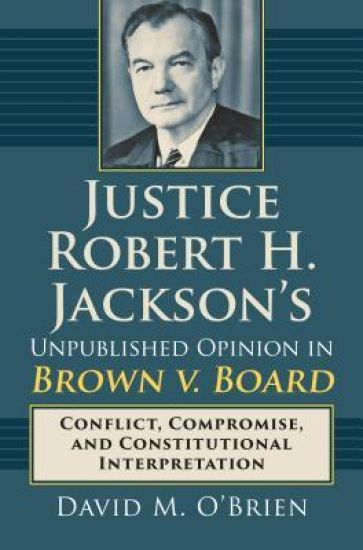
Justice Robert H. Jackson's Unpublished Opinion in Brown v. Board
Brown v. Board of Education is widely recognized as one of the US Supreme Court’s most important decisions in the twentieth century. Robert H. Jackson, an associate justice on the case, is generally considered one of the Court’s most gifted writers. Though much has been written about Brown, citing the writing and remarks of the justices who participated in the 1954 decision, comparatively little has been said about Jackson or his unpublished opinion, which is sometimes even mistakenly taken as a dissenting opinion. This book visits Brown v. Board of Education from Jackson’s perspective and, in doing so, offers a reinterpretation of the justice's thinking, and of the Supreme Court's decision making, in a ruling that continues to reverberate through the nation’s politics and public life.Weaving together judicial biography, legal history, and judicial politics, Justice Robert H. Jackson’s Unpublished Opinion in Brown v. Board provides a nuanced look at constitutional interpretation, and the intersection of law and politics, from inside the mind of a justice, within the context of a Court deciding a seminal case. Through an analysis of six drafts of Jackson's unpublished concurring opinion, David M. O’Brien explores the justice’s evolving thoughts on relevant issues at critical moments in the case. His retelling of Brown presents a new view of longstanding arguments confronted by Jackson and the other justices over “original intent” versus a “living Constitution,” the role of the Court, and social change and justice in American political life. The book includes the final draft of Jackson’s unpublished opinion, as well as the Warren Court's opinions in Brown and in Bolling v. Sharpe, for comparison, along with a timeline of developments and decision making leading to the Court’s landmark ruling.
Congress Shall Make No Law

Congress Shall Make No Law

David M. O'Brien

Rowman Littlefield
2010
sidottu
The First Amendment declares that 'Congress shall make no law . . . abridging the freedom of speech, or of the press. . . . ' Yet, in the following two hundred years, Congress and the states have sought repeatedly to curb these freedoms. The Supreme Court of the United States in turn gradually expanded First Amendment protection for freedom of expression but also defined certain categories of expression_obscenity, defamation, commercial speech , and 'fighting words' or disruptive expression-as constitutionally unprotected. From the Alien and Sedition Act of 1798 to the most recent cases to come before the Supreme Court, noted legal scholar David M. O'Brien provides the first comprehensive examination of these exceptions to the absolute command of the First Amendment, providing a history of each category of unprotected speech and putting into bold relief the larger questions of what kinds of expression should (and should not) receive First Amendment protection. O'Brien provides readers interested in civil liberties, constitutional history and law, and the U. S. Supreme Court a treasure trove of information and ideas about how to think about the First Amendment.