Kirjojen hintavertailu. Mukana 11 699 587 kirjaa ja 12 kauppaa.

Kirjahaku

Etsi kirjoja tekijän nimen, kirjan nimen tai ISBN:n perusteella.

9 kirjaa tekijältä David MacKenzie

Violent Solutions

Violent Solutions

David MacKenzie

University Press of America
1996
sidottu
This book deals with the impact of revolution, nationalism, and secret societies in modern European history from the Enlightenment to World War I. Special attention is devoted to the French Revolution, nationalism and unification of Italy, Germany, and Serbia, and the role of organizations such as "Young Italy" and the Serbian "Black Hand." Contents: List of Illustrations; List of Maps; Preface; The Enlightenment, Freemasonry and Rousseau; The French Revolution, 1789-1799; Babeuf and Buonarroti; Italian Nationalism Before 1848; The Unification of Italy, 1848-1870; German Nationalism and Revolutions of 1848; The Unification of Germany, 1850-1871; The Greek Revolution; The Russian Revolutionary Movement to 1881; The Emergence of Serbia to 1878; Serbia and the Creation of Yugoslavia, 1878-1918; The Legacy of Violence.
Violent Solutions

Violent Solutions

David MacKenzie

University Press of America
1996
nidottu
This book deals with the impact of revolution, nationalism, and secret societies in modern European history from the Enlightenment to World War I. Special attention is devoted to the French Revolution, nationalism and unification of Italy, Germany, and Serbia, and the role of organizations such as 'Young Italy' and the Serbian 'Black Hand.' Contents: List of Illustrations; List of Maps; Preface; The Enlightenment, Freemasonry and Rousseau; The French Revolution, 1789-1799; Babeuf and Buonarroti; Italian Nationalism Before 1848; The Unification of Italy, 1848-1870; German Nationalism and Revolutions of 1848; The Unification of Germany, 1850-1871; The Greek Revolution; The Russian Revolutionary Movement to 1881; The Emergence of Serbia to 1878; Serbia and the Creation of Yugoslavia, 1878-1918; The Legacy of Violence.
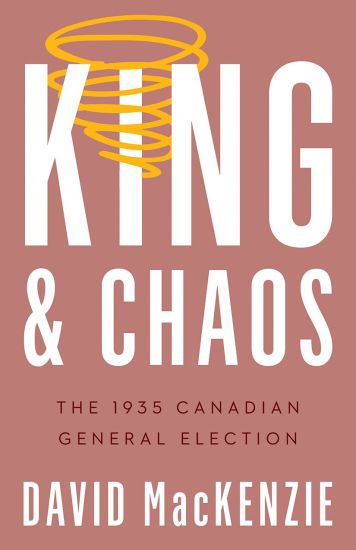
King and Chaos

King and Chaos

David MacKenzie

University of British Columbia Press
2023
pokkari
In 1935, Canadians went to the polls against the backdrop of the Great Depression and deteriorating international conditions. This election was like no other, as five major parties competed for voters who were used to a traditional slate of Liberals versus Conservatives. King and Chaos examines the significance of this turning point in political history.As the Conservative government splintered under the weight of outdated policies, the opposition Liberals watched the destruction. Meanwhile, the newly minted Co-operative Commonwealth Federation, Social Credit Party, and Reconstruction Party broadened the electoral base, bringing working-class Canadians – and working-class issues – more directly into the political process.Although Canadians ultimately swept Liberal William Lyon Mackenzie King back into power, King and Chaos demonstrates that the advent of third parties transformed the political landscape. And while other countries turned to dictators and demagogues, King delivered a less radical but equally important change: an effective electoral machine and a national coalition of French and English Canada that dominated politics for the next generation.
Serbs and Russians

Serbs and Russians

David MacKenzie

East European Monographs
1997
sidottu
MacKenzie deals in general terms with the historical relationship of the two groups and describes the roles of four important Serbian leaders who contributed to Yugoslav unification and national development before the second World War.
Canada and International Civil Aviation 1932-1948

Canada and International Civil Aviation 1932-1948

David MacKenzie

UNIVERSITY OF TORONTO PRESS
1989
pokkari
Among the many twentieth-century explosions in technology that have made the world into a global village, few have had tangible or far-reaching an impact as aviation. David MacKenzie examines the efforts made to establish an international system for the regulation and operation of international air services, and the role played by Canadians in its development. MacKenzie approaches international civil aviation as an arm of government policy: the extension abroad of Canadian national policy. He also looks at the relationship between the bureaucratic and political levels of government and, in the larger context, at the relations between Canada and its major allies, the United States and Great Britain. Drawing on private papers and government documents from Canada, the United States, Great Britain, and Ireland, MacKenzie offers an international perspective on one of Canada's most important contributions to public policy in the mid-twentieth century.
Inside the Atlantic Triangle

Inside the Atlantic Triangle

David MacKenzie

UNIVERSITY OF TORONTO PRESS
1986
pokkari
This book examines the evolution of Canadian policy towards Newfoundland during the decade leading up to Confederation in 1949. The outbreak of war in 1939 produced relatively few changes in Canadian- Newfoundland relations but, in 1940, with the Allied collapse in Europe and the base-destroyer deal which introduced an American presence in Newfoundland, the Canadian government was forced to take a more active interest in that country's welfare. Over the course of the war the Canadians increasingly provided for the defence of Newfoundland, and a vigorous effort was made to preserve and enhance Canada's influence there.
Arthur Irwin

Arthur Irwin

David MacKenzie

UNIVERSITY OF TORONTO PRESS
1993
pokkari
From 1925 to 1950, Arthur Irwin was the driving force behind the success of Maclean's Magazine, first as an associate editor, then managing editor, and, finally, as an editor. He had strong views on what it meant to be Canadian, and under his direction Maclean's was moulded into 'Canada's National Magazine,' mirroring the development of Canada as an independent nation in the twentieth century. In the years before the outbreak of the Second World War, he was at the centre of the Maclean Company’s investigation of the Department of National Defence's system of defence contracting, or what has become known as the 'Bren Gun Scandal.' In the 1940s Irwin actively sought out writers of talent and potential and gradually added to the magazine's staff many Canadian writers who went on to distinguished careers, including Ralph Allen, Pierre Berton, Blair Fraser, and Scott Young. After leaving Maclean's in 1950, Irwin was appointed film commissioner at the National Film Board, during a time when the board's survival was in doubt because of allegations of espionage and subversion. Irwin was the man called in to deal with the NFB's 'red scare,' and, afterwards, he reorganized the board and moved its operations from Ottawa to Montreal. Irwin subsequently went on to a career as a diplomat: he was appointed high commissioner in Australia, and ambassador to Brazil and Mexico. In his last professional position he was publisher of a Victoria newspaper. This book, in describing a man who was profoundly representative of his times, and whose presence in major Canadian institutions was influential, captures the mood of Irwin's period, and raises important questions about the roots of present-day Canadian nationalism and cultural identity.