Kirjojen hintavertailu. Mukana 12 390 323 kirjaa ja 12 kauppaa.

Kirjahaku

Etsi kirjoja tekijän nimen, kirjan nimen tai ISBN:n perusteella.

10 kirjaa tekijältä David N. Myers

Jewish History

Jewish History

David N. Myers

Oxford University Press Inc
2017
nidottu
How have the Jews survived? For millennia, they have defied odds by overcoming the travails of exile, persecution, and recurring plans for their annihilation. Many have attempted to explain this singular success as a result of divine intervention. In this engaging book, David N. Myers charts the long journey of the Jews through history. At the same time, it points to two unlikely-and decidedly this-worldly--factors to explain the survival of the Jews: antisemitism and assimilation. Usually regarded as grave dangers, these two factors have continually interacted with one other to enable the persistence of the Jews. At every turn in their history, not just in the modern age, Jews have adapted to new environments, cultures, languages, and social norms. These bountiful encounters with host societies have exercised the cultural muscle of the Jews, preventing the atrophy that would have occurred if they had not interacted so extensively with the non-Jewish world. It is through these encounters--indeed, through a process of assimilation--that Jews came to develop distinct local customs, speak many different languages, and cultivate diverse musical, culinary, and intellectual traditions. Left unchecked, the Jews' well-honed ability to absorb from surrounding cultures might have led to their disappearance. And yet, the route toward full and unbridled assimilation was checked by the nearly constant presence of hatred toward the Jew. Anti-Jewish expression and actions have regularly accompanied Jews throughout history. Part of the ironic success of antisemitism is its malleability, its talent in assuming new forms and portraying the Jew in diverse and often contradictory images--for example, at once the arch-capitalist and revolutionary Communist. Antisemitism not only served to blunt further assimilation, but, in a paradoxical twist, affirmed the Jew's sense of difference from the host society. And thus together assimilation and antisemitism (at least up to a certain limit) contribute to the survival of the Jews as a highly adaptable and yet distinct group.
The Stakes of History

The Stakes of History

David N. Myers

Yale University Press
2018
sidottu
A leading scholar of Jewish history’s bracing and challenging case for the role of the historian today Why do we study history? What is the role of the historian in the contemporary world? These questions prompted David N. Myers’s illuminating and poignant call for the relevance of historical research and writing. His inquiry identifies a number of key themes around which modern Jewish historians have wrapped their labors: liberation, consolation, and witnessing. Through these portraits, Myers revisits the chasm between history and memory, revealing the middle space occupied by modern Jewish historians as they work between the poles of empathic storytelling and the critical sifting of sources. History, properly applied, can both destroy ideologically rooted myths that breed group hatred and create new memories that are sustaining of life. Alive in these investigations is Myers’s belief that the historian today can and should attend to questions of political and moral urgency. Historical knowledge is not a luxury to society but an essential requirement for informed civic engagement, as well as a vital tool in policy making, conflict resolution, and restorative justice.
Resisting History

Resisting History

David N. Myers

Princeton University Press
2010
pokkari
Nineteenth-century European thought, especially in Germany, was increasingly dominated by a new historicist impulse to situate every event, person, or text in its particular context. At odds with the transcendent claims of philosophy and--more significantly--theology, historicism came to be attacked by its critics for reducing human experience to a series of disconnected moments, each of which was the product of decidedly mundane, rather than sacred, origins. By the late nineteenth century and into the Weimar period, historicism was seen by many as a grinding force that corroded social values and was emblematic of modern society's gravest ills. Resisting History examines the backlash against historicism, focusing on four major Jewish thinkers. David Myers situates these thinkers in proximity to leading Protestant thinkers of the time, but argues that German Jews and Christians shared a complex cultural and discursive world best understood in terms of exchange and adaptation rather than influence. After examining the growing dominance of the new historicist thinking in the nineteenth century, the book analyzes the critical responses of Hermann Cohen, Franz Rosenzweig, Leo Strauss, and Isaac Breuer. For this fascinating and diverse quartet of thinkers, historicism posed a stark challenge to the ongoing vitality of Judaism in the modern world. And yet, as they set out to dilute or eliminate its destructive tendencies, these thinkers often made recourse to the very tools and methods of historicism. In doing so, they demonstrated the utter inescapability of historicism in modern culture, whether approached from a Christian or Jewish perspective.
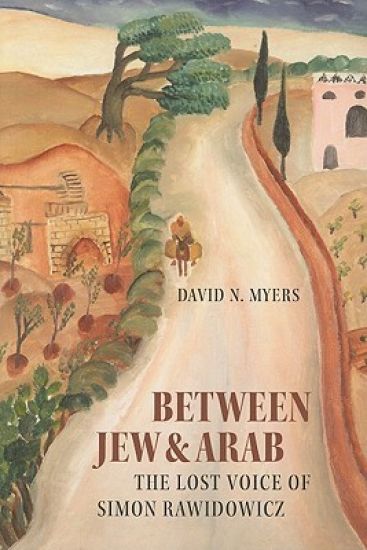
Between Jew and Arab

Between Jew and Arab

David N. Myers

Brandeis University Press
2010
nidottu
This book brings new attention to Simon Rawidowicz (1897-1957), the wide-ranging Jewish thinker and scholar who taught at Brandeis University in the 1950s. At the heart of Myers' book is a chapter that Rawidowicz wrote as a coda to his Hebrew tome Babylon and Jerusalem (1957) but never published. In it, Rawidowicz shifted his decades-long preoccupation with the "Jewish Question" to what he called the "Arab Question." Asserting that the "Arab Question" had become a most urgent political and moral matter for Jews after 1948, Rawidowicz called for an end to discrimination against Arabs resident in Israel-and more provocatively, for the repatriation of Arab refugees from 1948. Myers' book is divided into two main sections. Part I introduces the life and intellectual development of Rawidowicz. It traces the evolution of his thinking about the"Jewish Question," namely, the status of Jews as a national minority in the Diaspora. Part II concentrates on the shift occasioned by the creation of the State of Israel, when Jews assumed political sovereignty and entered into a new relationship with the native Arab population. Myers analyzes the structure, content, and context of Rawidowicz's unpublished chapter on the "Arab Question," paying particular attention to Rawidowicz's calls for an end to discrimination against Arabs in Israel, on the one hand, and for the repatriation of those refugees who left Palestine in 1948, on the other. The volume also includes a full English translation of"Between Jew and Arab," a timeline of significant events, and an appendix of official legal documents from Israel and the international community pertaining to the conflict.
Acculturation and Its Discontents

Acculturation and Its Discontents

David N. Myers; Massimo Ciavolella; Peter Reill; Geoffrey Symcox

University of Toronto Press
2008
sidottu
Exploring the fascinating cross-cultural influences between Jews and Christians in Italy from the Renaissance to the twentieth century, Acculturation and Its Discontents assembles essays by leading historians, literary scholars, and musicologists to present a well-rounded history of Italian Jewry. The contributors offer rich portraits of the many vibrant forms of cultural and artistic expression that Italian Jews contributed to, but this volume also pays close attention to the ways in which Italian Jews - both freely and under pressure - creatively adapted to the social, cultural, and legal norms of the surrounding society. Tracing both the triumphs and tragedies of Jewish communities within Italy over a broad span of time, Acculturation and Its Discontents challenges conventional assumptions about assimilation and state intervention and, in the process, charts the complex process of cultural exchange that left such a distinctive imprint not only on Italian Jewry, but also on Italian society itself. This collection of rigorous and thought-provoking essays makes a major contribution to both the history of Italian culture and the cultural influence and significance of European Jews.
Acculturation and Its Discontents

Acculturation and Its Discontents

David N. Myers; Massimo Ciavolella; Peter Reill; Geoffrey Symcox

University of Toronto Press
2020
pokkari
Exploring the fascinating cross-cultural influences between Jews and Christians in Italy from the Renaissance to the twentieth century, Acculturation and Its Discontents assembles essays by leading historians, literary scholars, and musicologists to present a well-rounded history of Italian Jewry. The contributors offer rich portraits of the many vibrant forms of cultural and artistic expression that Italian Jews contributed to, but this volume also pays close attention to the ways in which Italian Jews - both freely and under pressure - creatively adapted to the social, cultural, and legal norms of the surrounding society. Tracing both the triumphs and tragedies of Jewish communities within Italy over a broad span of time, Acculturation and Its Discontents challenges conventional assumptions about assimilation and state intervention and, in the process, charts the complex process of cultural exchange that left such a distinctive imprint not only on Italian Jewry, but also on Italian society itself. This collection of rigorous and thought-provoking essays makes a major contribution to both the history of Italian culture and the cultural influence and significance of European Jews.
New Trends in the Study of Haredi Culture and Society

New Trends in the Study of Haredi Culture and Society

David N. Myers; Nechumi Malovicki-Yaffe

PURDUE UNIVERSITY PRESS
2024
sidottu
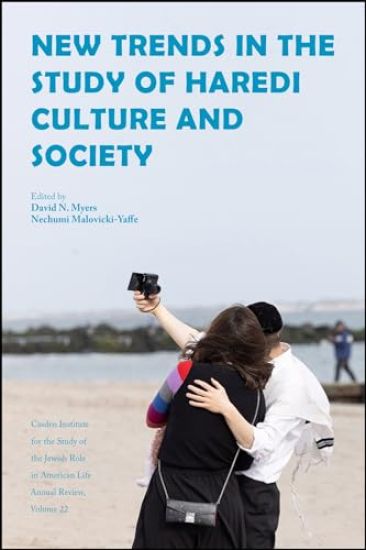
Who are Haredim? And why are they the source of both increasing attention and continuing misunderstanding? New Trends in the Study of Haredi Culture and Society draws on the innovative research of leading scholars from a variety of disciplines—including history, religious studies, demography, linguistics, and geography—to trace the growing prominence of Haredi (often called ultra-Orthodox) Jews in Jewish life. Haredi Jews are committed to preserving a measure of segregation from the rest of society consistent with the guiding principles of their forebears; yet increasingly, they are appearing more visibly and assertively in public spaces. Demographic analysis suggests that they will constitute a much larger share—nearly one-quarter—of the world Jewish population over the next twenty years. By examining the evolution of political, cultural, and social trends in Haredi communities across the globe, this interdisciplinary and transnational volume sheds important light both on Haredi communities and on the societies of which they are part.
New Trends in the Study of Haredi Culture and Society

New Trends in the Study of Haredi Culture and Society

David N. Myers; Nechumi Malovicki-Yaffe

PURDUE UNIVERSITY PRESS
2024
nidottu
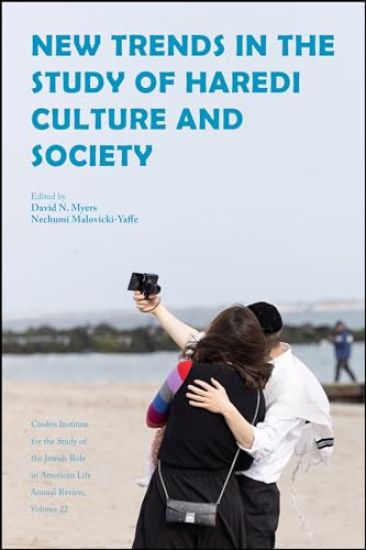
Who are Haredim? And why are they the source of both increasing attention and continuing misunderstanding? New Trends in the Study of Haredi Culture and Society draws on the innovative research of leading scholars from a variety of disciplines—including history, religious studies, demography, linguistics, and geography—to trace the growing prominence of Haredi (often called ultra-Orthodox) Jews in Jewish life. Haredi Jews are committed to preserving a measure of segregation from the rest of society consistent with the guiding principles of their forebears; yet increasingly, they are appearing more visibly and assertively in public spaces. Demographic analysis suggests that they will constitute a much larger share—nearly one-quarter—of the world Jewish population over the next twenty years. By examining the evolution of political, cultural, and social trends in Haredi communities across the globe, this interdisciplinary and transnational volume sheds important light both on Haredi communities and on the societies of which they are part.
American Shtetl

American Shtetl

Nomi M. Stolzenberg; David N. Myers

PRINCETON UNIVERSITY PRESS
2022
sidottu
A compelling account of how a group of Hasidic Jews established its own local government on American soilSettled in the mid-1970s by a small contingent of Hasidic families, Kiryas Joel is an American town with few parallels in Jewish history—but many precedents among religious communities in the United States. This book tells the story of how this group of pious, Yiddish-speaking Jews has grown to become a thriving insular enclave and a powerful local government in upstate New York. While rejecting the norms of mainstream American society, Kiryas Joel has been stunningly successful in creating a world apart by using the very instruments of secular political and legal power that it disavows.Nomi Stolzenberg and David Myers paint a richly textured portrait of daily life in Kiryas Joel, exploring the community's guiding religious, social, and economic norms. They delve into the roots of Satmar Hasidism and its charismatic founder, Rebbe Joel Teitelbaum, following his journey from nineteenth-century Hungary to post–World War II Brooklyn, where he dreamed of founding an ideal Jewish town modeled on the shtetls of eastern Europe. Stolzenberg and Myers chart the rise of Kiryas Joel as an official municipality with its own elected local government. They show how constant legal and political battles defined and even bolstered the community, whose very success has coincided with the rise of political conservatism and multiculturalism in American society over the past forty years.Timely and accessible, American Shtetl unravels the strands of cultural and legal conflict that gave rise to one of the most vibrant religious communities in America, and reveals a way of life shaped by both self-segregation and unwitting assimilation.
American Shtetl

American Shtetl

Nomi M. Stolzenberg; David N. Myers

PRINCETON UNIVERSITY PRESS
2024
pokkari
A compelling account of how a group of Hasidic Jews established its own local government on American soilSettled in the mid-1970s by a small contingent of Hasidic families, Kiryas Joel is an American town with few parallels in Jewish history—but many precedents among religious communities in the United States. This book tells the story of how this group of pious, Yiddish-speaking Jews has grown to become a thriving insular enclave and a powerful local government in upstate New York. While rejecting the norms of mainstream American society, Kiryas Joel has been stunningly successful in creating a world apart by using the very instruments of secular political and legal power that it disavows.Nomi Stolzenberg and David Myers paint a richly textured portrait of daily life in Kiryas Joel, exploring the community's guiding religious, social, and economic norms. They delve into the roots of Satmar Hasidism and its charismatic founder, Rebbe Joel Teitelbaum, following his journey from nineteenth-century Hungary to post–World War II Brooklyn, where he dreamed of founding an ideal Jewish town modeled on the shtetls of eastern Europe. Stolzenberg and Myers chart the rise of Kiryas Joel as an official municipality with its own elected local government. They show how constant legal and political battles defined and even bolstered the community, whose very success has coincided with the rise of political conservatism and multiculturalism in American society over the past forty years.Timely and accessible, American Shtetl unravels the strands of cultural and legal conflict that gave rise to one of the most vibrant religious communities in America, and reveals a way of life shaped by both self-segregation and unwitting assimilation.