Kirjojen hintavertailu. Mukana 11 342 296 kirjaa ja 12 kauppaa.

Kirjahaku

Etsi kirjoja tekijän nimen, kirjan nimen tai ISBN:n perusteella.

6 kirjaa tekijältä David N. Stamos

The Species Problem

The Species Problem

David N. Stamos

Lexington Books
2003
sidottu
In this provocative work, David N. Stamos tackles the problem of determining exactly what a biological species is: in short, whether species are real and the nature of their reality. Although many have written on this topic, The Species Problem is the only comprehensive single-authored book on this central concern of biology. Stamos critically considers the evolution of the three major contemporary views of species: species nominalism, species as classes, and species as individuals. Finally, he develops his own solution to the species problem, a solution aimed at providing a universal species concept worthy of the Modern Synthesis. This book will be of interest to philosophers of biology and of science in general, to historians of biology, and to biologists concerned with one of the most significant (and practical) conceptual issues in their field.
The Species Problem

The Species Problem

David N. Stamos

Lexington Books
2004
nidottu
In this provocative work, David N. Stamos tackles the problem of determining exactly what a biological species is: in short, whether species are real and the nature of their reality. Although many have written on this topic, The Species Problem is the only comprehensive single-authored book on this central concern of biology. Stamos critically considers the evolution of the three major contemporary views of species: species nominalism, species as classes, and species as individuals. Finally, he develops his own solution to the species problem, a solution aimed at providing a universal species concept worthy of the Modern Synthesis. This book will be of interest to philosophers of biology and of science in general, to historians of biology, and to biologists concerned with one of the most significant (and practical) conceptual issues in their field.
Evolution and the Big Questions

Evolution and the Big Questions

David N. Stamos

Wiley-Blackwell (an imprint of John Wiley Sons Ltd)
2008
sidottu
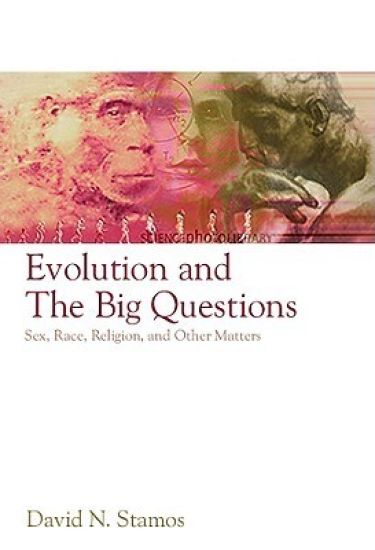
Evolution and the Big Questions “David N. Stamos’s Evolution and the Big Questions delivers what its title promises—you get to look at all of the issues, such as race and ethics and religion, that make the study of evolution so interesting, and more than just a science. The book is written in a clear and friendly manner and deserves a very wide readership.” Michael Ruse, Florida State University This provocative text considers whether evolutionary explanations can be used to clarify some of life’s biggest questions. It offers a lively, informative, and timely look at a wide variety of key issues facing all of us today—including questions of race, sex, gender, the nature of language, religion, ethics, knowledge, consciousness, and, ultimately, thc meaning of life. Some of the questions examined are: Did evolution make men and women fundamentally different?Is the concept of race merely a social construction?Is morality, including universal human rights, a mass delusion?Can religion and evolution really be harmonized?Docs evolution render life meaningless? Designed for students and anyone with an interest in the relationship between evolutionary heritage and human nature, the text takes an interdisciplinary approach and offers direction for further reading and research. Each chapter presents a main topic, together with discussion of related ideas and arguments from various perspectives. Along the way, it poses life’s biggest questions, pulling no punches, and presenting a challenge to thinkers on all levels.
Evolution and the Big Questions

Evolution and the Big Questions

David N. Stamos

Wiley-Blackwell (an imprint of John Wiley Sons Ltd)
2008
nidottu
Evolution and the Big Questions “David N. Stamos’s Evolution and the Big Questions delivers what its title promises—you get to look at all of the issues, such as race and ethics and religion, that make the study of evolution so interesting, and more than just a science. The book is written in a clear and friendly manner and deserves a very wide readership.” Michael Ruse, Florida State University This provocative text considers whether evolutionary explanations can be used to clarify some of life’s biggest questions. It offers a lively, informative, and timely look at a wide variety of key issues facing all of us today—including questions of race, sex, gender, the nature of language, religion, ethics, knowledge, consciousness, and, ultimately, thc meaning of life. Some of the questions examined are: Did evolution make men and women fundamentally different?Is the concept of race merely a social construction?Is morality, including universal human rights, a mass delusion?Can religion and evolution really be harmonized?Docs evolution render life meaningless? Designed for students and anyone with an interest in the relationship between evolutionary heritage and human nature, the text takes an interdisciplinary approach and offers direction for further reading and research. Each chapter presents a main topic, together with discussion of related ideas and arguments from various perspectives. Along the way, it poses life’s biggest questions, pulling no punches, and presenting a challenge to thinkers on all levels.
Myth of Universal Human Rights

Myth of Universal Human Rights

David N. Stamos

Paradigm
2013
sidottu
In this groundbreaking and provocative new book, philosopher of science David N. Stamos challenges the current conceptions of human rights, and argues that the existence of universal human rights is a modern myth. Using an evolutionary analysis to support his claims, Stamos traces the origin of the myth from the English Levellers of 1640s London to our modern day. Theoretical defenses of the belief in human rights are critically examined, including defenses of nonconsensus concepts. In the final chapter Stamos develops a method of naturalized normative ethics, which he then applies to topics routinely dealt with in terms of human rights. In all of this Stamos hopes to show that there is a better way of dealing with matters of ethics and justice, a way that involves applying the whole of our evolved moral being, rather than only parts of it, and that is fiction-free.
Myth of Universal Human Rights

Myth of Universal Human Rights

David N. Stamos

Paradigm
2014
nidottu
In this groundbreaking and provocative new book, philosopher of science David N. Stamos challenges the current conceptions of human rights, and argues that the existence of universal human rights is a modern myth. Using an evolutionary analysis to support his claims, Stamos traces the origin of the myth from the English Levellers of 1640s London to our modern day. Theoretical defenses of the belief in human rights are critically examined, including defenses of nonconsensus concepts. In the final chapter Stamos develops a method of naturalized normative ethics, which he then applies to topics routinely dealt with in terms of human rights. In all of this Stamos hopes to show that there is a better way of dealing with matters of ethics and justice, a way that involves applying the whole of our evolved moral being, rather than only parts of it, and that is fiction-free.