Kirjojen hintavertailu. Mukana 11 244 527 kirjaa ja 12 kauppaa.

Kirjahaku

Etsi kirjoja tekijän nimen, kirjan nimen tai ISBN:n perusteella.

9 kirjaa tekijältä David P. Barash

Threats

Threats

David P. Barash

Oxford University Press Inc
2020
sidottu
"It's a rare author who can combine literary erudition and an easy fluency of style together with expert knowledge of psychology and evolutionary biology. David Barash adds to all this a far-seeing wisdom and a humane decency that shines through on every page. The concluding section on the senseless and dangerous futility of nuclear deterrence theory is an irrefutable tour de force which should be read by every politician and senior military officer. If only!" -- Richard Dawkins From hurricanes and avalanches to diseases and car crashes, threats are everywhere. Beyond objective threats like these, there are also subjective ones: situations in which individuals threaten each other or feel threatened by society. Animals, too, make substantial use of threats. Evolution manipulates threats like these in surprising ways, leading us to question the ethics of honest versus dishonest communication. Rarely acknowledged--and yet crucially important--is the fact that humans, animals, and even plants don't only employ threats, they often respond with counter-threats that ultimately make things worse. By exploring the dynamic of threat and counter-threat, this book expands on many fraught human situations, including the fear of death, of strangers, and of "the other." Each of these leads to unique challenges, such as the specter of eternal damnation, the murderous culture of guns and capital punishment, and the emergence of right-wing nationalist populism. Most worrisome is the illusory security of deterrence, the idea that we can use the threat of nuclear war to prevent nuclear war! Threats are so widespread that we often don't realize how deeply they are ingrained in our minds or how profoundly and counter-productively they operate. Animals, humans, societies, and even countries internalize threats, behind which lie a myriad of intriguing questions: How do we know when to take a threat seriously? When do threats make things worse? Can they make things better? What can we do to use them wisely rather than destructively? In a comprehensive exploration into questions like these, noted scientist David P. Barash explains some of the most important characteristics of life as we know it.
Out of Eden: The Surprising Consequences of Polygamy
In this changing world of what is socially and politically "correct," polygamy is perhaps the last great taboo. Over the last thousand years, monogamy - at least in name - has been the default setting for coupledom and procreation in the Western world. And yet, throughout history, there have been inklings that "one-man, one-woman" is an uncomfortable institution for human beings. The consistently high rate of marital "cheating" by both sexes, plus the persistent interest in a variety of sexual partners - on the part of women as well as men - suggest strongly that monogamy isn't easy, and certainly isn't "natural," for either sex. Esteemed writer and evolutionary biologist David P. Barash tackles this uncomfortable finding: that humans are actually biologically and anthropologically inclined toward polygamy. Drawing on decades of research, Barash presents a remarkable array of scientific evidence from evolutionary biology and cross-cultural studies that guide the reader through the hidden impacts of polygamy on such crucial behavior as violence, parenting, sexual preferences, adultery and efforts at monogamy itself, along with mind-bending speculation about the possible role of our polygamous predisposition when it comes to human genius, homosexuality and even monotheism. But take heart, monogamists Although our species has long been "out of Eden," this fascinating read is ultimately reassuring that "biology is not destiny."
Through a Glass Brightly

Through a Glass Brightly

David P. Barash

Oxford University Press Inc
2018
sidottu
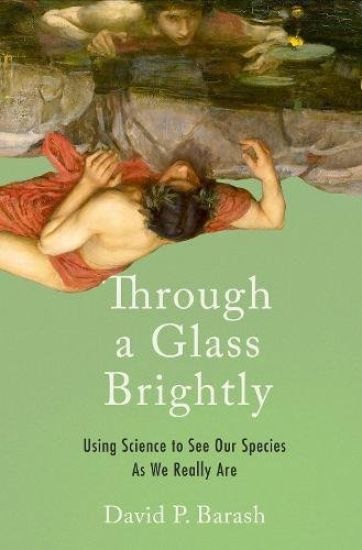
Human beings have long seen themselves as the center of the universe, the apple of God's eye, specially-created creatures who are somehow above and beyond the natural world. This viewpoint - a persistent paradigm of our own unique self-importance - is as dangerous as it is false. In Through a Glass Brightly, noted scientist David P. Barash explores the process by which science has, throughout time, cut humanity "down to size," and how humanity has responded. A good paradigm is a tough thing to lose, especially when its replacement leaves us feeling more vulnerable and less special. And yet, as science has progressed, we find ourselves - like it or not - bereft of many of our most cherished beliefs, confronting an array of paradigms lost. Barash models his argument around a set of "old" and "new" paradigms that define humanity's place in the universe. This new set of paradigms range from provocative revelations as to whether human beings are well designed, whether the universe has somehow been established with our species in mind (the so-called anthropic principle), whether life itself is inherently fragile, and whether Homo sapiens might someday be genetically combined with other species (and what that would mean for our self-image). Rather than seeing ourselves through a glass darkly, science enables us to perceive our strengths and weaknesses brightly and accurately at last, so that paradigms lost becomes wisdom gained. The result is a bracing, remarkably hopeful view of who we really are.
Homo Mysterious

Homo Mysterious

David P. Barash

Oxford University Press Inc
2013
nidottu
For all that science knows about the living world, notes David P. Barash, there are even more things that we don't know, genuine evolutionary mysteries that perplex the best minds in biology. Paradoxically, many of these mysteries are very close to home, involving some of the most personal aspects of being human. Homo Mysterious examines a number of these evolutionary mysteries, exploring things that we don't yet know about ourselves, laying out the best current hypotheses, and pointing toward insights that scientists are just beginning to glimpse. Why do women experience orgasm? Why do men have a shorter lifespan than women? Why does homosexuality exist? Why does religion exist in virtually every culture? Why do we have a fondness for the arts? Why do we have such large brains? And why does consciousness exist? Readers are plunged into an ocean of unknowns--the blank spots on the human evolutionary map, the terra incognita of our own species--and are introduced to the major hypotheses that currently occupy scientists who are attempting to unravel each puzzle (including some solutions proposed here for the first time). Throughout the book, readers are invited to share the thrill of science at its cutting edge, a place where we know what we don't know, and, moreover, where we know enough to come up with some compelling and seductive explanations. Homo Mysterious is a guide to creative thought and future explorations, based on the best, most current thinking by evolutionary scientists. It captures the allure of the "not-yet-known" for those interested in stretching their scientific imaginations.
Homo Mysterious

Homo Mysterious

David P. Barash

Oxford University Press Inc
2012
sidottu
For all that science knows about the living world, there are even more things that we don't know, genuine evolutionary mysteries that perplex the best minds in biology. And paradoxically, many of these mysteries are very close to home: They involve some of the most personal aspects of being human, including such unresolved questions as why do women experience orgasm, menstruation and menopause, why do men have a shorter lifespan than women, and why does homosexuality exist? Ditto for other evolutionary mysteries of our own species: Why is religion a "cross-cultural universal," along with a fondness for the arts? Why do we have such large brains, and why does consciousness exist? Homo Mysterious examines these and other evolutionary mysteries, exploring things that we don't (yet) know about ourselves, laying out the best current hypotheses and pointing toward insights that scientists are just beginning to glimpse. Readers are invited to share the thrill of science at its exploratory margins, where we know what we don't know, and, moreover, we know enough to come up with some compelling and seductive explanations. Homo Mysterious is a guide to creative thought and future explorations, based on the most current thinking of evolutionary scientists. For those who are interested in stretching their scientific imaginations, this book will expose the lure of the not yet known.
Buddhist Biology

Buddhist Biology

David P. Barash

Oxford University Press Inc
2013
sidottu
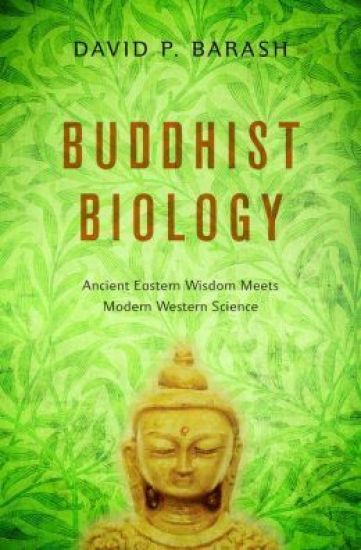
An eye-opening look at the crossroads of religion and science, illuminating the unexpected common ground shared by biology and Buddhism. Many high-profile public intellectuals-such as the well-known "New Atheists" Richard Dawkins, Daniel Dennett, and the late Christopher Hitchens-have argued that religion and science are highly antagonistic, two views of the world that are utterly incompatible. David Barish, a renowned biologist with thirty years of experience, largely agrees with them-with one very big exception. And that exception is Buddhism. In this fascinating book, David Barash highlights an intriguing patch of common ground between scientific and religious thought, illuminating the many parallels between biology and Buddhism, allowing readers to see both in a new way. Indeed, he shows that there are numerous places where the Buddhist and biological perspectives coincide. For instance, the cornerstone ecological concept—the interconnectedness and interdependence of all things—is remarkably similar to the fundamental insight of Buddhism. Indeed, a major Buddhist text, the Avatamsaka Sutra-which consists of ten insights into the "interpenetration" between beings and their environment-could well have been written by a trained ecologist. Barash underscores other similarities, including a shared distrust of simple cause-and-effect analysis, a recognition of life as transient and as a "process" rather than permanent and static, and an appreciation of the "rightness" of nature along with a recognition of the suffering that results when natural processes are tampered with. After decades of removing predators to protect deer and elk herds, ecologists have belatedly come to a Buddhist realization that predation—and even forest fires—are natural processes that have an important place in maintaining healthy ecosystems. Buddhist Biology sheds new light on biology, Buddhism, and the remarkable ways the two perspectives come together, like powerful searchlights that offer complementary and valuable perspectives on the world and our place in it.
Oops!: The Worst Blunders of All Time

Oops!: The Worst Blunders of All Time

David P. Barash

Skyhorse Publishing
2023
sidottu
Travel through history and around the world to learn about the greatest mistakes, blunders, and bloopers of all time Everyone makes mistakes and nearly everyone likes to know about them, especially when made by someone else The Worst Blunders of All Time: Shocking Tales from Pandora's Box to Putin's Invasion presents some of our most notable blunders, from the silly to the consequential, from ancient history to current events. It offers the pleasure of Schadenfreude and of an easy-going reading experience, as well as--here and there--some learning opportunities. The reader will see when relatively big things have gone wrong and couldn't be called back, such as iconic, mythical blunders like Pandora opening that troublesome box and Eve taking her ill-advised bite, to great historical oops such as Napoleon's invasion of Russia in 1812, as well as some less monumental but nonetheless exemplary mistakes, such as the "Curse of the Bambino," when the Boston Red Sox sold Babe Ruth--at the time, a pitcher--to the New York Yankees. These and other exemplary oops are presented in a light-hearted way, with some exceptions being catastrophic, current catastrophes, such as Trump's egregious mishandling of the COVID-19 pandemic. Author David P. Barash will take readers from the tragic to the whimsical, with the latter represented by, for example, "Wrong Way Corrigan," an early twentieth century aviator who thought he was flying nonstop from New York to California, but, confused by a heavy fog, ended up in Ireland. Pointing out these and other mistakes will be an exercise in Monday morning quarterbacking and 20-20 hindsight. Thus, The Worst Blunders of All Time shall "backstrapolate" looking in the rear-view mirror at mistakes made by others. The Worst Blunders of All Time is neither an advice book nor a series of cautionary tales. It's an easy and accessible read, especially useful as therapy in these difficult times. However, its nonetheless accurate and informative, giving rise to some potentially useful take-home messages, keyed to its material. Ideally, we should all benefit from our own mistakes, making lemonade out of lemons, while also following Eleanor Roosevelt's advice: "Learn from the mistakes of others. You cannot live long enough to make them all yourself."
Natural Selections

Natural Selections

David P. Barash

Bellevue Literary Press
2007
sidottu
"Barash . . . brilliantly integrat[es] science, literature, and pop culture into elegant and insightful commentaries on the most interesting and important questions of our time. A delightful read."--Michael Shermer, author of The Science of Good and Evil"Entertaining and thought-provoking."--Steven Pinker, author of The Blank SlateIf we are, in part, a product of our genes, can free will exist? Incisive and engaging, this indispensable tour of evolutionary biology runs the gamut of contemporary debates, from science and religion to our place in the universe. David Barash is the author of The Myth of Monogamy and Madame Bovary's Ovaries. He lives in Redmond, Washington.