Kirjojen hintavertailu. Mukana 11 447 286 kirjaa ja 12 kauppaa.

Kirjahaku

Etsi kirjoja tekijän nimen, kirjan nimen tai ISBN:n perusteella.

8 kirjaa tekijältä David P. Billington

From Insight to Innovation

From Insight to Innovation

David P. Billington

MIT Press
2020
sidottu
Technology is essential to modern life, yet few of us are technology-literate enough to know much about the engineering that underpins it. In this book, David P. Billington, Jr., offers accessible accounts of the key twentieth-century engineering innovations that brought us into the twenty-first century. Billington examines a series of engineering advances-from Hoover Dam and jet engines to the transistor, the microchip, the computer, and the internet-and explains how they came about and how they work.Each of these innovations tells a unique story. The great dams of the New Deal brought huge rivers under control, and a national highway system interconnected the nation, as did jet air travel. The transistor and the microchip originated in the private sector and found a mass market after early government support. The computer and the internet began as government projects and found a mass market later in the private sector. Billington finds that engineers with unconventional insights could succeed in a bureaucratic age; what mattered were independent vision and a society that welcomed innovation.This book completes the story of American engineering begun with the earlier volumes The Innovators (by the author's father) and Power, Speed, and Form (by the author and his father).

The Innovators

The Innovators

David P. Billington

John Wiley Sons Inc
1996
sidottu
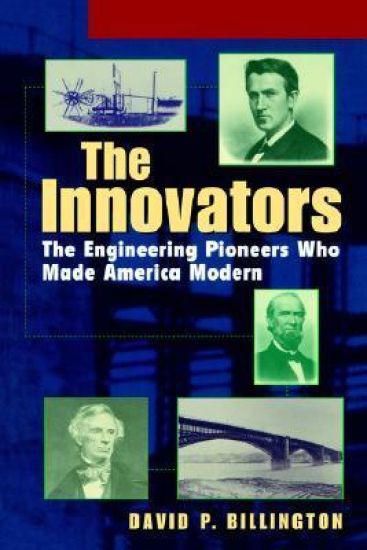
A richly illustrated introduction to the engineering triumphs that made America modern Praise for The Tower and the Bridge "Fascinating and informative. . . . [S]hould be required reading for architects, engineers, and anyone who is interested in the special role of structural art in our technological society." — Myron Goldsmith Coeditor (with David Billington) Technique and Aesthetics in the Design of Tall Buildings "David Billington brings the special insight of an engineer to the study of history. The result is a provocative analysis . . . bound to excite and instruct a wide variety of readers, from the casual buff to the professional scholar. The book is a delight to read." — Merritt Roe Smith Editor, Military Enterprise and Technological Change They built the future. Their ingenuity, their vision, their genius propelled a young nation toward the twentieth century, and paved the way for America's emergence as the world's leading industrial power. The Innovators tells the impressive story of the engineering pioneers whose designs revolutionized commerce, industry, and world history. Enter the workshops of America's early engineering geniuses and discover how they came up with their ideas and applied them to the marketplace. David Billington, acclaimed author of The Tower and the Bridge, reveals the strokes of brilliance behind such landmark developments as the steamboat, electric power, and the rise of the iron and steel industry. He explains each major innovation through the story of the remarkable new engineering formulas that made it possible, showing that one key to engineering progress is the discovery of fundamental relationships in the physical world. He also explores the political and social conditions that allowed these brilliant individuals to implement their ideas, and the sweeping changes that followed in their wake. Who were the innovators? Some are legendary: Robert Fulton, inventor of the steamboat; Samuel Morse, inventor of the telegraph; and Thomas Edison, inventor of the incandescent lightbulb. Others are not as well known, however, and readers will be introduced to many whose contributions, if not their names, have stood the test of time: people like J. Edgar Thompson, who built the Pennsylvania Railroad; and Thomas Telford, who revolutionized large-scale bridge building and design. In the age of microchips and space probes, The Innovators brings insight and perspective to America's engineering history.
The Innovators, College

The Innovators, College

David P. Billington

John Wiley Sons Inc
1996
nidottu
The major engineering pioneers whose works transformed America into the world's leading modern power, from Robert Fulton and his inventions of the steamboat to Thomas Edison's construction of the first electrical power network. Introduces each of the major figures and explains how they came up with their ideas and how their works tranformed commerce, industry, and society.
Robert Maillart: Builder, Designer, and Artist

Robert Maillart: Builder, Designer, and Artist

David P. Billington

Cambridge University Press
1997
sidottu
This comprehensive biography traces the life and works of Robert Maillart, one of the most important engineers and designers of the twentieth century. His career developed around a central issue of modern technological society: the debate between two antithetical views of engineering opposing applied science, which relied on general mathematical theories for understanding structures against design, which Maillart championed. Maillart considered structures not merely works of utility but also as works of art. As utilitarian objects, he created a series of innovations of lasting significance. Aesthetically, Maillart shaped his three innovations in concrete to create surprising and often stunning new forms. Providing an analysis of these innovations, this biography also connects Maillart’s aesthetic ideas with the private and professional context in which he worked.
The Tower and the Bridge

The Tower and the Bridge

David P. Billington

Princeton University Press
1985
pokkari
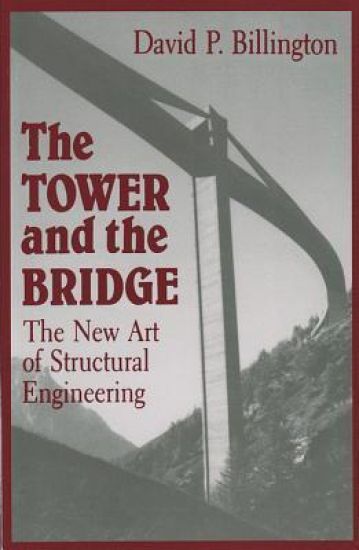
What do structures such as the Eiffel Tower, the Brooklyn Bridge, and the concrete roofs of Pier Luigi Nervi have in common? According to this book, now in its first paperback edition, all are striking examples of structural art, an exciting form distinct from either architecture or machine design. Aided by a number of stunning illustrations, David Billington discusses leading structural engineer-artists, such as John A. Roebling, Gustave Eiffel, Fazlur Khan, and Robert Maillart.
The Tower and the Bridge

The Tower and the Bridge

David P. Billington

PRINCETON UNIVERSITY PRESS
2022
pokkari
An essential exploration of the engineering aesthetics of celebrated structures from long-span bridges to high-rise buildingsWhat do structures such as the Eiffel Tower, the Brooklyn Bridge, and the concrete roofs of Pier Luigi Nervi have in common? According to The Tower and the Bridge, all are striking examples of structural art, an exciting area distinct from either architecture or machine design. Aided by stunning photographs, David Billington discusses the technical concerns and artistic principles underpinning the well-known projects of leading structural engineer-artists, including Othmar Ammann, Félix Candela, Gustave Eiffel, Fazlur Khan, Robert Maillart, John Roebling, and many others. A classic work, The Tower and the Bridge introduces readers to the fundamental aesthetics of engineering.
Der Turm und Brücke

Der Turm und Brücke

David P. Billington

Wilhelm Ernst Sohn Verlag fur Architektur und technische Wissenschaften
2013
nidottu
Long recognised as a classic in the USA, "The Tower and the Bridge" is now at last available in German translation. In his preface to the German edition, Jorg Schlaich writes. "This book is essential reading and a pleasure for the "structural engineering artist", in whose structures the connection between form and force flow is visible and which are distinguished by the ideals of efficiency, cost-effectiveness and elegance." Billington founded with this book structural art as a new, independent art form, which he considers equivalent to architecture. It is no coincidence that the title states the two classic domains of the structural engineer; in this case Billington is referring to two outstanding structures of the epoch, the Eiffel Tower and the Brooklyn Bridge. Billington describes in an easily readable style and in an entertaining manner the ideals, principles and methods of structural art during its historical development through examples of structures from outstanding engineers (e.g. Telford, Maillart, Freyssinet, Menn). With the establishment of structural art as an art form and the explication of its inherent principles, Billington gives the reader well founded arguments for the aesthetic discussion of engineering structures. This also provides a basis for criticism of the new art form; for the criticism of construction that has long been demanded. This timeless book thus has the potential to give a new impulse to the debate about construction culture and particularly the aesthetic aspects of structural engineering in German-speaking countries.