Kirjojen hintavertailu. Mukana 11 886 454 kirjaa ja 12 kauppaa.

Kirjahaku

Etsi kirjoja tekijän nimen, kirjan nimen tai ISBN:n perusteella.

6 kirjaa tekijältä David Paper

Web Programming for Business

Web Programming for Business

David Paper

Routledge
2015
sidottu
Web Programming for Business: PHP Object-Oriented Programming with Oracle focuses on fundamental PHP coding, giving students practical, enduring skills to solve data and technical problems in business. Using Oracle as the backend database, the book is version-neutral, teaching students code that will still work even with changes to PHP and Oracle. The code is clean, clearly explained and solutions-oriented, allowing students to understand how technologies such as XML, RSS or AJAX can be leveraged in business applications. The book is fully illustrated with examples, and includes chapters on: Database functionality Security programming Transformation programming to move dataPowerpoint slides, applied exam questions, and the raw code for all examples are available on a companion website. This book offers an innovative approach that allows anyone with basic SQL and HTML skills to learn PHP object-oriented programming.
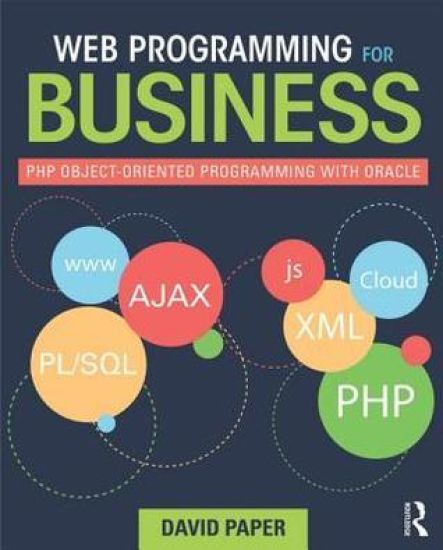
Web Programming for Business

Web Programming for Business

David Paper

Routledge
2015
nidottu
Web Programming for Business: PHP Object-Oriented Programming with Oracle focuses on fundamental PHP coding, giving students practical, enduring skills to solve data and technical problems in business. Using Oracle as the backend database, the book is version-neutral, teaching students code that will still work even with changes to PHP and Oracle. The code is clean, clearly explained and solutions-oriented, allowing students to understand how technologies such as XML, RSS or AJAX can be leveraged in business applications. The book is fully illustrated with examples, and includes chapters on: Database functionality Security programming Transformation programming to move dataPowerpoint slides, applied exam questions, and the raw code for all examples are available on a companion website. This book offers an innovative approach that allows anyone with basic SQL and HTML skills to learn PHP object-oriented programming.
Data Science Fundamentals for Python and MongoDB
Build the foundational data science skills necessary to work with and better understand complex data science algorithms. This example-driven book provides complete Python coding examples to complement and clarify data science concepts, and enrich the learning experience. Coding examples include visualizations whenever appropriate. The book is a necessary precursor to applying and implementing machine learning algorithms. The book is self-contained. All of the math, statistics, stochastic, and programming skills required to master the content are covered. In-depth knowledge of object-oriented programming isn’t required because complete examples are provided and explained.Data Science Fundamentals with Python and MongoDB is an excellent starting point for those interested in pursuing a career in data science. Like any science, the fundamentals of data science are a prerequisite to competency. Without proficiency in mathematics, statistics, data manipulation, and coding, the path to success is “rocky” at best. The coding examples in this book are concise, accurate, and complete, and perfectly complement the data science concepts introduced. What You'll LearnPrepare for a career in data scienceWork with complex data structures in PythonSimulate with Monte Carlo and Stochastic algorithmsApply linear algebra using vectors and matricesUtilize complex algorithms such as gradient descent and principal component analysisWrangle, cleanse, visualize, and problem solve with dataUse MongoDB and JSON to work with dataWho This Book Is ForThe novice yearning to break into the data science world, and the enthusiast looking to enrich, deepen, and develop data science skills through mastering the underlying fundamentalsthat are sometimes skipped over in the rush to be productive. Some knowledge of object-oriented programming will make learning easier.
Hands-on Scikit-Learn for Machine Learning Applications
Aspiring data science professionals can learn the Scikit-Learn library along with the fundamentals of machine learning with this book. The book combines the Anaconda Python distribution with the popular Scikit-Learn library to demonstrate a wide range of supervised and unsupervised machine learning algorithms. Care is taken to walk you through the principles of machine learning through clear examples written in Python that you can try out and experiment with at home on your own machine.All applied math and programming skills required to master the content are covered in this book. In-depth knowledge of object-oriented programming is not required as working and complete examples are provided and explained. Coding examples are in-depth and complex when necessary. They are also concise, accurate, and complete, and complement the machine learning concepts introduced. Working the examples helps to build the skills necessary to understand and apply complexmachine learning algorithms.Hands-on Scikit-Learn for Machine Learning Applications is an excellent starting point for those pursuing a career in machine learning. Students of this book will learn the fundamentals that are a prerequisite to competency. Readers will be exposed to the Anaconda distribution of Python that is designed specifically for data science professionals, and will build skills in the popular Scikit-Learn library that underlies many machine learning applications in the world of Python.What You'll LearnWork with simple and complex datasets common to Scikit-LearnManipulate data into vectors and matrices for algorithmic processingBecome familiar with the Anaconda distribution used in data scienceApply machine learning with Classifiers, Regressors, and Dimensionality ReductionTune algorithms and find the best algorithms for each datasetLoad data from and save to CSV, JSON, Numpy, and Pandas formatsWho This Book Is ForThe aspiring data scientist yearning to break into machine learning through mastering the underlying fundamentals that are sometimes skipped over in the rush to be productive. Some knowledge of object-oriented programming and very basic applied linear algebra will make learning easier, although anyone can benefit from this book.
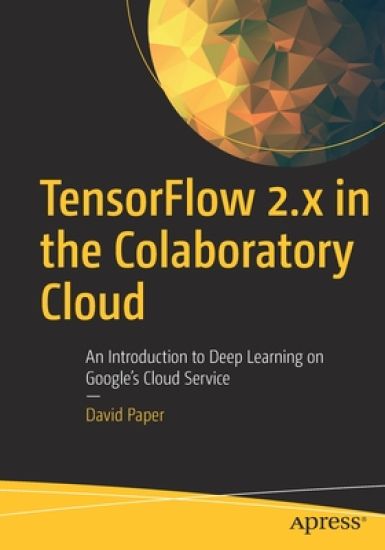
TensorFlow 2.x in the Colaboratory Cloud
Use TensorFlow 2.x with Google's Colaboratory (Colab) product that offers a free cloud service for Python programmers. Colab is especially well suited as a platform for TensorFlow 2.x deep learning applications. You will learn Colab’s default install of the most current TensorFlow 2.x along with Colab’s easy access to on-demand GPU hardware acceleration in the cloud for fast execution of deep learning models. This book offers you the opportunity to grasp deep learning in an applied manner with the only requirement being an Internet connection. Everything else—Python, TensorFlow 2.x, GPU support, and Jupyter Notebooks—is provided and ready to go from Colab. The book begins with an introduction to TensorFlow 2.x and the Google Colab cloud service. You will learn how to provision a workspace on Google Colab and build a simple neural network application. From there you will progress into TensorFlow datasets and building input pipelines in support of modeling and testing. You will find coverage of deep learning classification and regression, with clear code examples showing how to perform each of those functions. Advanced topics covered in the book include convolutional neural networks and recurrent neural networks. This book contains all the applied math and programming you need to master the content. Examples range from simple to relatively complex when necessary to ensure acquisition of appropriate deep learning concepts and constructs. Examples are carefully explained, concise, accurate, and complete to perfectly complement deep learning skill development. Care is taken to walk you through the foundational principles of deep learning through clear examples written in Python that you can try out and experiment with using Google Colab from the comfort of your own home or office.What You Will LearnBe familiar with the basic concepts and constructs of applied deep learningCreate machine learning models with clean and reliable Python codeWork with datasets common to deep learning applicationsPrepare data for TensorFlow consumptionTake advantage of Google Colab’s built-in support for deep learningExecute deep learning experiments using a variety of neural network modelsBe able to mount Google Colab directly to your Google Drive accountVisualize training versus test performance to see model fitWho This Book Is ForReaders who want to learn the highly popular TensorFlow 2.x deep learning platform, those who wish to master deep learning fundamentals that are sometimes skipped over in the rush to be productive, and those looking to build competency with a modern cloud service tool such as Google Colab
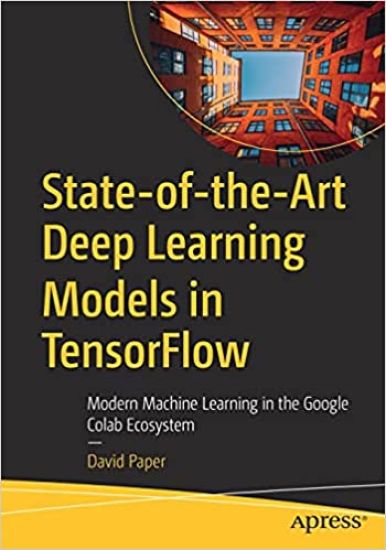
State-of-the-Art Deep Learning Models in TensorFlow
Use TensorFlow 2.x in the Google Colab ecosystem to create state-of-the-art deep learning models guided by hands-on examples. The Colab ecosystem provides a free cloud service with easy access to on-demand GPU (and TPU) hardware acceleration for fast execution of the models you learn to build. This book teaches you state-of-the-art deep learning models in an applied manner with the only requirement being an Internet connection. The Colab ecosystem provides everything else that you need, including Python, TensorFlow 2.x, GPU and TPU support, and Jupyter Notebooks. The book begins with an example-driven approach to building input pipelines that feed all machine learning models. You will learn how to provision a workspace on the Colab ecosystem to enable construction of effective input pipelines in a step-by-step manner. From there, you will progress into data augmentation techniques and TensorFlow datasets to gain a deeper understanding of how to work with complex datasets. You will find coverage of Tensor Processing Units (TPUs) and transfer learning followed by state-of-the-art deep learning models, including autoencoders, generative adversarial networks, fast style transfer, object detection, and reinforcement learning. Author Dr. Paper provides all the applied math, programming, and concepts you need to master the content. Examples range from relatively simple to very complex when necessary. Examples are carefully explained, concise, accurate, and complete. Care is taken to walk you through each topic through clear examples written in Python that you can try out and experiment with in the Google Colab ecosystem in the comfort of your own home or office. What You Will LearnTake advantage of the built-in support of the Google Colab ecosystemWork with TensorFlow data setsCreate input pipelines to feed state-of-the-art deep learning modelsCreate pipelined state-of-the-art deep learning models with clean and reliable Python codeLeverage pre-trained deep learning models to solve complex machine learning tasksCreate a simple environment to teach an intelligent agent to make automated decisionsWho This Book Is ForReaders who want to learn the highly popular TensorFlow deep learning platform, those who wish to master the basics of state-of-the-art deep learning models, and those looking to build competency with a modern cloud service tool such as Google Colab