Kirjojen hintavertailu. Mukana 11 342 296 kirjaa ja 12 kauppaa.

Kirjahaku

Etsi kirjoja tekijän nimen, kirjan nimen tai ISBN:n perusteella.

5 kirjaa tekijältä David R. Heise

Expressive Order

Expressive Order

David R. Heise

Springer-Verlag New York Inc.
2006
sidottu
Expressive Order introduces affect control theory to lay readers of sociology, and additionally guides sociology specialists into the theory's deep structure. Briefly, affect control theory proposes that individuals shape their social interactions so that emerging impressions reinforce sentiments about salient identities, behaviors, and settings. Emotions signal how the process of confirming sentiments is going for each individual. The theory explains behaviors, emotions, social labeling, and personality attributions in a wide variety of social contexts – including intimate relations, work-world interactions, courtrooms, and international relations. Part 1 of the book provides a plain-language exposition of the theory, along with numerous interpretive analyses of everyday situations. This is engaging and provocative reading for anyone interested in social relations, including undergraduates in and out of the social sciences. Part 2 presents the mathematical derivations that define sentiment-confirming behavior, labeling, attribution, and emotion. The mathematical solutions, conjoined with understandings about social institutions, are the basis of the theory's explanations. The derivations clarify the theory's assumptions and reasoning, as only mathematics can. Part 3 of Expressive Order describes the research program associated with the theory and the computer simulation software that is used in research. This part of the book offers a jump start for individuals wishing to use affect control theory in their own research.
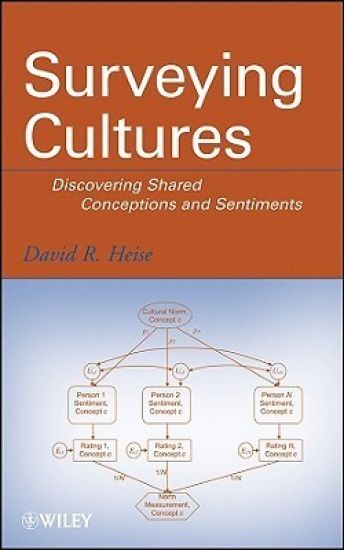
Surveying Cultures

Surveying Cultures

David R. Heise

John Wiley Sons Inc
2010
sidottu
Surveying Cultures uniquely employs techniques rooted in survey methodology to discover cultural patterns in social science research. Examining both classical and emerging methods that are used to survey and assess differing norms among populations, the book successfully breaks new ground in the field, introducing a theory of measurement for ethnographic studies that employs the consensus-as-culture model. The book begins with a basic overview of cross-cultural measurement of sentiments and presents innovative and sophisticated analyses of measurement issues and of homogeneity among respondents. Subsequent chapters explore topics that are at the core of successful data collection and analysis in culture studies, including: The role of bipolar scales and Internet data collection in measuring sentiments Key methodological variables that determine the quality of quantitative data, including measurement errors, validity, and reliability New approaches to reliability and several new methods of assessing a respondent's degree of inculcation into group culture Sampling, coverage, nonresponse, and measurement errors, with an in-depth discussion of their occurrence in culture surveys, their impact assessments, and how current measurement techniques are constructed to help prevent these kinds of errors Common problems often encountered in the acquisition and communication of data, including identifying error variances, interpreting gender differences in responses, and defining the difference between cultures and subcultures Throughout the book, each topic is accompanied by a review of related methodological literature. For many of the presented concepts, the author includes a formal analysis of the related issues in measuring cultural norms and reports on analyses. Each chapter concludes with an organized list of major findings as well as an insightful outline of specific recommendations regarding practical problems in culture studies. Surveying Cultures serves as a valuable supplemental book to courses on survey and research methods at the upper-undergraduate and graduate levels. It is also an excellent reference for researchers in the fields of sociology, anthropology, psychology, and political science.
Understanding Events

Understanding Events

David R. Heise

Cambridge University Press
1979
pokkari
It is Professor Heise's premise that the psychology of affect theoretically governs common social actions, such as those of a patient toward a doctor or a mother toward a child. Human behaviour, he argues, normally promotes the maintenance of a steady emotional state. Should events produce undue strain, the individual attempts to anticipate subsequent developments, formulate a course of action and create new events designed to confirm his established sentiments. This book lays the foundation for this approach to interpreting events: it offers a mathematical model grounded in empirical procedures for analysing what happens in social relationships. Topics covered in the book include how situations are defined and events constructed, past research on processes of impression formation, the mathematical derivation for predicting behaviour and the application of this approach to the study of roles. Throughout the book, the theory is shown to be relevant not only for the construction of social action, but also for the reconstruction of events and, in particular, for the identification of social deviants.
Expressive Order

Expressive Order

David R. Heise

Springer-Verlag New York Inc.
2010
nidottu
Expressive Order introduces affect control theory to lay readers of sociology, and additionally guides sociology specialists into the theory's deep structure. Briefly, affect control theory proposes that individuals shape their social interactions so that emerging impressions reinforce sentiments about salient identities, behaviors, and settings. Emotions signal how the process of confirming sentiments is going for each individual. The theory explains behaviors, emotions, social labeling, and personality attributions in a wide variety of social contexts – including intimate relations, work-world interactions, courtrooms, and international relations. Part 1 of the book provides a plain-language exposition of the theory, along with numerous interpretive analyses of everyday situations. This is engaging and provocative reading for anyone interested in social relations, including undergraduates in and out of the social sciences. Part 2 presents the mathematical derivations that define sentiment-confirming behavior, labeling, attribution, and emotion. The mathematical solutions, conjoined with understandings about social institutions, are the basis of the theory's explanations. The derivations clarify the theory's assumptions and reasoning, as only mathematics can. Part 3 of Expressive Order describes the research program associated with the theory and the computer simulation software that is used in research. This part of the book offers a jump start for individuals wishing to use affect control theory in their own research.

Cultural Meanings and Social Institutions

Cultural Meanings and Social Institutions

David R. Heise

Springer Nature Switzerland AG
2019
sidottu
Employing three methods of assessing meaning, this book demonstrates that the thousands of human identities in English coalesce into groups that are recognizable as role sets in the contemporary social institutions of economy, kinship, religion, polity, law, education, medicine, sport, and arts. After establishing a theoretical and a methodological framework for his empirical work, David Heise presents the results obtained when meanings are assessed via dictionary definitions, collocates, and word associations. A close comparison of the results reveals that similar outcomes are obtained through each of these three different approaches of defining meaning. The final chapter summarizes the study, considers the benefits and limitations of studying society via language, and applies the results to describing how individuals operate social institutions via their daily social interactions. Aspects of this book will be of interest to social psychologists, sociologists, and linguists.