Kirjojen hintavertailu. Mukana 11 244 527 kirjaa ja 12 kauppaa.

Kirjahaku

Etsi kirjoja tekijän nimen, kirjan nimen tai ISBN:n perusteella.

12 kirjaa tekijältä David R. Higgins

Panzer II vs 7TP

Panzer II vs 7TP

David R. Higgins

Osprey Publishing
2015
nidottu
Hitler's lightning invasion of Poland in 1939 marked the beginning of World War II in Europe. This was the period when armoured warfare inscribed itself into global consciousness as the Poles desperately sought to stave off the Blitzkrieg.At the heart of the fighting on the ground, large numbers of Nazi Germany's PzKpfw II battled against Poland's better-armed but much less numerous 7TP tank. The two types both possessed unique strengths and weaknesses - unlike the 7TP the PzKpfw II was always equipped with radio, which proved critical for command and control purposes in the heat of combat. But the German tank was blighted by thin armour, which could not withstand Polish gunfire at combat ranges.This fully illustrated, detailed work evaluates the qualities and idiosyncrasies of each tank, giving a stark and arresting crewman’s-eye-view of the brutal armoured combat at the height of the invasion of Poland.
US Marine vs NVA Soldier

US Marine vs NVA Soldier

David R. Higgins

Osprey Publishing
2015
nidottu
In 1967–68, the United States Marine Corps (USMC) was on the front line of the defence of South Vietnam’s Quang Tri province, which was at the very heart of the Vietnam conflict.Facing them were the soldiers of the North Vietnamese Army (NVA), men whose organization and equipment made them a very different opponent from the famous, irregular Viet Cong forces. From the ‘Hill Battles’ in April 1967 to the struggle for the city of Hue (January–March 1968) this bloody campaign forced the two sides into a gruelling trial of strength. The USMC held a general technological and logistical advantage – including close air support and airborne transport, technology, and supplies – but could not always utilize these resources effectively in mountainous, jungle, or urban environments better known by their Vietnamese opponents.In this arresting account of small-unit combat, David R. Higgins steps into the tropical terrain of Vietnam to assess the performance and experience of USMC and NVA forces in three savage battles that stretched both sides to the limit.
M48 Patton vs Centurion

M48 Patton vs Centurion

David R. Higgins

Osprey Publishing
2016
nidottu
The British Centurion and the American M48 Patton, two leading tanks of the Cold War era, clashed in the 1965 Indo-Pakistan War. Expert author David P. Higgins assesses the strengths and limitations of the two tanks and explores their clashes in the largest tank battles seen since 1945.The two countries’ tank regiments, many of which shared a proud legacy in the British Indian Army, fought one another in the difficult terrain of Jammu and Kashmir, the focus of a long-running dispute between India and Pakistan. The armoured clashes at Asal Uttar, Chawinda and Phillora would demonstrate that the Centurion, with its powerful gun and lower profile, generally proved superior to the faster, lighter but overly complex Patton.Featuring full-colour artwork, expert analysis and archive photographs, this is the full story of the clash between two leading tanks of the Cold War era that were never designed to fight each other, but rather to line up on battlefields as allies.
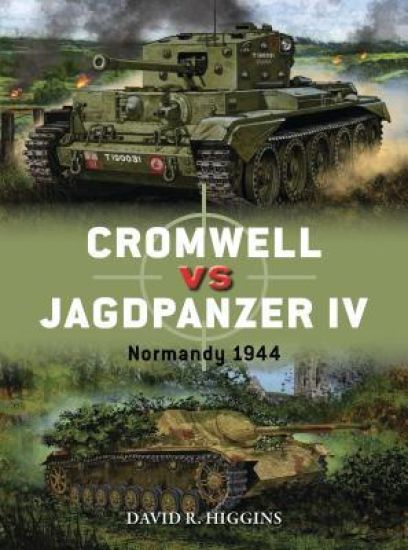
Cromwell vs Jagdpanzer IV

Cromwell vs Jagdpanzer IV

David R. Higgins

Osprey Publishing
2018
nidottu
By 1944, the evolution of armoured doctrine had produced very different outcomes in Britain and Germany. Offering a good balance of speed, protection and firepower, the British Cromwell tank was much faster than its German opponent, but the Jagdpanzer IV tank destroyer had a high-velocity main gun and a lower profile that made it formidable on the defensive, especially in ambush situations. The two types would fight in a series of bloody encounters, from the initial days of the struggle for Normandy through to its climax as the Allies sought to trap their opponents in the Falaise Pocket. Using archive photographs, specially commissioned artwork and battle reports, this fascinating study expertly assesses the realities of tactical armoured combat during the desperate battles after D-Day.
German Soldier vs Polish Soldier

German Soldier vs Polish Soldier

David R. Higgins

Osprey Publishing
2020
nidottu
The Nazi invasion of Poland in September 1939 saw mostly untested German troops face equally inexperienced Polish forces. With the Polish senior leadership endeavouring to hold the country’s industrialized east, Hitler’s forces unleashed what was essentially a large pincer operation intended to encircle and eliminate much of Poland’s military strength. Harnessing this initial operational advantage, the Germans were able to attack Polish logistics, communications and command centres, thereby gaining and maintaining battlefield momentum. With the average infantry soldier on both sides comparatively well-led, equipped and transported, vital differences in battlefield support (especially air power and artillery), tactics, organization and technology would make all the difference in combat.Featuring specially commissioned artwork, archive photography and battle maps, this study focuses upon three actions that reveal the evolving nature of the 1939 campaign. The battle of Tuchola Forest (1–5 September) pitted fast­-moving German forces against uncoordinated Polish resistance, while the battle of Wizna (7–10 September) saw outnumbered Polish forces impede the German push north-east of Warsaw. Finally, the battle of Bzura (9–19 September) demonstrated the Polish forces’ ability to surprise the Germans operationally during a spirited counter-attack against the invaders. All three battles featured in this book cast light on the motivation, training, tactics and combat performance of the fighting men of both sides in the 1939 struggle for Poland.
An Unquiet Calm: A Collection of Short Stories

An Unquiet Calm: A Collection of Short Stories

David R. Higgins

Createspace Independent Publishing Platform
2014
nidottu
A collection of five short works of speculative fiction, containing two new and three republished stories: Thieves in the Night: With Comet Grijalva predicted to wipe out life on Earth, Jason Pendrick fled to his uncle-in-law's farm. When the apocalypse doesn't happen, he has an opportunity to help rebuild society, but will the past drag him down? (6,444 words) Washed Clean: Seimunda lives in a hovel, eking out a living bartering herbal remedies to villagers. But an accusation of witchcraft threatens to rob her of even that. (1,326 words) Some Secrets: Always appearing when least expected, a mysterious man orders whichever sandwich Jo has been eyeing up. Do they just have similar tastes or is it something more inexplicable? Either way, there is definitely a connection. (2,572 words) Blossom: When Mari Austan's husband, Jerek, joins the army she is left to run their drought-stricken farm alone. As both her crop dies and the letters home falter, she relies on cold fury to get through the days. But will she break before the weather does? (1,003 words) An Unquiet Calm: When Frances Withrick is found holding the revolver that killed her husband, Inspector Stevens expects an all too human case of anger and regret. But a second killing and evidence the revolver was loaded with very unusual cartridge, force Stevens to consider a different theory: that the whispers of an inhuman force in the hills are true. (4,913 words)
Guderian 1941

Guderian 1941

David R. Higgins

PEN SWORD BOOKS LTD
2023
sidottu
During the first few weeks of Operation Barbarossa, Hitler’s invasion of the Soviet Union in 1941, Heinz Guderian's Second Panzer Group played a leading role, cutting through the defences on the border, then taking part in the massive encirclement battles near Minsk, Smolensk, and Kiev. The extraordinary speed of the advance reflects the experience of the Wehrmacht as a whole during the first phase of the war on the Eastern Front. That is why David Higgins’s graphic narrative, which describes how Guderian’s forces achieved enormous success before they were forced to halt, is such compelling reading. It is a fascinating story, vividly told. Drawing on a wide range of official German and Soviet records, he reconstructs the entire course of Second Panzer Group's advance, covering each stage in unprecedented detail. His narrative offers a German perspective and an inside view of what the opposing commanders knew during each operation and shows how important logistics became as the German supply lines stretched deep into the Soviet Union. It also explains how Soviet resistance and reinforcements, declining strength and the onset of the Russian winter combined to bring Guderian to a stop at Tula where he was relieved of his command. The high hopes with which the German army had launched the campaign were dashed only a few months later before Moscow. This in-depth study the of operations of Second Panzer Group gives the reader a telling insight into what went wrong.
Mark IV vs A7V

Mark IV vs A7V

David R. Higgins

Osprey Publishing
2013
nidottu
In April 1918 history’s first tank-vs-tank battle pitted the British Mark IV against the German A7V on the Western Front. Featuring full-colour artwork, this is the story of this momentous encounter, which foreshadowed the massed armoured warfare of World War II and beyond.The German A7V and the British Mark IV were similar in weight, size, and speed, but differed significantly in armour, armament and maneuverability. The A7V had thicker armour, and had nearly double the horsepower per ton. The Mark IV’s pair of side-mounted 6pdr cannons forced the vehicle to present its side arc to an enemy in order to fire one of its main guns. Possessing twice as many machine guns as the Mark IV, the A7V had a frontally mounted 57mm gun that proved capable of defeating the Mark IV’s armour. The Mark IV’s rhomboid design proved superior in crossing trenches, climbing obstacles and moving over rough terrain.This book explores the first tank-versus-tank engagement in history, the fighting around Villers-Bretonneux, and showcases the British Mark IV and German A7V designs. Although not purpose-built to combat enemy armour, both vehicles proved the viability of such operations, which during the postwar period led to key advances in suspension, armour, gunsights, ammunition, and command and control. While the British continued to develop their armoured forces, German armour development never materialized, and only in the postwar period did they address the issue.
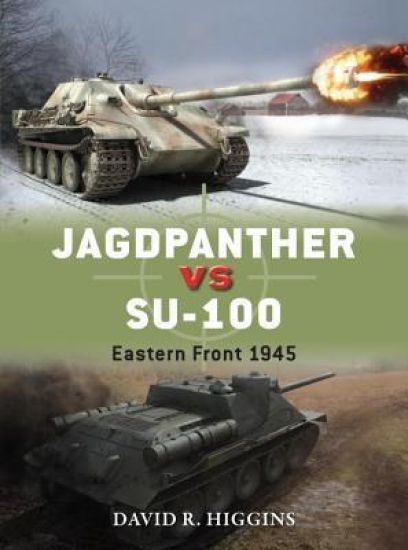
Jagdpanther vs SU-100

Jagdpanther vs SU-100

David R. Higgins

Osprey Publishing
2014
nidottu
Featuring specially commissioned full-colour artwork, this engaging study casts new light on the background and details of this clash between two turretless tank destroyers as the two sides contested Hungary’s vital oil resources in March 1945.As World War II in Europe reached its end, armour development and doctrine had experienced several years of massively accelerated change, especially within the crucible of the Eastern Front. The German Jagdpanther and Soviet SU-100, both turretless tank-destroyer designs based on a ‘traditional’ turret-tank chassis, were the culminating examples of how the progression of experience, resources and time constraints produced vehicles that were well suited for roles of defence and offence, respectively.As this compact book details, the Jagdpanther represented a well-balanced solution and an excellent use of limited resources, while the SU-100 was a natural progression of the SU-85, where numbers produced compensated for rudimentary construction, poor crew comfort and limited optics.
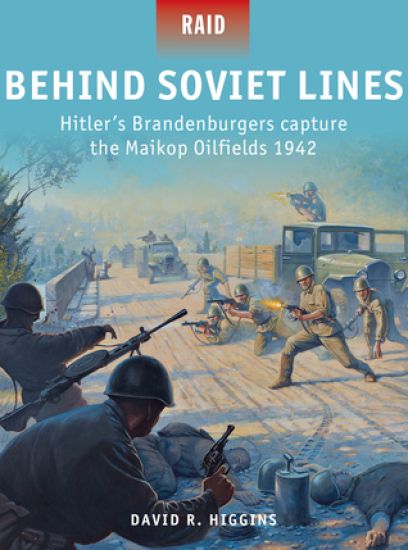
Behind Soviet Lines

Behind Soviet Lines

David R. Higgins

Osprey Publishing
2014
nidottu
In the summer of 1942, following the invasion of Russia the previous year, Hitler’s ‘Brandenburger’ commando units undertook a daring operation deep inside Soviet-held territory. Disguised as members of Stalin’s NKVD, the secret police dreaded by most Soviet citizens and soldiers, the Brandenburgers passed unsuspected past the Red Army’s checkpoints, before launching their surprise operation to seize the vital Soviet oil facilities around Maikop – delivering them intact into Nazi hands. Featuring specially commissioned full-colour artwork, this expert assessment of the Maikop operation casts new light on German special-forces operations on the Eastern Front.
The Swamp Fox

The Swamp Fox

David R. Higgins

Osprey Publishing
2013
nidottu
The American Revolution was deadlocked in the north, and in 1778, the focus of the conflict shifted south. Following his decisive 1780 victory at Charleston, Cornwallis launched a campaign through the Carolinas that was designed to expel American Continental and militia forces from the south. The subsequent patriot victory at King’s Mountain forced Cornwallis to withdraw into South Carolina in what was one of the turning points in the Revolutionary War. To the southeast, Francis Marion enacted a series of successful hit-and-run operations. Cornwallis responded to this string of raids by assigning Banastre Tarleton to capture or kill the rebel guerrilla commander. What followed was an unsuccessful pursuit of the elusive Marion, in which Tarleton practiced a scorched-earth policy that ultimately disillusioned Loyalist sympathizers and hurt the British cause in the Carolinas. This book highlights the unique style of southern frontier warfare during the Revolutionary War, and how its combatants were supplied, organized, and operated. The series of actions between August and November 1780 illustrate Marion’s unconventional efforts to hinder their enemy’s war effort in the south- earning him his Swamp Fox moniker- and Tarleton’s equally irregular efforts to counter it.
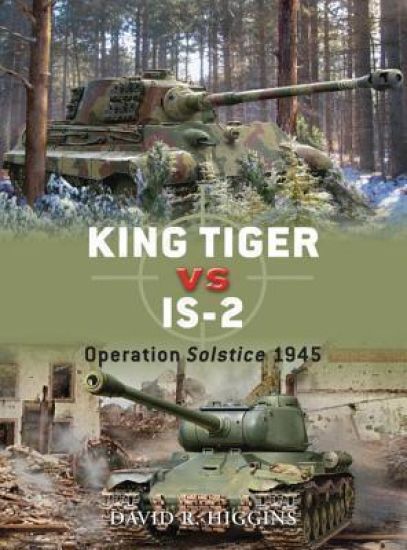
King Tiger vs IS-2

King Tiger vs IS-2

David R. Higgins

Osprey Publishing
2011
nidottu
This book examines the technology and strategy that defined the outcome of the battles between the King Tiger and the IS-2.The Soviets had been quick to develop tanks that could fight the Tiger on an equal footing, but these were developed as part of a completely different strategy than that employed by the Germans. The King Tiger was a modern marvel, and remained unmatched in one-on-one combat. Technologically superior, with greater firepower and better armour than the Soviet IS-2, the King Tiger was a formidable opponent. However, the IS-2 was lighter, more manoeuvrable and most importantly, far more numerous. As well as analysing how different designs and technology helped and hindered each tank, this book also discusses how these weapons affected and shaped the overall strategy of the German and Soviet forces. Ultimately, with overwhelming numerical superiority, the Soviets were able to simply overwhelm their opponents, negating the technical superiority of the King Tiger.