Kirjojen hintavertailu. Mukana 11 717 486 kirjaa ja 12 kauppaa.

Kirjahaku

Etsi kirjoja tekijän nimen, kirjan nimen tai ISBN:n perusteella.

5 kirjaa tekijältä David R. Johnson

Conrad Richter

Conrad Richter

David R. Johnson

Pennsylvania State University Press
2002
pokkari
Conrad Richter: A Writer's Life is the story of an aspiring writer who failed and then, desperate for money, tried again and wrote himself out of penny-a-word pulp magazines and into a Pulitzer Prize and a National Book Award. Based upon unrestricted access to all of Richter's letters, journals, notebooks, and private papers, this biography offers an intimate account of Richter's personal struggle to achieve success in his own and in other people's terms. Johnson's biography will engage anyone interested in the art of biography and in a novelist's act of writing. Admirers of Richter's novels will also find much of interest in his life. So, too, will those who find value in the story of a man who, despite his sense of himself as an imperfect vessel for God's plan for human evolution, lived his life with as much grace, determination, and courage as he could.
Longdendale & Glossopdale

Longdendale & Glossopdale

David R. Johnson

The History Press Ltd
1996
nidottu
This book is part of the Archive Photographs series, which uses old photographs and archived images to show the history of various local areas in Great Britain, through their streets, shops, pubs, and people.
A Fractured Profession

A Fractured Profession

David R. Johnson

Johns Hopkins University Press
2017
sidottu
The commercialization of research is one of the most significant contemporary features of US higher education, yet we know surprisingly little about how scientists perceive and experience commercial rewards. A Fractured Profession is the first book to systematically examine the implications of commercialization for both universities and faculty members from the perspective of academic scientists. Drawing on richly detailed interviews with sixty-one scientists at four universities across the United States, sociologist David R. Johnson explores how an ideology of commercialism produces intraprofessional conflict in academia. The words of scientists themselves reveal competing constructions of status, conflicting norms, and divergent career paths and professional identities. Commercialist scientists embrace a professional ideology that emphasizes the creation of technologies that control societal uncertainties and advancing knowledge toward particular-and financial-ends. Traditionalist scientists, on the other hand, often find themselves embattled and threatened by university and federal emphasis on commercialization. They are less concerned about issues such as conflicts of interest and corruption than they are about unequal rewards, unequal conditions of work, and conflicts of commitment to university roles and basic science. Arguing that the division between commercialists and traditionalists represents a new form of inequality in the academic profession, this book offers an incisive look into the changing conditions of work in an era of academic capitalism. Focusing on how the profit motive is reshaping higher education and redefining what faculty are supposed to do, this book will appeal to scientists and academics, higher education scholars, university administrators and policy makers, and students considering a career in science.
Fort Amanda - A Historical Redress

Fort Amanda - A Historical Redress

David R. Johnson

Createspace Independent Publishing Platform
2017
nidottu
Fort Amanda - The Real Story( A Historical Redress)Someone once said, "History doesn't repeat itself, historians repeat other historians." That same thing can be said for most of what's been written about Fort Amanda over the past 100 years. Unfortunately much of the information they repeated was either incorrect, misleading a myth or sometimes a combination of all three. David Johnson (formerly of Lima, Oh) has spent more than 40 years researching the history of Fort Amanda and in 2017 published this book, "Fort Amanda - A Historical Redress" that addresses many of those issues. The book focuses on events that began in 1790 and led up to construction of the fort in 1812 including his theory that General Anthony Wayne" may have built something on the site as early as 1795. Johnson's book contains over 360 pages including 74 of which are dedicated to biographical and genealogical information of many of the man and the families they left at home; or as Johnson refers to them; "the other half of the team."
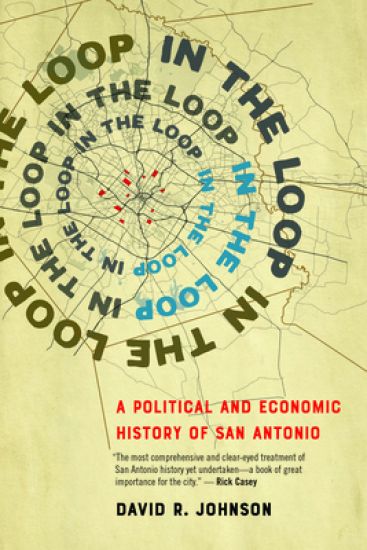
In the Loop

In the Loop

David R. Johnson

Trinity University Press,U.S.
2020
sidottu
In the Loop: A Political and Economic History of San Antonio, is the culmination of urban historian David Johnson’s extensive research into the development of Texas’s oldest city. Beginning with San Antonio’s formation more than three hundred years ago, Johnson lays out the factors that drove the largely uneven and unplanned distribution of resources and amenities and analyzes the demographics that transformed the city from a frontier settlement into a diverse and complex modern metropolis. Following the shift from military interests to more diverse industries and punctuated by evocative descriptions and historical quotations, this urban biography reveals how city mayors balanced constituents’ push for amenities with the pull of business interests such as tourism and the military. Deep dives into city archives fuel the story and round out portraits of Sam Maverick, Henry B. Gonzales, Lila Cockrell, and other political figures. Johnson reveals the interplay of business interests, economic attractiveness, and political goals that spurred San Antonio’s historic tenacity and continuing growth and highlights individual agendas that influenced its development. He focuses on the crucial link between urban development and booster coalitions, outlining how politicians and business owners everywhere work side by side, although not necessarily together, to shape the future of any metropolitan area, including geographical disparities. Three photo galleries illustrate boosterism’s impact on San Antonio’s public and private space and highlight its tangible results. In the Loop recounts each stage of San Antonio’s economic development with logic and care, building a rich story to contextualize our understanding of the current state of the city and our notions of how an American city can form.