Kirjojen hintavertailu. Mukana 11 342 296 kirjaa ja 12 kauppaa.

Kirjahaku

Etsi kirjoja tekijän nimen, kirjan nimen tai ISBN:n perusteella.

8 kirjaa tekijältä David R. Mares

Violent Peace

Violent Peace

David R. Mares

Columbia University Press
2001
sidottu
When is military force an acceptable tool of foreign policy? Why do democracies use force against each other? David R. Mares argues that the key factors influencing political leaders in all types of polities are the costs to their constituencies of using force and whether the leader can survive their displeasure if the costs exceed what they are willing to pay. Violent Peace proposes a conceptual scheme for analyzing militarized conflict and supports this framework with evidence from the history of Latin America. His model has greater explanatory power when applied to this conflict-ridden region than a model emphasizing U.S. power, levels of democracy, or the balance of power. Mares takes conflict as a given in international relations but does not believe that large-scale violence must inevitably result, arguing that it is the management of conflict, and not necessarily its resolution, that should be the focus of students, scholars, and practitioners of international relations. Mares argues that deterrence represents the key to conflict management by directly affecting the costs of using force. Conflicts escalate to violence when leaders ignore the requisites for credible and ongoing deterrence. Successful deterrence, he suggests, lies in a strategy that combines diplomatic and military incentives, allowing competition among heterogenous states to be managed in a way that minimizes conflict and maximizes cooperation.
Violent Peace

Violent Peace

David R. Mares

Columbia University Press
2001
pokkari
When is military force an acceptable tool of foreign policy? Why do democracies use force against each other? David R. Mares argues that the key factors influencing political leaders in all types of polities are the costs to their constituencies of using force and whether the leader can survive their displeasure if the costs exceed what they are willing to pay. Violent Peace proposes a conceptual scheme for analyzing militarized conflict and supports this framework with evidence from the history of Latin America. His model has greater explanatory power when applied to this conflict-ridden region than a model emphasizing U.S. power, levels of democracy, or the balance of power. Mares takes conflict as a given in international relations but does not believe that large-scale violence must inevitably result, arguing that it is the management of conflict, and not necessarily its resolution, that should be the focus of students, scholars, and practitioners of international relations. Mares argues that deterrence represents the key to conflict management by directly affecting the costs of using force. Conflicts escalate to violence when leaders ignore the requisites for credible and ongoing deterrence. Successful deterrence, he suggests, lies in a strategy that combines diplomatic and military incentives, allowing competition among heterogenous states to be managed in a way that minimizes conflict and maximizes cooperation.
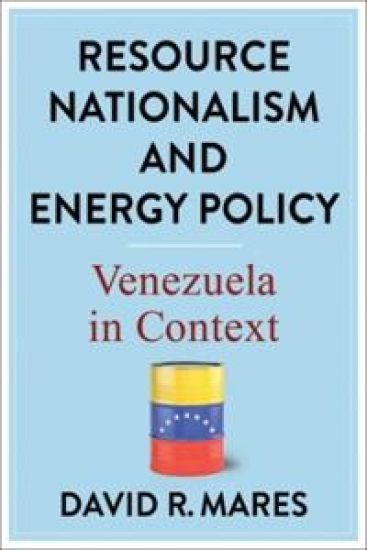
Resource Nationalism and Energy Policy

Resource Nationalism and Energy Policy

David R. Mares

Columbia University Press
2022
sidottu
It is widely thought that state ownership of natural resources, oil and natural gas in particular, causes countries to fall under the sway of the “resource curse.” In such cases, governments allegedly display “resource nationalism,” which destabilizes the economy, society, and politics. In this book, David R. Mares dispels these beliefs and develops a powerful new account of the relationship between state resource ownership and energy policy.Mares examines variations in energy policy across a wide range of countries, underscoring the fact that in most of the world outside the United States, subsoil natural resources are owned by the state. He considers the history of Latin American oil and gas policies and provides an in-depth analysis of Venezuela from 1989 to 2016—before, during, and after the presidency of Hugo Chávez. Mares demonstrates that the key factors that influence energy policy are the inclusiveness of the political system, the level of competitiveness within policy making, and the characteristics of individual leaders. Domestic politics, not state ownership, determines the effectiveness and efficiency of energy policies: the “resource curse” is avoidable. Drawing on these findings, Mares reconceptualizes resource nationalism, arguing that government intervention into resource extraction is legitimate as long as the benefits are shared through the provision of public goods. Featuring a sophisticated grasp of both Latin American politics and energy policy, this book sheds new light on why some governments are responsible stewards of natural resources while others appropriate national wealth for partisan or private benefit.
Resource Nationalism and Energy Policy

Resource Nationalism and Energy Policy

David R. Mares

Columbia University Press
2022
pokkari
It is widely thought that state ownership of natural resources, oil and natural gas in particular, causes countries to fall under the sway of the “resource curse.” In such cases, governments allegedly display “resource nationalism,” which destabilizes the economy, society, and politics. In this book, David R. Mares dispels these beliefs and develops a powerful new account of the relationship between state resource ownership and energy policy.Mares examines variations in energy policy across a wide range of countries, underscoring the fact that in most of the world outside the United States, subsoil natural resources are owned by the state. He considers the history of Latin American oil and gas policies and provides an in-depth analysis of Venezuela from 1989 to 2016—before, during, and after the presidency of Hugo Chávez. Mares demonstrates that the key factors that influence energy policy are the inclusiveness of the political system, the level of competitiveness within policy making, and the characteristics of individual leaders. Domestic politics, not state ownership, determines the effectiveness and efficiency of energy policies: the “resource curse” is avoidable. Drawing on these findings, Mares reconceptualizes resource nationalism, arguing that government intervention into resource extraction is legitimate as long as the benefits are shared through the provision of public goods. Featuring a sophisticated grasp of both Latin American politics and energy policy, this book sheds new light on why some governments are responsible stewards of natural resources while others appropriate national wealth for partisan or private benefit.
Latin America and the Illusion of Peace
This book explores interstate conflict and its dynamics in the context of Latin America’s contemporary conflict management experience. The myth of Latin America as a region of peace means that each time the use of force rises to the level of global attention (e.g., Ecuador-Peru 1995 or Colombia-Ecuador 2008) analysts and the press ask, "how could that happen here?" Yet the official uses of military force in interstate relations are significantly more prevalent than most analysts within and outside the region understand, and the region is facing new and potentially destabilizing challenges. It is the contention of this book that mitigating the threat raised by militarized interstate relations requires understanding the various ways in which military force can be employed short of war; this in turn requires illuminating the decision making process that produces militarization of a disagreement, considering options for dissuading the decision makers from choosing to militarize and limiting escalations when militarization does occur.
Latin America and the Illusion of Peace
This book explores interstate conflict and its dynamics in the context of Latin America‘s contemporary conflict management experience. The myth of Latin America as a region of peace means that each time the use of force rises to the level of global attention (e.g., Ecuador-Peru 1995 or Colombia-Ecuador 2008) analysts and the press ask, "how could that happen here?" Yet the official uses of military force in interstate relations are significantly more prevalent than most analysts within and outside the region understand, and the region is facing new and potentially destabilizing challenges. It is the contention of this book that mitigating the threat raised by militarized interstate relations requires understanding the various ways in which military force can be employed short of war; this in turn requires illuminating the decision making process that produces militarization of a disagreement, considering options for dissuading the decision makers from choosing to militarize and limiting escalations when militarization does occur.
Drug Wars and Coffeehouses

Drug Wars and Coffeehouses

David R. Mares

CQ Press
2005
nidottu
An international policy issue awash in myths, moral inconsistencies, social prejudices, and political rhetoric, it’s no wonder students find the international drug trade an alluring topic to study and discuss. With his brief and engaging new book, David Mares explores the reasons why there is so much disagreement among nations about which policies are most appropriate to address drug production, distribution, and trade. From the more tolerant "coffee house" style policies of the Netherlands which focus on public health concerns, to the United States’ just-say-no "drug war" approach, nations frame and seek to resolve these issues in very different ways and with different levels of success. This variation creates a host of global cooperation and policy coordination problems, making Drug Wars and Coffee Houses an ideal supplement for giving students an opportunity to apply the larger themes of any political economy course to a substantive policy area.A compelling framework—focusing on political economic ideas and analysis—shows students how leaders and policymakers need to understand the drug trade as a full-blown commodity system if they are to impact its different segments. As he discusses drug production, consumption, distribution, and money laundering, Mares carefully shows what insights micro political economic, realist, constructivist, and social deviant perspectives each bring to bear on the problem. And, through the book’s use of extended case studies, this text offers students an inside look at a complex and fascinating policy area, from Sweden’s attempts to enforce drug-war style policies, to the UK’s movement towards decriminalization, to the responses of such international organizations as the United Nations and the European Union. A comprehensive bibliography of websites, articles, and book length studies point to further research on the topic, while class-tested research and study questions for each chapter will jumpstart class discussions and projects.