Kirjojen hintavertailu. Mukana 11 244 527 kirjaa ja 12 kauppaa.

Kirjahaku

Etsi kirjoja tekijän nimen, kirjan nimen tai ISBN:n perusteella.

26 kirjaa tekijältä David R. Slavitt

The Book of Lamentations

The Book of Lamentations

David R. Slavitt

Johns Hopkins University Press
2001
pokkari
Distinguished poet and translator David R. Slavitt here provides a translation of and meditation upon the Book of Lamentations, the biblical account of the destruction of the Temple in Jerusalem in 587 B.C.,on the ninth day of the Jewish month of Av-Tish'a b'Av. (Six centuries later the Romans destroyed the second Temple on the same day.) Most of the Jewish population was deported to Babylon, and the ensuing period came to be known as the Babylonian Captivity. According to tradition, the Book of Lamentations was written in response to this political, social, and religious crisis. The five poems composing the book express Israel's sorrow, brokenness, and bewilderment before God. Tish'a b'Av is the day on which observant Jews fast and pray. And mourn. As Slavitt observes in his meditation:" It is forbidden on Tish'a b'Av even to study the Torah, except for the Book of Job and the Book of Lamentations. This is the day on which we grieve for every terrible thing that happens in this world. It is the worst day of the year."Slavitt's meditation provides a context for reading the scriptural text. Cast in the same style as the Hebrew poetry, his meditation recounts how sorrow and catastrophe have characterized so much of the history of the Jewish people, from their enslavement in Egypt to the Holocaust of Nazi Germany. Few translations of this remarkable book of the Bible attempt to reproduce in English, as Slavitt does here, the Hebrew acrostics. In the original, each verse begins with a different letter of the Hebrew alphabet in sequential order; Slavitt elegantly reproduces this effect using the first 22 letters of the English alphabet. More than a structural or mnemonic device, Slavitt argues, the acrostics are "a serious assertion that the language itself is speaking, that the speech is inspired, and that there is, beyond all the disaster and pain the book recounts, an intricacy and an orderly coherence."
Equinox and Other Poems

Equinox and Other Poems

David R. Slavitt

Louisiana State University Press
1989
nidottu
In his newest volume of verse, David R. Slavitt offers some of his finest poetry to date. Equinox is a collection of twenty-five poems on various subjects. They are occasional, the that most of them are the result of specific moments of experience, whether of an art work, as in ""Canaletto's Ruin,"" or a moment of natural beauty, as in ""The Field of Light"":The road, past Worcester and sundown, unwound in hollows' evergreen shadows, velvet billows: the firm earth melted under the wheels. But then, at a turn onto high ground, I entered into a field of light. Light was its crop, a yield of gold that oozed up like the sweat of plums.Throughout the collection, Slavitt explores the tensions between lawful order and murderous chaos, the desire to preserve things against inevitable decline, even the conflict between honest desire and the parody of it, as manifested in ""Refinement"": ""Ours are plenty's penalties, gout, girth, / atherosclerosis, kidney stones, / and ennui..."" And he offers meditations on the relations between generations, as in ""Circus Costumes,"" in which he recalls his grandfather, and ""Letter to a Grandchild.""In the title poem, Slavitt presents a moving and controlled portrayal of the difficulties of coming to terms with death, especially the violent death, of a loved one:A balance shifts, and we can feel the night heavy in the scale, darkness and cold will weigh with us from now on . . .Wise and profound, frequently warm and occasionally bitter, these are the poems of a master craftsman.
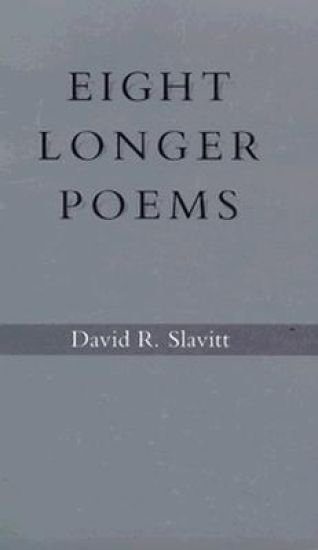
Eight Longer Poems

Eight Longer Poems

David R. Slavitt

Louisiana State University Press
1990
nidottu
In this volume David R. Slavitt brings together eight poems that deal largely with the mind's relation to history, personal history, and the history of myth and of empires. In addressing these two seemingly independent modes of thinking and remembering, Slavitt reveals that they are in fact closely related, and that they are both part of our poetic consciousness.""Gesualdo"" is a historical poem concerning suffering, desire, and art. In, ""Cleaning,"" a man goes through a closetful of accumulated and forgotten artifacts that lead to a meditative discourse on the process of memory and how our past are collections of such fragments. In ""History of My Ear,"" the silences of the world as ""between a lightning bold and a thunderclap,"" become the places in which we learn to live as we grow older. ""Monster Dance"" considers the odd bedtime rituals we perform for our children.In ""Grove Isle,"" reminiscent of the meditative poems of Wallace Stevens and other poets who stress the primacy of the imagination, Slavitt describes the harmonies and discords between the perceiving eye and nature, between the mind the that world. The setting is a beach resort where the accoutrements of civilisation and the purity of nature clash with and reflect one another.In ""The Wound,"" the spear of Achilles becomes the focal point around which Slavitt turns a discussion of the source, nature, and evolution of human suffering, Achilles and a host of other historical characters become emblematic of our present-day condition and its sense of helplessness, and injustice.""Vlad"" and ""The Gate of Horn"" are tended historical piece that, like ""Gesualdo"" and ""The Wound,"" have as their central thrust the humanization of historical figures and the consequent elevation of human emotions to epic proportions. ""Vlad"" takes its title from the historical figure Vlad the Impaler, who was transformed in the European imagination into the figure of Dracula. Here Slavitt presents strange and beautiful insights into the mind of a creature that sees into both the world of men and the world of raw nature. In ""The Gate of Horn,"" Slavitt considers that romantic and visionary authors of the Golden Age of Spain and their creations.Eight Longer Poems is an engrossing collection from one of our most skilled and versatile poets.
Crossroads

Crossroads

David R. Slavitt

Louisiana State University Press
1994
nidottu
In his twelfth book of original verse David R. Slavitt leads us to a crossroads where terror, loneliness, and despair are transfigured by love and art.Much of the collection centers on the poet's family history. In the title poem, Slavitt imagines the ""dour landscape"" of the Polish hamlet his grandparents left in search of a safer haven, at the same time that he reflects ruefully on the hazards of contemporary life in America:but what they abandoned is what I dream of now, asleep, while people who don't even know my name monitor consoles that show what zones in my house have been violated, what doors or windows opened, or motion sensors tripped by the cat or some intruder. On the street, cars are stolen and strippedby desperate men, wild children . . . Who can say?In another poem, he recalls his mother and his discovery only after her death, her murder, that the name she had been given was not Adele but Ida. As a young woman she had chosen to call herself something ""not too cute, but not too plain, not Ida."" And it is Adele he decides on for her grave marker, in deference to her whimsical and brave spirit.Not only family but also the worlds of art, music, and literature animate Slavitt's verses, from a consideration of the modes of salvation suggested by El Grenco's and Goy's paintings of Saint Peter to a reflection upon our common response to a discordantly tuned instrument, from echoes of Paradise Lost to witty and deft variations on Catullus.Throughout this collection David Slavitt's keen intelligence, wry humor, and deep compassion shine through. Crossroads allows us to observe a poet working at the peak of his powers.
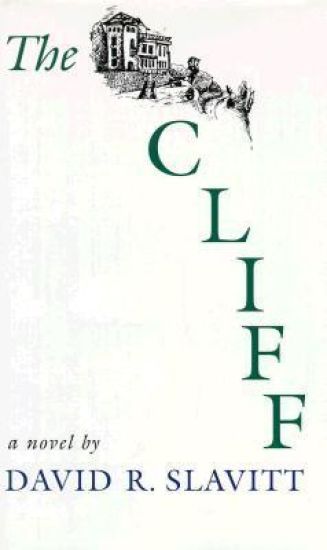
The Cliff

The Cliff

David R. Slavitt

Louisiana State University Press
1994
sidottu
John Smith is an imminent historian, secure in his well-paid position as an endowed professor at a major university. Any day he expects a favourable reply to his application for a residency at the Villa Sfrondata, a foundation-supported colony for artists and intellectuals on the banks of Italy's Lake Como, where he hopes to finish work on a study of MussoliniJohn Smith, the other John Smith, is a bitter and failed novelist, an adjunct assistant professor of English at the same university. Suffering from writer's block, ignored by his daughter, hounded by his former wife's attorney for back alimony, and about to lose his job, his prospects could not be dimmer, that is, until the day the Villa Sfrondata's invitation to the eminent historian is delivered to him by mistake. Before you know it, the down-and-out-how-can-things-get-worse-what-have-I-got-to-lose John Smith is in Italy, ensconced, imposter though he is, in a room at the centuries-old villa.But what had promised to be a blissful if ill-gotten idyll quickly sours. The villa is drafty and decaying, the staffs are surly and incompetent, and the other residents, among them a Nigerian economist, a Washington lawyer, a book designer, an art historian, and a feminist poet from California, are a motley and eccentric group whom Smith finds all but insufferable. He seizes every opportunity to deflate their overblown pretensions with a razor-sharp wit, which he possesses in astonishing abundance. At the same time, he must take care that some misstep does not reveal him as a fraud. His life is further complicated when one of the guest, the despised feminist poet, mysteriously disappears.After passing through what he calls ""a cloudy afternoon of the soul,"" including the very real fear that he will be implicated in the disappearance of the poet, Smith contrives in the end to amend his life and even to revive his all but abandoned literary career.This devastatingly satiric and funny book, David R. Slavitt's fiftieth, is a complicated burlesque that turns out to be a moving story of human frailty and spiritual rebirth. It is a feat of literary legerdemain that will dazzle even admirers of Slavitt's Turkish Delights, Lives of the Saints, Salazar Blinks, and The Hussar.
A Gift

A Gift

David R. Slavitt

Louisiana State University Press
1996
nidottu
Epic poem, biography, literary criticism, historical romance, in A Gift, David Slavitt presents the fascinating life of Mozart's librettist, Lorenzo da Ponte, one of history's great unknowns, a man blessed and cursed by his conviction that within him lay the capacity for literary greatness.Educated in the church, the young da Ponte carouses in Venice, flees Italy, and finds himself in Austria, trying to establish a career in the theater. Under the tepid patronage of Joseph II of Austria, he turns out libretti for Salieri and learns the ""whorey tricks"" of writing on demand: ""Adaptation, translation, theft."" In lines that ring harrowingly true, Slavitt reflects the young man's self-doubts:The mad hopegrows like a mold on breadthat it's not so bad,is better than you think, but what that meansis only that your judgment is going too,you can't tell good from bad, are a fraud, impostorThen, on the brink of despair, he encounters Mozart, boorish, preferring crude farce to literary grace. Still, the partnership thrives with The Marriage of Figaro, Don Giovanni, Così fan tutte. But good luck is not to be trusted, and ""misfortune is not reliable either.""Despite his brilliant gift, success eludes da Ponte. Ever gullible, ever generous, he is destined to accumulate others' debts, to be at the wrong place at the wrong time, to be forgotten. Da Ponte lives out his life in the fledgling United States, plagued by sickness, debt, and the implacably looming specter of failure.Slavitt has created a lovely, heartening book, one that reminds us that untested faith is no faith at all. Alight with muted passion, A Gift chronicles a man's refusal to despair despite the growing awareness that nothing awaits but poverty and ignominy, ""that this ill-fitting garment is what the wardrobe holds."" Through Slavitt's lively imagination, we feel reverence rather than pity for the dogged nobility of da Ponte's struggle. Ultimately, Lorenzo da Ponte is a hero, his life a victory.
Epic and Epigram

Epic and Epigram

David R. Slavitt

Louisiana State University Press
1997
nidottu
David R. Slavitt's affectionate translations of epigrams by sixteenth-century Welsh academic John Owen transmute a careful selection of the writer's work into a vision of life, and in so doing bring Owen into conversation with the present day. Pithy, quick, favouring balance and economy over elaboration of style, the epigram is difficult in any language; that Owen mastered it in a language other than his own attests to his immense talent. Owen's small treasures go directly to the core: ""At your coming into the world, you gave a cry / of protest: why then protest that you must die?""Duessa's Version: A Dirge in Seven Canticles offers an irreverent and provocative recapitulation of The Faerie Queene, as told by Duessa, the mutable sorceress of Spenser's epic poem. Slavitt invests her with an unforgettable voice, outraged, profane, wise, and wickedly funny, and an exasperated contempt for the hero, Spenser's Redcrosse Knight. Duessa's retelling of The Faerie Queene becomes the scaffolding upon which Slavitt hangs his reflections on twentieth-century civilisation and culture that are indebted at once to intelligent observation, to Spenser, and to Borscht Belt comedy.Here are virtuoso performances by a poet with resources of wit and erudition that are nothing short of astonishing. These masterly translations are bound ""to get him, or at least his ghost, invited back.
PS3569.L3

PS3569.L3

David R. Slavitt

Louisiana State University Press
1998
nidottu
PS3569.L3, David R. Slavitt's sixtieth book, is a collection of poems, translations, imitations, parodies, jeux de mots, and jeux d'esprit, work that ranges from grief-stricken brooding to exuberant clowning around. The odd title, for instance, is nothing more or less than the author's Library of Congress identification, which he adopts now that it has adopted him. Few contemporary poets display his range of sensibility and response to the various occasions of chaotic existence in our time, and Slavitt offers us his reactions to those stresses and cultural shocks that have not so much engaged his attention as ambushed it. He writes poetry that ascends to Pindar and Meleager, or descends some traditional prosodic scale even to the point where it risks gibberish, or basks in it, and he makes no apology for this.
Short Stories Are Not Real Life

Short Stories Are Not Real Life

David R. Slavitt

Louisiana State University Press
1999
nidottu
In these fourteen beautifully crafted stories David R. Slavitt shows his mastery of the form. Elegant, spare, sometimes funny, sometimes elegiac- this collection reflects a writer in admirable control of his craft.The title story (complete with footnotes á la The Norton Anthology of Short Fiction) braids together the tidy conventions of fiction and the brutal reality of New York as a writing teacher ponders s student's sexually explicit story that may- or may not- be autobiographical. In The Impostor a writer's brother exploits the legerdemain of fiction in a series of ever-bolder impersonations.Several of the stories are presented by emotionally wounded narrators, disillusioned men looking for a hint of grace in a world where expectations are frequently doomed to disappointment. In such a world only one thing is certain we will hurt- and be hurt by- the ones we love. And in the vacuum left when traditions that might have been redemptive have lost their meaning, ""punishment gets to be a habit, a way of life, or at least something to hold onto."" The stories pivot on nuance, on the half-realized insight, on ""some perfectly innocent and insignificant insight, on ""some perfectly innocent and insignificant gesture that turns round and grows into a medium-to-large awkwardness.""We find what the divorced father futilely awaiting his daughter's visit in Hurricane Charlie calls ""dabblers in distress"": lonely, decent people trying to discover where love- and life- went. In Simple Justice a man striving for some definitive family memory compares the process to archaeology: ""The shards that remain are pathetically small and almost grudging."" Thus through the faltering memory of an elderly cousin in ""conflations"" a man becomes a kind of incarnation of his own father and for a moment finds himself at the ""vanishing point"" where a lost past meets an unknowable future; in The long Island Train a simple anecdote becomes a metaphor for the opacity of the most apparently transparent human intentions. Yet it is often these shard of tradition and memory that seem to hold our only promise of transcendence. The protagonist of Grandfather, for example, through his reluctant participation in his grandson's bris, finds a moment of reconciliation with a past that has broken loose of its moorings.Even the most experimental of these pieces- Instructions, a list of admonitions ranging from the quotidian to the cosmic- shows a deep humanity and a maturity of vision that steers adeptly between humor and despair. These stories will linger in the reader's memory long after the book is closed.
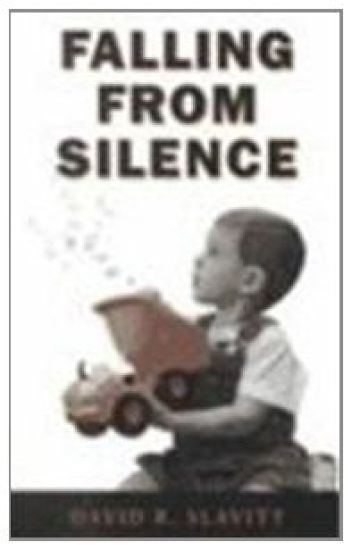
Falling from Silence

Falling from Silence

David R. Slavitt

Louisiana State University Press
2001
nidottu
Falling from Silence is the seventy-third book by David Slavitt, the prolific poet, novelist, translator, and editor. His amazing rate of production has only amplified and reigned the power of his art. This is the work of an accomplished veteran, a craftsman who laments the limitations of what his hard-earned talent can do in the face of age and loss. He turns to religion, reads the classics, and in moments of cheer that may not be mere mania, he horses around and fools with the words that have been his toys, but nothing helps- or, more accurately, nothing helps enough. It is nevertheless true that, as he says in Pen: ""The letters/ that danced in the light like gnats will suddenly light/ on some twig of a notion a held breath can make tremble/ in an unpredictable motion- like this pen's- / that no one would think could bear the fruit of truth."" Ranging in tone from devilish and droll to dignified and desolate, the poems here examine death and aging and bespeak the reassuring connection between the generations. In ""Angel of Death,"" the speaker remarkably balances grief and joy in describing the birth of his grandson, who bears the name of the poet's father: ""I hold him in my arms, the precious, breathing / weight, and admire the tiny hands / that will bear the weight one day of my coffïn's corner. . . . / That a Sam once more will carry me is a comfort.""Slavitt's wry wit, profound humanity, and agile intellect illuminate every page of Falling from Silence. In contrast to its title, it is, indeed, a resounding poetic triumph.
Change of Address

Change of Address

David R. Slavitt

Louisiana State University Press
2005
nidottu
A selection of recent work as well as the best from thirteen volumes of poetry published across four decades, Change of Address highlights the magnitude and scope of David Slavitt's poetic achievement. Meditating on both the quotidian and the sublime and ranging from brilliant satire to tender elegy, this retrospective collection brings into sharp relief Slavitt's intelligence, strength of voice, and ease in varied poetic forms. From the beginning of his career, Slavitt has displayed a rare technical virtuosity, and his verse has long confronted -- with urbanity and poise -- questions of love, grief, loss, and death. Though he is an exuberantly playful poet, his gamesmanship is earnest, toying wisely and bravely with the largest experiences of joy and heartbreak. And his gestures, while seemingly effortless, are carefully considered. The result is a body of poetry that haunts us as only the best literature can.A splendid capstone to Slavitt's copious output, Change of Address grants readers access to the extraordinary spectrum of his poetry in a single volume. ""body betrays, and even a mind can rebel,// but against what? What remains? Slowly but surely,// we are forced to suppose a soul, which serves us well,// while we serve it unfaithfully and impurely.// Infinitely regressive? Or merely shy?// Call it what watches, suffers, and remains// our subject/object, despite whatever pains// we may impose upon it, an inner I. Or is it a mere fiction that one may admit// as useful or even necessary? Its truth// is theoretical, a series, a trend,// almost algebraic: and one conjures it// from the motes that fly in the thin air of his youth// to create the granite block that marks his end.""- Soul
William Henry Harrison and Other Poems

William Henry Harrison and Other Poems

David R. Slavitt

Louisiana State University Press
2006
nidottu
The prodigiously imaginative mind and penetrating wit of David R. Slavitt are on full display in his newest collection of poetry that is perhaps his most engaging to date. The title poem begins by fooling around- ""With three names like that, it sounds as though his mother is calling him and she's really angry""- but then builds into a shrewd, thoughtful account of the life of the ninth U.S. president. A second long poem offers a fresh and very amusing appraisal of the practice of buying, writing, and sending souvenir postcards. In between this pair, there are shorter pieces impressive in their range and tone and theme (be sure to read ""Poem without Even One Word"") that dazzle in an already glittering body of work.Slavitt's poems can be playful, even silly, and then astonishingly convert levity into earnest urgency. Dark lines glint with the light of intelligence and mirth, even as artful puns and jokes reveal a rueful aspect. The poet gets older but his work is as graceful as ever, the lovable little boy signaling from inside the sometimes-cranky septuagenarian.
The Seven Deadly Sins and Other Poems

The Seven Deadly Sins and Other Poems

David R. Slavitt

Louisiana State University Press
2009
nidottu
In The Seven Deadly Sins and Other Poems, veteran poet David R. Slavitt touches on topics from the mundane to the mysterious with his signature wit and intelligence. In Stupid, for instance, he transforms a simple head cold into an appreciation for the richness of consciousness, and in Waking, the very effort of rising from bed becomes something like a miracle: ""I heave myself up to a sitting position, pause / a moment, and am amazed by what I have done...."" Slavitt explores the range of the human condition with such ease and insight that readers cannot help but ponder what life is -- and what it could be. What if -- like the mythic sea creature in ""The Dogfish"" -- humans could return to the womb when frightened? In the collection's title poem, Slavitt gives a voice to the Seven Deadly Sins, each of which claims, persuasively, to possess a value to humans that is seldom noticed or appreciated. Slavitt has a unique ability to examine an idea -- be it virtue or vice, dark or blithe -- and offer perspective and wisdom about the conundrums of our existence.
Civil Wars

Civil Wars

David R. Slavitt

Louisiana State University Press
2013
nidottu
Praise for David R. Slavitt""Slavitt's touch is light, and he writes beautifully.... His satire is sharp, and he can be wildly funny.""- New York Times Book Review""One of America's most lucid and classical poets.... Slavitt's attitude is, as one would expect of a Hebrew as well as Greco-Latin classicist, sharply questioning as well as tragic. He is a poet one reads to know more.""- Booklist ""Slavitt is both smart and wise; he's as well known for his translations of the writers of antiquity as he is for his original work, both poetry and prose.... With a rich sense of humor, a bit of attitude, and a fascination with details, even minutiae, Slavitt tries his hand at new and curious measures and forms as well as seemingly free-range meditations- or, one might say, meanderings.""- Library JournalThe bravura of David R. Slavitt's first book of poems, published more than fifty years ago, continues to reverberate through his newest collection in a voice matured and roughened by age. Civil Wars conjures the mutterings of old men: meditations- despondent yet playfully witty and bold- on the meaning of life and death, the reasoning for human action or inaction, and misremembered memories. Nothing proves too lofty or too trifling for the poet's scrutiny. Slavitt's attention roves from the carnage inflicted by the Achaeans at Troy, to the performances of Borrah Minevich and the Harmonica Rascals, from meditations on Spinoza to the baseball of the New York Yankees. He considers with deliberation all of these subjects and deems them necessary to help create a spiritual connection in our lives. Slavitt encourages contemplation of the world and writing rather than acceptance of the thoughts of the critic, who ""comes, austere, a man of authority, / and offers to help"" but only dilutes the power of a poem. In this collection, Slavitt also includes translations of Greek, Hebrew, Provençal, French, and Old English poems, including a little-known piece by the mathematician Pierre de Fermat and the Old English epic poem ""The Battle of Maldon.
The Octaves

The Octaves

David R. Slavitt

Louisiana State University Press
2017
nidottu
An accomplished poet and a keen observer of the human condition, David Slavitt deploys both skills to create the whimsical, insightful, and witty poems of The Octaves. In these graceful but often blunt, slyly humorous eight-line poems, Slavitt notes the passing of decades and the loss that entails, the questions that arise when studying works from ancient Greece, and the paradoxes found in philosophy, art, and even the common cold.
Opus Posthumous and Other Poems

Opus Posthumous and Other Poems

David R. Slavitt

Louisiana State University Press
2021
pokkari
As he enters his sixth decade of publishing poetry, David R. Slavitt remains a determined wildcatter who ranges as far as he thinks necessary to drill for meaning, wherever and however he can get it. In his new collection, Slavitt traverses Africa, India, Israel, and the America in which he finds himself, complete with visits to zoos, casinos, baseball fields, and cemeteries, as he searches for clues from which he might learn at least a little. He translates verse from Yiddish and Provençal and offers commentaries on received wisdom, everyday events, and the vagaries of existence.With Opus Posthumous and Other Poems—the title is a joke, as he remains very much alive—Slavitt presents an august work possessed of a richness toward which he has worked throughout his long life. By turns wry, erudite, and dyspeptic, this new volume offers ample rewards of his maturity.
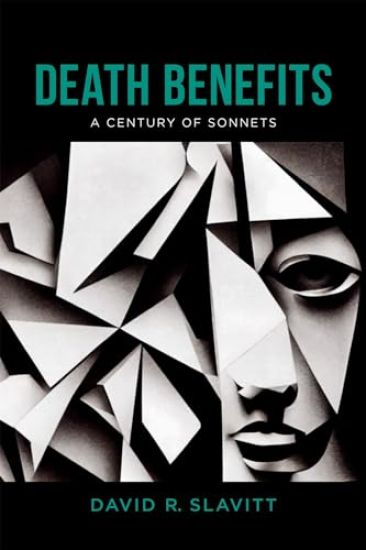
Death Benefits

Death Benefits

David R. Slavitt

LOUISIANA STATE UNIVERSITY PRESS
2024
pokkari
Death Benefits deepens and extends David R. Slavitt's sublime, lyric confrontation with mortality and does so in a plainspoken and marvelously entertaining, conversational way. His poetry encourages us to recognize our own predicaments, as we see ourselves reflected as fellow sufferers entrapped by daily circumstance. In his new collection, Slavitt presents a sequence of one hundred sonnets, each one loaded with life, observation, and quicksilver wit. Readers will delight in looking on with wonder, at every turn of the page, to see how the poet will pull it off this time and what kind of linguistic magic he will use to fend off the mortal pain of getting through each day. His voice plays over the grid of the meter in utterly natural intonations. His music squarely faces the dark, but its enduring note is faith in common sense and the pleasure that poetry provides, rather than cynicism or despair.
Day Sailing

Day Sailing

David R. Slavitt

The University of North Carolina Press
1969
nidottu
This volume of poetry illustrates a new side of the author of The Carnivore and Suits for the Dead. The wit, the toughness, the shining lyric clarity of the earlier books are still here, but they have been joined by a quiet understanding, a joyfulness, and an acceptance of things as they are that indicates the poet has moved into a new and most exciting period.A UNC Press Enduring Edition -- UNC Press Enduring Editions use the latest in digital technology to make available again books from our distinguished backlist that were previously out of print. These editions are published unaltered from the original, and are presented in affordable paperback formats, bringing readers both historical and cultural value.
George Sanders, Zsa Zsa, and Me

George Sanders, Zsa Zsa, and Me

David R. Slavitt

Northwestern University Press
2009
nidottu
Taking its inspiration from Sanders' own autobiography ""Memoirs of a Professional Cad"" (1960), this book is part witty, bawdy, and irreverent memoir, part moving meditation on the price of fame; like most of David Slavitt's work, it defies easy categorization. In George Sanders, ""Zsa Zsa, and Me"", Slavitt looks back to his career as a film critic in the glamorous - at least superficially - world of 1950s Hollywood, when he traveled in circles that included the talented British actor George Sanders (1906-1972) and his then-wife, Zsa Zsa Gabor, who was talented at, well, being famous. Sanders, who seemed to maintain an ironic detachment from roles that were often beneath him, nonetheless couldn't bear the decline of his later years and committed suicide at the age of sixty-five. Darkly humorous to the end, his note read, 'Dear World, I am leaving because I am bored. I feel I have lived long enough. I am leaving you with your worries in this sweet cesspool. Good luck'. Zsa Zsa, on the other hand, remains in the headlines (with her dubiously named husband Frederic Prinz von Anhalt) at age ninety-two. Although he punctuates his story with witty asides - the author's encounter with Marilyn Monroe is particularly memorable - Slavitt turns a critic's eye toward questions of talent and art, while also tackling the difficult and universal questions of aging, relationships, and mortality.
Re Verse

Re Verse

David R. Slavitt

Northwestern University Press
2009
nidottu
David R. Slavitt does not believe in literary criticism so much as in 'remarks', and in this witty and unusual work, he remarks on the life of the poet: how it was - and how it is - to be an American writer in our time. Combining personal reminiscence with deft literary analysis, incisive biographical sketches, and, sometimes, literary gossip, the essays in ""Re Verse"" give new perspectives on the famous, including Harold Bloom, Robert Penn Warren, Robert Frost, and Stephen Spender, and recover the charms of the nearly forgotten, such as Dudley Fitts, Winfield Townley Scott, Merrill Moore, and John Hall Wheelock. Slavitt writes with self-deprecating humor of his own literary education and uses his impressive experience and erudition to illuminate the whims of poetic influence, passion, and reputation. With a refreshing honesty and considerable poise, he gives readers an enlightening view of the vast and ever-changing literary universe.