Kirjojen hintavertailu. Mukana 11 699 587 kirjaa ja 12 kauppaa.

Kirjahaku

Etsi kirjoja tekijän nimen, kirjan nimen tai ISBN:n perusteella.

11 kirjaa tekijältä David Rieff

Bed for the Night

Bed for the Night

David Rieff

Vintage
2002
pokkari
Drawing on first-hand reporting from hot war zones around the world - Bosnia, Rwanda, Congo, Kosovo, Sudan and, most recently, Afghanistan - David Rieff shows us what humanitarian aid workers do in the field and the growing gap between their noble ambitions and their actual capabilities for alleviating suffering.
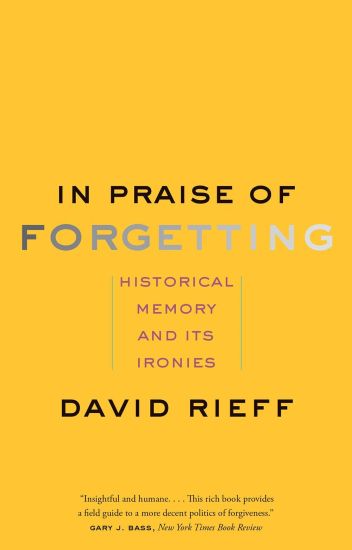
In Praise of Forgetting

In Praise of Forgetting

David Rieff

Yale University Press
2017
pokkari
A leading contrarian thinker explores the ethical paradox at the heart of history's wounds The conventional wisdom about historical memory is summed up in George Santayana’s celebrated phrase, “Those who cannot remember the past are condemned to repeat it.” Today, the consensus that it is moral to remember, immoral to forget, is nearly absolute. And yet is this right? David Rieff, an independent writer who has reported on bloody conflicts in Africa, the Balkans, and Central Asia, insists that things are not so simple. He poses hard questions about whether remembrance ever truly has, or indeed ever could, “inoculate” the present against repeating the crimes of the past. He argues that rubbing raw historical wounds—whether self-inflicted or imposed by outside forces—neither remedies injustice nor confers reconciliation. If he is right, then historical memory is not a moral imperative but rather a moral option—sometimes called for, sometimes not. Collective remembrance can be toxic. Sometimes, Rieff concludes, it may be more moral to forget. Ranging widely across some of the defining conflicts of modern times—the Irish Troubles and the Easter Uprising of 1916, the white settlement of Australia, the American Civil War, the Balkan wars, the Holocaust, and 9/11—Rieff presents a pellucid examination of the uses and abuses of historical memory. His contentious, brilliant, and elegant essay is an indispensable work of moral philosophy.
Against Remembrance

Against Remembrance

David Rieff

MELBOURNE UNIVERSITY PRESS
2011
nidottu
In Against Remembrance, David Rieff provocatively argues that the business of remembrance, particularly of the great tragedies of the past, are policitised events of highly selective memory. Rather than ending injustices, as we expect it to, collective memory in so many cases dooms us to an endless cycle of vengeance. Humanity, he says, simply cannot cope with the true ambivalence of historical events. And if we remember only partially, how can our memories serve us, or our society, as well as we hope?
At the Point Of a Gun: Democratic Dreams and Armed Intervention
Writing from the front lines of the hot wars of the post-Cold War world -- the Balkans, Africa, the Middle East, and most recently Afghanistan and Iraq for The New York Times Magazine -- David Rieff witnessed firsthand most of the armed interventions waged by the West or the United Nations in the name of human rights and democratization. His report is anything but reassuring. In this timely collection of his most illuminating articles, Rieff, one of our leading experts on the subject, reassesses some of his own judgments about the use of military might to solve the world's most pressing humanitarian problems and curb the world's cruelest human rights abusers, presenting what, taken as a whole, is a thoughtful and impassioned argument against armed intervention in all but the most extreme cases. At the Point of a Gun raises critical questions we cannot ignore in this era of gunboat democracy. When, if ever, is it appropriate to intervene militarily in the domestic affairs of other nations? Are human rights and humanitarian concerns legitimate reasons for intervening, or is the assault on sovereignty -- sovereignty that is as much an article of faith at the UN as it is in Washington -- a flag of convenience for the recolonization of part of the world? What role should the United Nations play in alleviating humanitarian crises? And, above all, can democracy be imposed through the barrel of an M16? Collected here for the first time, Rieff's essays draw a searing portrait of what happens when the grandiose schemes of policymakers and the grandiose ethical ambitions of human rights activists go horribly wrong in the field. Again and again, they ask the question: Do these moral ambitions of ours to protect people from massacre and want match either our means or our wisdom? Rieff's articles appear as they were written. Some, however, are accompanied by brief reconsiderations in which the author describes how and why his thinking has changed both as he has reflected on what it means, as in Iraq, to impose democracy by force, and as he has witnessed, firsthand, what that redemptive project actually looks like in practice. This is not an optimistic report. To the contrary, it is the chastened conclusion of a writer who was once one of the leading advocates of such interventions. But the questions Rieff raises are of the essence as the United States grapples with the harsh consequences of what it has wrought on the ground in Afghanistan and Iraq.
Swimming in a Sea of Death

Swimming in a Sea of Death

David Rieff

SS - Simon Schuster
2016
pokkari
Both a memoir and an investigation, "Swimming in a Sea of Death" is David Rieff's loving tribute to his mother, the writer Susan Sontag, and her final battle with cancer. Rieff's brave, passionate, and unsparing witness of the last nine months of her life, from her initial diagnosis to her death, is both an intensely personal portrait of the relationship between a mother and a son, and a reflection on what it is like to try to help someone gravely ill in her fight to go on living and, when the time comes, to die with dignity. Rieff offers no easy answers. Instead, his intensely personal book is a meditation on what it means to confront death in our culture. In his most profound work, this brilliant writer confronts the blunt feelings of the survivor -- the guilt, the self-questioning, the sense of not having done enough. And he tries to understand what it means to desire so desperately, as his mother did to the end of her life, to try almost anything in order to go on living. Drawing on his mother's heroic struggle, paying tribute to her doctors' ingenuity and faithfulness, and determined to tell what happened to them all, "Swimming in a Sea of Death" subtly draws wider lessons that will be of value to others when they find themselves in the same situation.
The Reproach of Hunger: Food, Justice, and Money in the Twenty-First Century
Hailed as "invaluable...a substantial work of political thought," (New Statesman) in a groundbreaking report, based on years of reporting, David Rieff assesses whether ending extreme poverty and widespread hunger is truly within our reach, as is increasingly promised.Can we provide enough food for nine billion people in 2050, especially the bottom poorest in the Global South? Some of the most brilliant scientists, world politicians, and aid and development experts forecast an end to the crisis of massive malnutrition in the next decades. The World Bank, IMF, and Western governments look to public-private partnerships to solve the problems of access and the cost of food. "Philanthrocapitalists" Bill Gates and Warren Buffett spend billions to solve the problem, relying on technology. And the international development "Establishment" gets publicity from stars Bob Geldorf, George Clooney, and Bono. "Hunger, David Rieff] writes, is a political problem, and fighting it means rejecting the fashionable consensus that only the private sector can act efficiently" (The New Yorker). Rieff, who has been studying and reporting on humanitarian aid and development for thirty years, takes a careful look. He cites climate change, unstable governments that receive aid, the cozy relationship between the philanthropic sector and giants like Monsanto, that are often glossed over in the race to solve the crisis. "This is a stellar addition to the canon of development policy literature" (Publishers Weekly, starred review). The Reproach of Hunger is the most complete and informed description of the world's most fundamental question: Can we feed the world's population? Rieff answers a careful "Yes" and charts the path by showing how it will take seizing all opportunities; technological, cultural, and political to wipe out famine and malnutrition.
Swimming In A  Sea Of Death

Swimming In A Sea Of Death

David Rieff

Granta Books
2009
nidottu
In spring 2004, Susan Sontag was diagnosed with the incurable blood cancer. She had a huge appetite for experience, and a wild, extravagant desire to live. Rieff writes movingly about being by her side during that last year and at her death, and about his own contradictory emotions: his guilt both for not consoling her enough, and for somehow colluding with her in her belief that she could beat the disease. Drawing on Sontag's journals and letters, which Rieff read after her death, and on the writings about the deaths of other great thinkers, Swimming in a Sea of Death provides a vivid portrait of Sontag in the last year of her life and a haunting meditation on mortality.