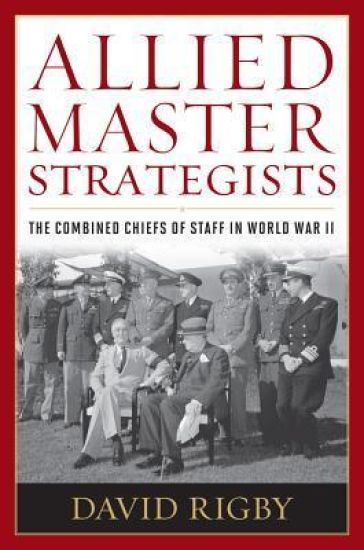
Allied Master Strategists describes the unique and vital contribution to Allied victory in World War II made by the Combined Chiefs of Staff. Based on a combination of primary and secondary source material, this book proves that the Combined Chiefs of Staff organisation was the glue holding the British-American wartime alliance together. As such, the Combined Chiefs of Staff was probably the most important international organisation of the Twentieth Century. Readers will get a good view of the personalities of the principals, such as Field Marshal Sir Alan Brooke and Fleet Admiral Ernest J. King. The book provides insight into the relationships between the Combined Chiefs of Staff and Allied theatre commanders, the role of the Combined Chiefs regarding economic mobilisation, and the bitter inter-Allied strategic debates in regard to OVERLORD and the war in the Pacific. This book is a must-read for anyone interested in the British American alliance in World War II.Careful attention is paid in the book to the three organisations that contributed the principal membership of the Combined Chiefs of Staff; i.e., the U.S. Joint Chiefs of Staff, the British Chiefs of Staff Committee, and (in the case of Sir John Dill) the British Joint Staff Mission in Washington. After providing a biographical background of the principal members of the Combined Chiefs of Staff, Rigby provides information on wartime Washington, D.C. as the home base for the Combined Chiefs of Staff organisation. Detailed information is given regarding the Casablanca Conference, but the author is careful to distinguish between the formal nature of the big Allied wartime summit meetings and the much less formal day-to-day give and take which characterised British-American strategic debates between the British Joint Staff Mission in Washington and the U.S. Joint Chiefs of Staff. Indeed, it is a major contention of the book that it is critical to remember that more than half of the meetings of the Combined Chiefs of Staff took place in Washington, D.C. in a regularly scheduled weekly pattern and not at the big Allied conferences such as Yalta.The role of the Combined Chiefs of Staff in directing the war in the Pacific and in planning the OVERLORD cross-channel invasion of western Europe, respectively, is covered in detail. These were the two most contentious issues with which the Combined Chiefs of Staff had to deal. Rigby attempts to answer the question of why two combative, fearless, warriors like Churchill and Brooke would be so unwilling to go back across the Channel, and to explain the tug-of-war the British Chiefs of Staff had to conduct with Churchill before a British battle fleet could join the American Central Pacific Drive late in the war.The book also provides a wealth of information on the role played by members of the Combined Chiefs of Staff in the spheres of economic mobilisation and wartime diplomacy. Most of all, what Allied Master Strategists does is to give the Combined Chiefs of Staff what they have long deserved—a book of their own; a book that is not weighted towards the U.S. Joint Chiefs on the one hand or the British Chiefs of Staff on the other; a book that is not strictly a “naval” book, an “army” book, or an “air” book, but a book that like the western alliance during World War II, is truly “combined” in an international as well as an inter-service manner.