Kirjojen hintavertailu. Mukana 11 717 486 kirjaa ja 12 kauppaa.

Kirjahaku

Etsi kirjoja tekijän nimen, kirjan nimen tai ISBN:n perusteella.

4 kirjaa tekijältä David Rosenthal

Consciousness and Mind

Consciousness and Mind

David Rosenthal

Clarendon Press
2005
nidottu
Consciousness and Mind presents David Rosenthal's influential work on the nature of consciousness. Central to that work is Rosenthal's higher-order-thought theory of consciousness, according to which a sensation, thought, or other mental state is conscious if one has a higher-order thought (HOT) that one is in that state. The first four essays develop various aspects of that theory. The next three essays present Rosenthal's homomorphism theory of mental qualities and qualitative consciousness, and show how that theory fits with and helps sustain the HOT theory. A crucial feature of homomorphism theory is that it individuates and taxonomizes mental qualities independently of the way we're conscious of them, and indeed independently of our being conscious of them at all. So the theory accommodates the qualitative character not only of conscious sensations and perceptions, but also of those which fall outside our stream of consciousness. Rosenthal argues that, because this account of mental qualities makes no appeal to consciousness, it enables us to dispel such traditional quandaries as the alleged conceivability of undetectable quality inversion, and to disarm various apparent obstacles to explaining qualitative consciousness and understanding its nature. Six further essays build on the HOT theory to explain various important features of consciousness, among them the complex connections that hold in humans between consciousness and speech, the self-interpretative aspect of consciousness, and the compelling sense we have that consciousness is unified. Two of the essays, one an extended treatment of homomorphism theory, appear here for the first time. There is also a substantive introduction, which draws out the connections between the essays and highlights their implications.
Consciousness and Mind

Consciousness and Mind

David Rosenthal

Clarendon Press
2005
sidottu
Consciousness and Mind presents David Rosenthal's influential work on the nature of consciousness. Central to that work is Rosenthal's higher-order-thought theory of consciousness, according to which a sensation, thought, or other mental state is conscious if one has a higher-order thought (HOT) that one is in that state. The first four essays develop various aspects of that theory. The next three essays present Rosenthal's homomorphism theory of mental qualities and qualitative consciousness, and show how that theory fits with and helps sustain the HOT theory. A crucial feature of homomorphism theory is that it individuates and taxonomizes mental qualities independently of the way we're conscious of them, and indeed independently of our being conscious of them at all. So the theory accommodates the qualitative character not only of conscious sensations and perceptions, but also of those which fall outside our stream of consciousness. Rosenthal argues that, because this account of mental qualities makes no appeal to consciousness, it enables us to dispel such traditional quandaries as the alleged conceivability of undetectable quality inversion, and to disarm various apparent obstacles to explaining qualitative consciousness and understanding its nature. Six further essays build on the HOT theory to explain various important features of consciousness, among them the complex connections that hold in humans between consciousness and speech, the self-interpretative aspect of consciousness, and the compelling sense we have that consciousness is unified. Two of the essays, one an extended treatment of homomorphism theory, appear here for the first time. There is also a substantive introduction, which draws out the connections between the essays and highlights their implications.
Why Open Orthodoxy Is Not Orthodox

Why Open Orthodoxy Is Not Orthodox

David Rosenthal

Yad Yosef Publications
2016
nidottu
Since 1997, Open Orthodoxy, through its institutions, Yeshivat Chovevei Torah and Yeshivat Maharat, has ordained over 100 students, most of whom serve in positions throughout America. It is often viewed as-and claims to be-a branch of Orthodoxy. However, the truth is far from this. Citing countless statements from the leaders and disciples of Open Orthodoxy, this book shows beyond a shadow of a doubt that this movement is not Orthodox and, in fact, seeks to undermine Orthodoxy. "...Open Orthodoxy is a movement which poses as Orthodoxy, with teachers who pose as halachic authorities and students who pose as Orthodox Rabbis." -From the Foreword by Harav Aharon Feldman
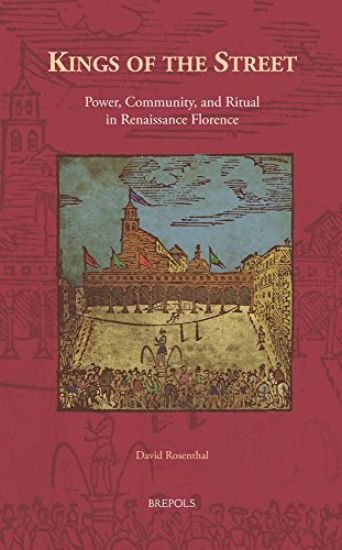
Kings of the Street

Kings of the Street

David Rosenthal

Brepols N.V.
2015
sidottu
For more than a century the artisans and labourers of Renaissance Florence turned the city into their own 'empire' during times of public festivity. From the republic of the late 1400s through to the grand duchy of the early seventeenth century, up to forty brigades of men called the potenze, or powers, elected kings, carved out territories, and entered into a dialogue with citizens and with their Medici patrons. This study traces the rise and fall of this carnivalesque subculture for the first time. It describes how workers represented themselves, their neighbourhoods, and their trades on the public stage through rituals such as stone-fighting and jousting, and reveals how the politics of this festive world were closely linked to everyday patterns of social bargaining around the person of the prince. In the early 1600s the micro-states of the potenze were partially suppressed and they gradually disappeared from the Florentine urban stage. The account of this transformation presented here shows how Tridentine reform and economic crisis combined to undermine hypermasculine carnival ritual as a language of civic contract, confining the potenze to making pilgrimages to shrines and convents in the Florentine countryside. At the same time it is shown how economic and religious change empowered groups of artisan women to take up the model of the potenze in order to make their own collective pilgrimages outside the city walls. Through the story of the potenze, this book provides fresh insights into the dynamics of class and gender relations, and the nature of agency, in early modern Italy.