Kirjojen hintavertailu. Mukana 11 342 296 kirjaa ja 12 kauppaa.

Kirjahaku

Etsi kirjoja tekijän nimen, kirjan nimen tai ISBN:n perusteella.

3 kirjaa tekijältä David Ross Fryer

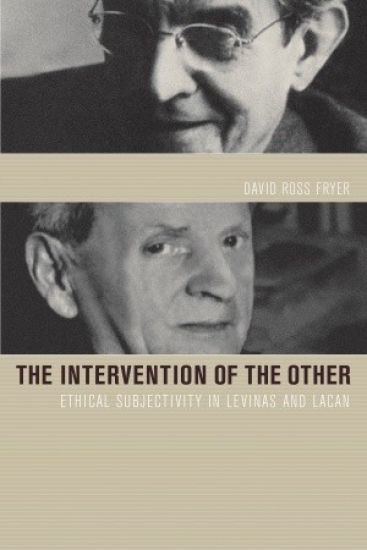
Intervention of the Other

Intervention of the Other

David Ross Fryer

Other Press Professional
2004
nidottu
The Intervention of the Other deftly brings the thought of Emmanuel Levinas and Jacques Lacan into fruitful dialogue through a comparative analysis of these two seemingly disparate thinkers. Emmanuel Levinas, Lithuanian-born French phenomenologist of the nonphenomenon, and Jacques Lacan, controversial French psychoanalyst and (post)structuralist theorist of the Freudian Unconscious, lived and wrote in the same city, at the same time, among the same colleagues, often using the same language and the same sources, sometimes writing to the same audiences and yet they never wrote to or about one another. Following Sartre, Levinas thought that Freud had fundamentally misunderstood the nature of consciousness when he posited the Unconscious as a second, but hidden, consciousness. Despite this suspicion of psychoanalysis, however, Levinas own work celebrated a certain something that could not be contained by thought. For his part, Lacan was suspicious of philosophical ethics. He subscribed to a Freudian critique of ethics as pathogenic. Nevertheless, he saw his own work as fundamentally about a kind of ethics, specifically an ethics concerned with how people live their lives in an already normative society. While the two never engaged with each other s thought directly, Levinas and Lacan were interested in many of the same questions: What is the nature of the self? What is it to be a subject? Can the ethical be grounded in a post-foundationalist world? Through close textual analysis, David Ross Fryer shows how Levinas and Lacan offer two ways of positing the ethical subject in the post-humanist landscape of contemporary thought.
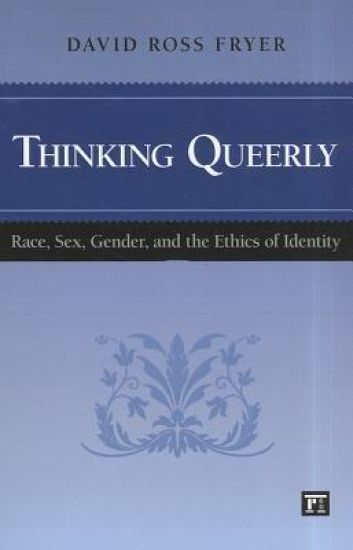
Thinking Queerly

Thinking Queerly

David Ross Fryer

Paradigm
2010
sidottu
Queer theory and the gay rights movement historically have been in tension, with the former critiquing precisely the identity politics on which the latter relies. Yet neither queer theory, in its predominately poststructuralist form, nor the gay rights movement, with its conservative "inclusionary" aspirations, has adequately addressed questions of identity or the political struggles against normativity that mark the lives of so many queer people. Taking on issues of race, sex, gender, and what he calls "the ethics of identity," Fryer offers a new take on queer theory-one rooted in phenomenology rather than poststructuralism-that seeks to put postnormative thinking at its center. This provocative book gives us a glimpse of what "thinking queer" can look like in our "posthumanist age."
Thinking Queerly

Thinking Queerly

David Ross Fryer

Paradigm
2011
nidottu
Queer theory and the gay rights movement historically have been in tension, with the former critiquing precisely the identity politics on which the latter relies. Yet neither queer theory, in its predominately poststructuralist form, nor the gay rights movement, with its conservative "inclusionary" aspirations, has adequately addressed questions of identity or the political struggles against normativity that mark the lives of so many queer people. Taking on issues of race, sex, gender, and what he calls "the ethics of identity," Fryer offers a new take on queer theory-one rooted in phenomenology rather than poststructuralism-that seeks to put postnormative thinking at its center. This provocative book gives us a glimpse of what "thinking queer" can look like in our "posthumanist age."