Kirjojen hintavertailu. Mukana 12 016 292 kirjaa ja 12 kauppaa.

Kirjahaku

Etsi kirjoja tekijän nimen, kirjan nimen tai ISBN:n perusteella.

15 kirjaa tekijältä David Rothenberg

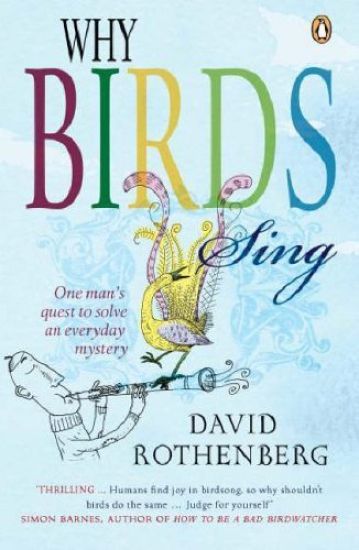
Why Birds Sing

Why Birds Sing

David Rothenberg

Penguin Books Ltd
2006
pokkari
The richness and variety of birdsong is both a scientific mystery and a source of wonder. David Rothenberg has a unique approach to this fascinating subject, combining the latest scientific research with a deep understanding of musical beauty and form. Can the standard explanations of territoriality or sexual selection account for so many species' astonishing inventiveness and devotion to singing? Whether playing the clarinet with the white-crested laughing thrush in Pittsburgh or jamming in the Australian winter breeding grounds of the Albert's lyrebird, Rothenberg touches the heart and soul of birdsong, offering an intimate look at the most lovely of natural phenomena.
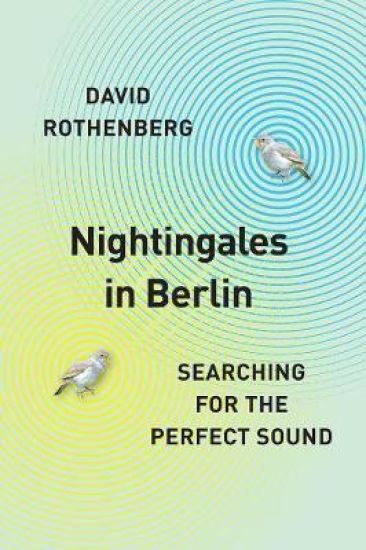
Nightingales in Berlin

Nightingales in Berlin

David Rothenberg

University of Chicago Press
2019
sidottu
A celebrated figure in myth, song, and story, the nightingale has captivated the imagination for millennia, its complex song evoking a prism of human emotions,—from melancholy to joy, from the fear of death to the immortality of art. But have you ever listened closely to a nightingale’s song? It’s a strange and unsettling sort of composition—an eclectic assortment of chirps, whirrs, trills, clicks, whistles, twitters, and gurgles. At times it is mellifluous, at others downright guttural. It is a rhythmic assault, always eluding capture. What happens if you decide to join in? As philosopher and musician David Rothenberg shows in this searching and personal new book, the nightingale’s song is so peculiar in part because it reflects our own cacophony back at us. As vocal learners, nightingales acquire their music through the world around them, singing amidst the sounds of humanity in all its contradictions of noise and beauty, hard machinery and soft melody. Rather than try to capture a sound not made for us to understand, Rothenberg seeks these musical creatures out, clarinet in tow, and makes a new sound with them. He takes us to the urban landscape of Berlin—longtime home to nightingale colonies where the birds sing ever louder in order to be heard—and invites us to listen in on their remarkable collaboration as birds and instruments riff off of each other’s sounds. Through dialogue, travel records, sonograms, tours of Berlin’s city parks, and musings on the place animal music occupies in our collective imagination, Rothenberg takes us on a quest for a new sonic alchemy, a music impossible for any one species to make alone. In the tradition of The Hidden Life of Trees and The Invention of Nature, Rothenberg has written a provocative and accessible book to attune us ever closer to the natural environment around us.
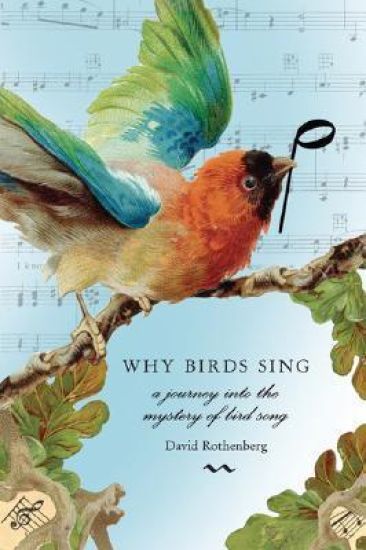
Why Birds Sing

Why Birds Sing

David Rothenberg

Basic Books
2006
pokkari
The astonishing richness of birdsong is both an aesthetic and a scientific mystery. Evolutionists have never been able to completely explain why birdsong is so inventive and why many species devote so many hours to singing. The standard explanations of defending territories and attracting mates don't begin to account for the variety and energy that the commonest birds exhibit. Is it possible that birds sing because they like to? This seemingly naive explanation is starting to look more and more like the truth. Why Birds Sing is a lyric exploration of birdsong that blends the latest scientific research with a deep understanding of musical beauty and form. Drawing on conversations with neuroscientists, ecologists, and composers, it is the first book to investigate the elusive question of why birds sing and what their song means to both avian and human ears. Whether playing his clarinet with the whitecrested laughing thrush in Pittsburgh, or jamming in the Australian winter breeding grounds of the Albert's lyrebird, Rothenberg immerses himself in the heart and soul of birdsong. He approaches the subject as a naturalist, philosopher, musician, and investigator. An intimate look at the mostlovely of natural phenomena, Why Birds Sing is a beautifully written exploration of a phenomenon that's at once familiar and profoundly alien.
Hand's End

Hand's End

David Rothenberg

University of California Press
1995
pokkari
"Hand's End" offers a new philosophy of technology as the fundamental way in which humans experience and define nature - the tool as humanity extended. Rothenberg examines human inventions from the water wheel to the nuclear bomb and discusses theories of technology in the thought of philosophers including Plato, Aristotle, Bacon, Marx, Heidegger, Spinoza, Mumford, and McLuhan.
Is It Painful To Think

Is It Painful To Think

David Rothenberg

University of Minnesota Press
1992
nidottu
Although he is known primarily as the inventor of the phrase "deep ecology," Norwegian philosopher Arne Naess's thoughts and approaches have waded through all the major streams and events of our times. From a childhood during World War I through the study of psychoanalysis in Freud's Vienna, through the midcentury hardening of ideologies to the most recent decades with the emergence of ecology as a political force, his life in the throes of nature has always fuelled a will to espouse precise and clear thinking in the face of the great contemporary dilemmas. Through a series of conversations covering the whole span of Naess's rich and complex life, David Rothenberg presents the grand old man of natural philosophy in his own words. What emerges is the personal vision of a life imbued with ecology, which reveals in the most human terms how respect for and contact with the natural world can provide the foundation for a total view of the vast problems of humanity and our place in the world. "Is it Painful to Think?" reveals insights and inspiration, hypotheses and conclusions, but above all paradox, as the difference between ideas and events comes to the surface. These are issues that all philosophers of nature must come to terms with, and this unconventional book seeks not to provide answers as much as stir discussion and reflection. This, says Naess, is where philosophy differs from religion, where conversation veers from pronouncement.
Wild Ideas

Wild Ideas

David Rothenberg

University of Minnesota Press
1995
nidottu
A new view of what’s “wild,” and a new path for environmentalism.At the very heart of American respect for nature, historically and philosophically, is the notion of the wild. This notion comes under scrutiny in Wild Ideas, a collection of essays that bring a fresh and refreshing perspective to the wilderness paradoxically at the center of our civilization. Blending well-known and new voices, the volume surveys classical and romantic concepts of wilderness, from the scary to the sublime, and shows why neither serves us anymore. Instead, the authors argue for a “wild culture,” in which nature is not opposed to humanity, a mere matter of resources and consumers. A cogent reassessment of the ideas that drive the conservation movement, Wild Ideas points out a new direction for future environmentalism.Among the topics discussed are the confluence of wilderness, empire, and race in the United States; the way the ecology movement uses language; gendered views of the wilderness; maps and topology, and how they affect our view of the wild; healing by the wilderness experience; and the idea of an urban wilderness. Contributors: David Abram; Douglas Buege, U of Wisconsin; Denis Cosgrove, U of London; Robert Greenway, Sonoma State U; Ed Grumbine, Sierra Institute; Marvin Henberg, Linfield College; Irene Klaver, Montana State U; Andrew Light, U of Alberta; Lois Lorentzen, U of San Francisco; Max Oelschlaeger, U of North Texas; R. Murray Schafer; Tom Wolf.
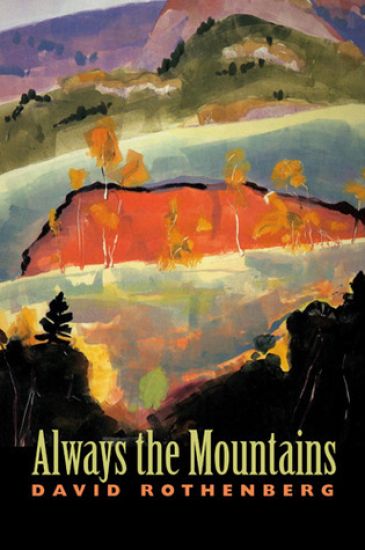
Always the Mountains

Always the Mountains

David Rothenberg

University of Georgia Press
2007
pokkari
David Rothenberg is one of our most eloquent observers of the interplay between nature, culture, and technology. These nineteen pieces exemplify what has been called Rothenberg's "amiable" mix of interests, styles, and approaches.In settings that range from wildest Norway to his own front porch in upstate New York, Rothenberg discusses the Hudson River School of painters, the hazy provenance of Chief Seattle's famous speech, ecoterrorism, suburbia, the World Wide Web, and much more. He asks if we can save a place less obtrusively than by turning it into a park. He muses on the plight of a pacifist beset by a swarm of mosquitoes. He ascends Mt. Ventoux with Petrarch and Mt. Katahdin with Thoreau.In Always the Mountains, Rothenberg dares us to "enjoy the fundamental uncertainty that grounds human existence," to wean ourselves from the habit of simple answers and embrace the world's vastness.
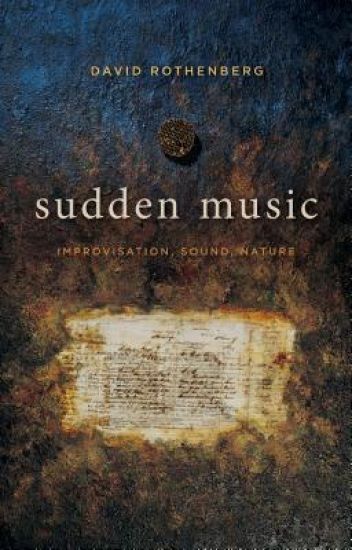
Sudden Music

Sudden Music

David Rothenberg

University of Georgia Press
2016
pokkari
Music, said Zen patriarch Hui Neng, "is a means of rapid transformation." It takes us home to a natural world that functions outside of logic, where harmony and dissonance, tension and release work in surprising ways. Weaving memoir, travelogue, and philosophical reflection, Sudden Music presents a musical way of knowing that can closely engage us with the world and open us to its spontaneity.Improvisation is everywhere, says David Rothenberg, and his book is a testament to its creative, surprising power. Linking in original ways the improvised in nature, composition, and instrumentation, Rothenberg touches on a wide range of music traditions, from Rob Nachman's stories to John Cage's aleatory. Writing not as a critic but as a practicing musician, Rothenberg draws on his own extensive travels to Scandinavia, India, and Nepal to describe from close observation the improvisational traditions that inform and inspire his own art.The accompanying audio disc features eleven original compositions by Rothenberg, none of which have been previously released on CD. Included are a duet with clarinet and white-crested laughing bird, and another duet with clarinet and Samchillian TipTipTip Cheeepeeeee, an electronic computer instrument played by its inventor Leon Gruebaum. Also featured are multicultural works blending South Indian veena and Turkish g-clarinet with spoken text from the Upanishads; a piece commissioned by the Tanglewood Contemporary Music Festival with readings of texts by E. O. Wilson accompanied by clarinet and electronics; and improvisations based upon Tibetan Buddhist music, Japanese shakuhachi music, and the image of a black crow on white snow.Sudden Music is a concise and delicate work of beauty. It will help all readers experience the world as a musical place, full of wonderful events that come out of nowhere to create a strange and rhythmic harmony.
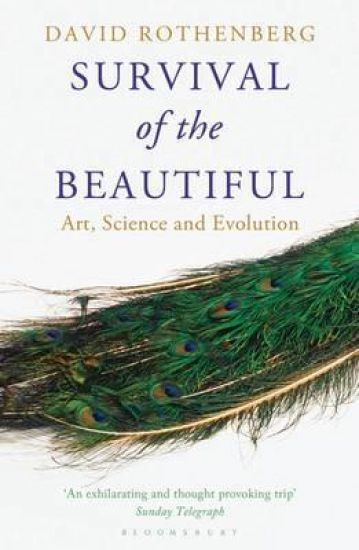
Survival of the Beautiful

Survival of the Beautiful

David Rothenberg

Bloomsbury Publishing PLC
2013
nidottu
A brilliant investigation of why nature is beautiful and how art has influenced science'Rothenberg's passionate optimism - a belief in the beauty of nature, and vice versa - together with his elegant prose turns Survival of the Beautiful into an exhilarating and thought provoking trip' Sunday Telegraph'The peacock's tail makes me sick,' Charles Darwin once said - not aesthetically, but because the theory of evolution as adaptation can't explain why nature is so beautiful. It took the concept of sexual selection for Darwin to explain the emergence of beauty, a process that has more to do with aesthetic taste than adaptive fitness.Survival of the Beautiful is a revolutionary new examination of the interplay of beauty, art, and culture in evolution. Taking inspiration from Darwin's observation that animals have a natural aesthetic sense, philosopher and musician David Rothenberg probes why animals, humans included, have an innate appreciation for beauty - and why nature is, indeed, beautiful.
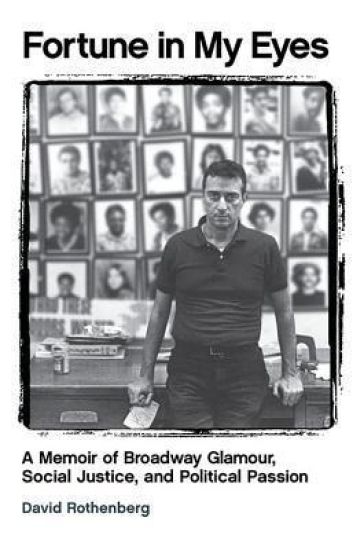
Fortune in My Eyes

Fortune in My Eyes

David Rothenberg

Applause Theatre Book Publishers
2015
pokkari
David Rothenberg's multilayered life thrust him into Broadway's brightest lights prison riots political campaigns civil rights sit-ins and a Central American civil war. In his memoir ÊFortune in My EyesÊ his journey includes many of the most celebrated names in the theater: Richard Burton Elizabeth Taylor Bette Davis Sir John Gielgud Peggy Lee Alvin Ailey Lauren Bacall Christine Ebersole and numerous others.ÞHe produced an Off-Broadway prison drama ÊFortune and Men's EyesÊ which reshaped his life. John Herbert's chilling play led directly to the creation of the Fortune Society which has evolved into one of the nation's most formidable advocacy and service organizations in criminal justice.ÞRothenberg was Elizabeth Taylor's opening night date at the Richard Burton Hamlet ä a distant cry from his entering Attica prison during that institution's famed inmate uprising; these are just two of the experiences revealed in this memoir. As a theater publicist and producer ä and as a social activist ä he shares experiences with politicians and with anonymous men and women out of prison who have fought to reclaim their lives. The human drama of the formerly incarcerated that unfolds in this book is a match for many of the entertainment world's most fabled characters.
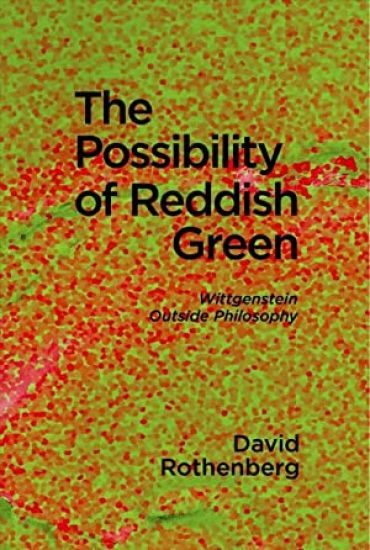
The Possibility of Reddish Green

The Possibility of Reddish Green

David Rothenberg

Terra Nova Press
2020
pokkari
How Wittgenstein's theories have been bent, transformed, and expanded in the world outside philosophy.The expression of his eyes remained the same, a cold, piercing sadness. Yet his final words were "Tell them I had a happy life." This poetic book examines the way Ludwig Wittgenstein has influenced artists of the word beyond his own field, thereby touching the subject of how philosophy can be relevant at large. By studying the ways Wittgenstein's theories have been bent, transformed, and expanded, David Rothenberg shows that responses to the reading of philosophy can take many deep, reflective, and different forms. Aphoristically constructed in the style of E. M. Cioran or Edmond Jabès, carefully illustrated with paintings and drawings by Doug Hall, Leif Haglund, and Debra Pughe, The Possibility of Reddish Green situates Wittgenstein in the age of the sound bite and the artistic fragment, promoting the aesthetic of detachment and yet seeking to find a route through the sea of disconnected, jumbled ideas and changes that mark our time.
Arne Næss; gjør det vondt å tenke?

Arne Næss; gjør det vondt å tenke?

David Rothenberg

Cappelen Damm
2009
pokkari
I samtale med forfatteren forteller Arne Næss levende om barndom og studietid, om venner og ekteskap, klatring og filosofi, øko-engasjement og verdens ansvar. Boken gir et bilde av Arne Næss' rastløse søken etter sannheten i en turbulent tid -- storparten av det 20. århundre. Her finner du ikke oppsummeringer av tankene hans, men begivenhetene som formet dem. Det som først og fremst kommer frem, er en holdning, en måte å nærme seg livet på som begynner med undring -- over de enorme mulighetene som verden tilbyr oss -- og som fører til glede når hver enkelt velger sin individuelle måte å ta del i dette underet på, finner sitt eget sted og sørger for at dette stedet vil bli meningsfylt for andre og for verden som helhet.
Arne Næss

Arne Næss

David Rothenberg

Cappelen Damm
nidottu
I samtale med forfatteren forteller Arne Næss levende om barndom og studietid, om venner og ekteskap, klatring og filosofi, øko-engasjement og verdens ansvar. Boken gir et bilde av filosofens rastløse søken etter sannheten gjennom storparten av det 20. århundre, og en innsikt i begivenhetene som formet hans tanker. Vi møter en måte å nærme seg livet på som begynner med undring over de enorme mulighetene som verden gir, og som fører til glede når hver enkelt velger sin individuelle måte å ta del i underet på, finner sitt eget sted og sørger for at stedet blir meningsfylt for andre og for verden som helhet. Illustrert og med et nytt etterord av forfatteren.