Kirjojen hintavertailu. Mukana 12 016 292 kirjaa ja 12 kauppaa.

Kirjahaku

Etsi kirjoja tekijän nimen, kirjan nimen tai ISBN:n perusteella.

7 kirjaa tekijältä David Savran

Tell it to the World

Tell it to the World

David Savran

OXFORD UNIVERSITY PRESS INC
2024
sidottu
What happens when Broadway goes abroad? Tell It to the World: The Broadway Musical Abroad offers a look at how the Broadway musical travels the world, influencing and even transforming local practices and traditions. It traces especially how the musical has been indigenized in South Korea and Germany, the commercial centers for Broadway musicals in East Asia and continental Europe. Both countries were occupied after World War II by the United States, which disseminated U.S. American popular music, jazz, movies, and musical theatre in the belief that these nations needed to rebuild their cultures in accordance with U.S. guidelines. By the 1990s, Broadway imports had become phenomenally popular in Seoul and Hamburg while home-grown musicals proliferated that adapted and transformed the prototypes that had been disseminated by the U.S. Although this book focuses on recent musicals, it also looks back through the twentieth century to plot the evolution of musical theatre in South Korea and Germany. Part One considers the key questions: What is a musical? Why is it the great success story of U.S. theatre? How has it been assimilated to musical theatre traditions around the world? Part Two focuses on musical theatre in South Korea, studying the import/export business in large-scale musicals about Korean history and innovative hybrid experiments that mix local performance traditions with the Broadway vernacular. Part Three moves to Europe to analyze the conflicted attitudes toward musicals in the German-speaking world. Its three chapters survey the history of musicals in Germany from 1945 until the fall of the Berlin Wall, the reconfiguration of musical theatre conventions by experimental directors, and finally the ground-breaking German-language productions of Broadway classics by Barrie Kosky and other innovative directors. In the twenty-first century, Broadway-style musical theatre has succeeded in becoming a lingua franca, the template for musical theatre around the world. This book shows how some of the most innovative, beautiful, and exciting musical theatre is being made outside the United States.
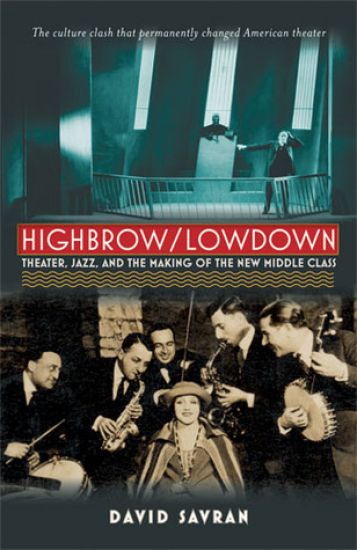
Highbrow/Lowdown

Highbrow/Lowdown

David Savran

The University of Michigan Press
2010
nidottu
"An elegant, erudite, and thorough study . . . The venture into music history and the impact, both positive and negative, of jazz on culture, and especially the emergence of a literary art theater, is the book's most obvious unique contribution . . . the analysis of the place of various critics and the audience in a period of major cultural change involving class, race, and ethnicity is especially welcome."---Choice"Highbrow/Lowdown stakes out the secret history of how that yawning abyss between mass culture and serious theatre came about---a dynamic that still plays out to this day both in the commercial and resident theatres. This intellectual study, a revelatory blending of music criticism and drama history, delves into the critical and artistic antagonisms between jazz and classical music, the serious and lively arts, as well as the old and new middle-class tastes."---American Theatre"A book about the fracturing of the theater audience in the 1920s using jazz as a lens. [Savran] points to jazzy composers such as Gershwin, who never got his due while he was writing because of his embrace of jazz . . . What is intriguing about Savran's book is how these class distinctions still hold true today."---All About JazzHighbrow/Lowdown explores the twentieth century's first culture war and the forces that permanently transformed American theater into the art form we know today. The arrival of jazz in the 1920s sparked a cultural revolution that was impossible to contain. The music affected every stratum of U.S. society and culture, confusing and challenging long-entrenched hierarchies based on class, race, and ethnicity. But jazz was much more than the music---it was also a powerful cultural force that brought African American, Jewish, and working-class culture into the white Protestant mainstream. When the influence of jazz spread to legitimate theater, playwrights, producers, and critics rushed to distinguish the newly emerging literary theater from its illegitimate cousins. The efforts to defeat the democratizing influences of jazz and to canonize playwrights like Eugene O'Neill triumphed, giving birth to American theater as we know it today.David Savran is Distinguished Professor of Theatre and Vera Mowry Roberts Chair in American Theatre at the Graduate Center, City University of New York.
A Queer Sort of Materialism

A Queer Sort of Materialism

David Savran

The University of Michigan Press
2003
nidottu
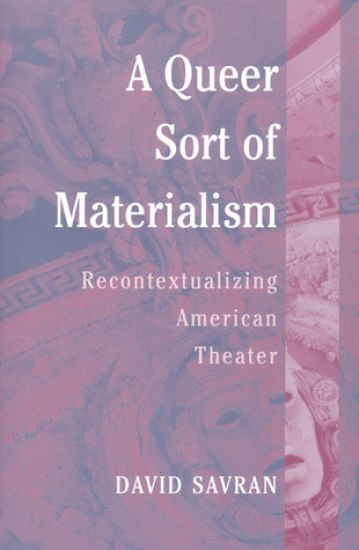
In engaging, accessible prose, leading theater critic and cultural commentator David Savran explores the intersections between art and culture, offering smart, compelling interpretations of the economic and social contexts of theatrical texts and practices. Acknowledging theater's marginal status in U.S. culture, A Queer Sort of Materialism takes on "the trouble-makers--the ghost, closeted homosexual, masochist, drag king, Third World laborer, even the white male as victim"--who figure more prominently in theater than in other cultural forms. In impeccably researched and argued essays that range in subject matter from Rodgers and Hammerstein to Paula Vogel, from Suddenly Last Summer to Iron John, Savran uncovers the ways that such troublemakers both challenge and reinforce orthodox social practices. The selections presented here are by turns entertaining, informative, sophisticated, and polemical, reflecting the author's dual citizenship as rigorous scholar and engaging theater critic. This book also provides a model for a kind of queer historical materialism that will prove useful to a wide range of disciplines, including theater and performance, gender and sexuality, queer/gay/lesbian/transgender studies, American studies, and popular culture. David Savran is Professor of Theater, the Graduate Center, the City University of New York, and author of Cowboys, Communists, and Queers and Taking It Like a Man.
A Queer Sort of Materialism

A Queer Sort of Materialism

David Savran

The University of Michigan Press
2003
sidottu
In engaging, accessible prose, leading theater critic and cultural commentator David Savran explores the intersections between art and culture, offering smart, compelling interpretations of the economic and social contexts of theatrical texts and practices. Acknowledging theater's marginal status in U.S. culture, A Queer Sort of Materialism takes on "the trouble-makers--the ghost, closeted homosexual, masochist, drag king, Third World laborer, even the white male as victim"--who figure more prominently in theater than in other cultural forms. In impeccably researched and argued essays that range in subject matter from Rodgers and Hammerstein to Paula Vogel, from Suddenly Last Summer to Iron John, Savran uncovers the ways that such troublemakers both challenge and reinforce orthodox social practices. The selections presented here are by turns entertaining, informative, sophisticated, and polemical, reflecting the author's dual citizenship as rigorous scholar and engaging theater critic. This book also provides a model for a kind of queer historical materialism that will prove useful to a wide range of disciplines, including theater and performance, gender and sexuality, queer/gay/lesbian/transgender studies, American studies, and popular culture. David Savran is Professor of Theater, the Graduate Center, the City University of New York, and author of Cowboys, Communists, and Queers and Taking It Like a Man.