Kirjojen hintavertailu. Mukana 11 699 587 kirjaa ja 12 kauppaa.

Kirjahaku

Etsi kirjoja tekijän nimen, kirjan nimen tai ISBN:n perusteella.

4 kirjaa tekijältä David Shatz

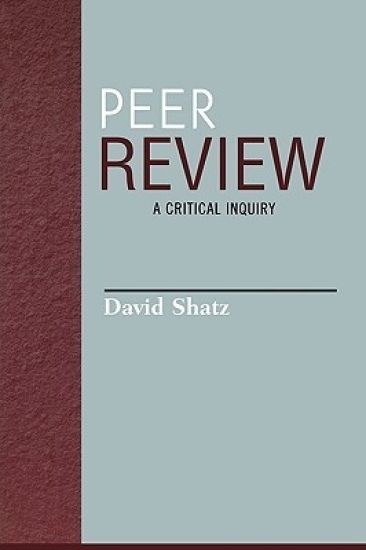
Peer Review

Peer Review

David Shatz

Rowman Littlefield Publishers
2004
nidottu
Peer review is the process by which submissions to journals and presses are evaluated with regard to suitability for publication. Armed with the results of numerous empirical studies, critics have leveled a variety of harsh charges against peer review such as: reviewers and editors are biased toward authors from prestigious institutions, peer review is biased toward established ideas, and it does a poor job of detecting errors and fraud. While an immense literature has sprouted on peer review in the sciences and social sciences, Peer Review is the first book-length, wide-ranging study of peer review that utilizes methods and resources of contemporary philosophy. Its six chapters cover the following topics: the tension between peer review and the liberal notion that truth emerges when ideas proliferate in the marketplace of ideas; arguments for and against blind review of submissions; the alleged conservatism of peer review; the anomalous nature of book reviewing; the status of non-peer-reviewed publications, such as invited articles or Internet publications, in tenure and promotion cases; and the future of peer review in the age of the Internet. The author has also included several key readings about peer review.

Judaism and the Philosophy of Religion

Judaism and the Philosophy of Religion

David Shatz

Cambridge University Press
2025
sidottu
Analytic philosophy of religion is a vibrant area of inquiry, but it has generally focused on generic forms of theism or on Christianity. David Shatz here offers a new and fresh approach to the field in a wide-ranging and engaging introduction to the analytic philosophy of religion from the perspective of Judaism. Exploring classical Jewish texts about philosophical topics in light of the concepts and arguments at the heart of analytic philosophy, he demonstrates how each tradition illuminates the other, yielding a deeper understanding of both Jewish sources and general philosophical issues. Shatz also advances growing efforts to imagine Jewish philosophy not only as an engrossing, invaluable part of Jewish intellectual history, but also as a creative, constructive enterprise that mines the methods and literature of contemporary philosophy. His book offers new pathways to think deeply about God, evil, morality, freedom, ethics, and religious diversity, among other topics.
Judaism and the Philosophy of Religion

Judaism and the Philosophy of Religion

David Shatz

Cambridge University Press
2025
nidottu
Analytic philosophy of religion is a vibrant area of inquiry, but it has generally focused on generic forms of theism or on Christianity. David Shatz here offers a new and fresh approach to the field in a wide-ranging and engaging introduction to the analytic philosophy of religion from the perspective of Judaism. Exploring classical Jewish texts about philosophical topics in light of the concepts and arguments at the heart of analytic philosophy, he demonstrates how each tradition illuminates the other, yielding a deeper understanding of both Jewish sources and general philosophical issues. Shatz also advances growing efforts to imagine Jewish philosophy not only as an engrossing, invaluable part of Jewish intellectual history, but also as a creative, constructive enterprise that mines the methods and literature of contemporary philosophy. His book offers new pathways to think deeply about God, evil, morality, freedom, ethics, and religious diversity, among other topics.
Jewish Thought in Dialogue

Jewish Thought in Dialogue

David Shatz

Academic Studies Press
2010
sidottu
In this carefully crafted collection of essays, "Jewish Thought in Dialogue" offers creative interpretations of major Jewish texts and as well as original treatments of significant issues in Jewish theology and ethics. The collection includes philosophical readings of biblical narratives, analyses of topics in the thought of Maimonides, Rabbi Abraham Isaac Kook and Rabbi Joseph B Soloveitchik, and critical and constructive examinations of divine providence, religious anthropology, free will, 9/11, evil, Halakhah and morality, altruism, autonomy in Jewish medical ethics, and the epistemology of religious belief. The author frequently brings Jewish philosophy and law into dialogue with contemporary Anglo-American philosophy.