Kirjojen hintavertailu. Mukana 11 244 527 kirjaa ja 12 kauppaa.

Kirjahaku

Etsi kirjoja tekijän nimen, kirjan nimen tai ISBN:n perusteella.

13 kirjaa tekijältä David Shulman

Freedom and Despair

Freedom and Despair

David Shulman

University of Chicago Press
2018
sidottu
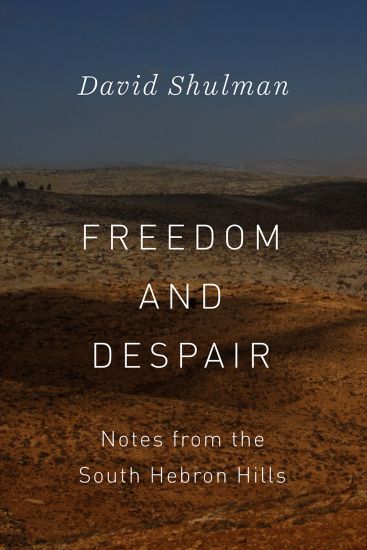
Lately, it seems as if we wake up to a new atrocity each day. Every morning is now a ritual of scrolling through our Twitter feeds or scanning our newspapers for the latest updates on fresh horrors around the globe. Despite the countless protests we attend, the phone calls we make, or the streets we march, it sometimes feels like no matter how hard we fight, the relentless crush of injustice will never abate. David Shulman knows intimately what it takes to live your beliefs, to return, day after day, to the struggle, despite knowing you are often more likely to lose than win. Interweaving powerful stories and deep meditations, Freedom and Despair offers vivid firsthand reports from the occupied West Bank in Palestine as seen through the eyes of an experienced Israeli peace activist who has seen the Israeli occupation close up as it impacts on the lives of all Palestinian civilians. Alongside a handful of beautifully written and often shocking tales from the field, Shulman meditates deeply on how to understand the evils around him, what it means to persevere as an activist decade after decade, and what it truly means to be free. The violent realities of the occupation are on full display. We get to know and understand the Palestinian shepherds and farmers and Israeli volunteers who face this situation head-on with nonviolent resistance. Shulman does not hold back on acknowledging the daily struggles that often leave him and his fellow activists full of despair. Inspired by these committed individuals who are not prepared to be silent or passive, Shulman suggests a model for ordinary people everywhere. Anyone prepared to take a risk and fight their oppressive political systems, he argues, can make a difference-if they strive to act with compassion and to keep hope alive. This is the moving story of a man who continues to fight for good in the midst of despair. An indispensable book in our era of reactionary politics and refugee crises, political violence and ecological devastation, Freedom and Despair is a gripping memoir of struggle, activism, and hope for peace.
Freedom and Despair

Freedom and Despair

David Shulman

University of Chicago Press
2018
pokkari
Lately, it seems as if we wake up to a new atrocity each day. Every morning is now a ritual of scrolling through our Twitter feeds or scanning our newspapers for the latest updates on fresh horrors around the globe. Despite the countless protests we attend, the phone calls we make, or the streets we march, it sometimes feels like no matter how hard we fight, the relentless crush of injustice will never abate. David Shulman knows intimately what it takes to live your beliefs, to return, day after day, to the struggle, despite knowing you are often more likely to lose than win. Interweaving powerful stories and deep meditations, Freedom and Despair offers vivid firsthand reports from the occupied West Bank in Palestine as seen through the eyes of an experienced Israeli peace activist who has seen the Israeli occupation close up as it impacts on the lives of all Palestinian civilians. Alongside a handful of beautifully written and often shocking tales from the field, Shulman meditates deeply on how to understand the evils around him, what it means to persevere as an activist decade after decade, and what it truly means to be free. The violent realities of the occupation are on full display. We get to know and understand the Palestinian shepherds and farmers and Israeli volunteers who face this situation head-on with nonviolent resistance. Shulman does not hold back on acknowledging the daily struggles that often leave him and his fellow activists full of despair. Inspired by these committed individuals who are not prepared to be silent or passive, Shulman suggests a model for ordinary people everywhere. Anyone prepared to take a risk and fight their oppressive political systems, he argues, can make a difference-if they strive to act with compassion and to keep hope alive. This is the moving story of a man who continues to fight for good in the midst of despair. An indispensable book in our era of reactionary politics and refugee crises, political violence and ecological devastation, Freedom and Despair is a gripping memoir of struggle, activism, and hope for peace.
The Hungry God

The Hungry God

David Shulman

University of Chicago Press
1993
sidottu
The folklore and classical literature of India abound with stories of parents who sacrifice their children. In this book the author examines one set of such tales - Hindu texts that bear similarities to the biblical aqedah, the account of Abraham's near-sacrifice of Isaac. In all the stories that Shulman explores, the sacrifice proceeds from a divine command and has no utilitarian explanation or rationale. Both the biblical and Indian aqedah texts are central to their cultures: later texts resume the narrative, rework its premises, and develop its paradigmatic character so that it comes to function as a "root metaphor" for its civilization. Shulman traces this history by unravelling the cumulative meanings of the Hindu, aqedah, particularly the Tamil tale of the Little Devotee and the stories of Sunahsepa and Suka. Throughout, Shulman is sensitive to the poignant tones and overtones of each text. His final chapter contrasts the Hindu tales of child sacrifice and their counterparts in Hebrew and Greek.
Dark Hope

Dark Hope

David Shulman

University of Chicago Press
2007
sidottu
For decades, we've been shocked by images of violent clashes between Israelis and Palestinians in the West Bank and Gaza. But for all their power, those images leave us at a loss: from our vantage at home, it's hard for us to imagine the struggles of those living in the midst of the fighting. Now, American-born Israeli David Shulman takes us right into the heart of the conflict with "Dark Hope", an eye-opening chronicle of his work as a member of the peace group Ta'ayush, which takes its name from the Arabic for "living together." Though Shulman never denies the complexity of the issues fueling the conflict - nor the culpability of people on both sides - he forcefully clarifies the injustices perpetrated by Israel by showing us the human dimension of the occupation. Here we meet Palestinians whose houses have been blown up by the Israeli army, shepherds whose sheep have been poisoned by settlers, farmers stripped of their land by Israel's dividing wall. We watch as whip-swinging police on horseback attack crowds of nonviolent demonstrators, as Israeli settlers shoot innocent Palestinians harvesting olives, and as families and communities become utterly destroyed by the unrelenting violence of the occupation. Opposing such injustices, Shulman and his companions - Israeli and Palestinian both - doggedly work through checkpoints to bring aid, rebuild houses, and physically block the progress of the dividing wall. As they face off against police, soldiers, and hostile Israeli settlers, anger mixes with compassion, moment of kinship alternate with confrontation, and, throughout, Shulman wrestles with his duty to fight the cruelty enabled by "that dependable and devastating human failure to feel." With "Dark Hope", Shulman has written a book of deep moral searching, an attempt to discover how his beloved Israel went wrong - and how, through acts of compassionate disobedience, it might still be brought back.
Spring, Heat, Rains

Spring, Heat, Rains

David Shulman

University of Chicago Press
2008
sidottu
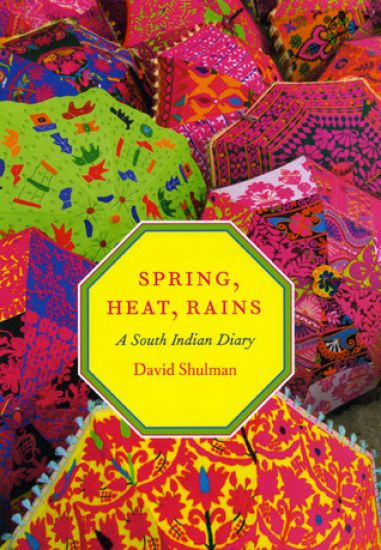
Rocks. Goats. Dry shrubs. Buffaloes. Thorns. A fallen tamarind tree. Such were the sights that greeted David Shulman on his arrival in Andhra Pradesh in the spring of 2006. An expert on South Indian languages and cultures, Shulman knew the region well, but from the moment he arrived for this seven-month sojourn he actively soaked up such simple aspects of his surroundings, determined to attend to the rich texture of daily life - choosing to be at the same time scholar and tourist, wanderer and wonderer.Lyrical, sensual, and introspective, "Spring, Heat, Rains" is Shulman's diary of that experience. Evocative reflections on daily events - from explorations of crumbling temples to battles with ineradicable bugs to joyous dinners with friends - are organically interwoven with considerations of the ancient poetry and myths that remain such an inextricable part of life in contemporary India. With Shulman as our guide, we meet singers and poets, washermen and betel-nut vendors, modern literati and ancient gods and goddesses.We marvel at the 'golden electrocution' that is the taste of a mango fresh from the tree. And we plunge into the searing heat of an Indian summer, so oppressive and inescapable that when the monsoon arrives to banish the heat with sheets of rain, we understand why, year after year, it is celebrated as a miracle. An unabashedly personal account from a scholar whose deep knowledge has never obscured his joy in discovery, "Spring, Heat, Rains" is a passionate act of sharing, an unforgettable gift for anyone who has ever dreamed of India.
More than Real

More than Real

David Shulman

Harvard University Press
2012
sidottu
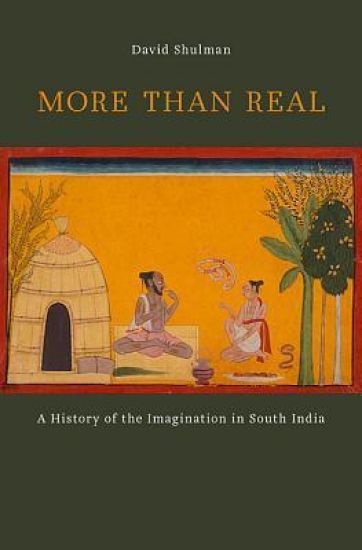
From the fifteenth to the eighteenth centuries, the major cultures of southern India underwent a revolution in sensibility reminiscent of what had occurred in Renaissance Italy. During this time, the imagination came to be recognized as the defining feature of human beings. More than Real draws our attention to a period in Indian history that signified major civilizational change and the emergence of a new, proto-modern vision.In general, India conceived of the imagination as a causative agent: things we perceive are real because we imagine them. David Shulman illuminates this distinctiveness and shows how it differed radically from Western notions of reality and models of the mind. Shulman's explication offers insightful points of comparison with ancient Greek, medieval Islamic, and early modern European theories of mind, and returns Indology to its rightful position of intellectual relevance in the humanities.At a time when contemporary ideologies and language wars threaten to segregate the study of pre-modern India into linguistic silos, Shulman demonstrates through his virtuoso readings of important literary works—works translated lyrically by the author from Sanskrit, Tamil, Telugu, and Malayalam—that Sanskrit and the classical languages of southern India have been intimately interwoven for centuries.
Tamil

Tamil

David Shulman

The Belknap Press
2016
sidottu
Spoken by eighty million people in South Asia and a diaspora that stretches across the globe, Tamil is one of the great world languages, and one of the few ancient languages that survives as a mother tongue for so many speakers. David Shulman presents a comprehensive cultural history of Tamil—language, literature, and civilization—emphasizing how Tamil speakers and poets have understood the unique features of their language over its long history. Impetuous, musical, whimsical, in constant flux, Tamil is a living entity, and this is its biography.Two stories animate Shulman’s narrative. The first concerns the evolution of Tamil’s distinctive modes of speaking, thinking, and singing. The second describes Tamil’s major expressive themes, the stunning poems of love and war known as Sangam poetry, and Tamil’s influence as a shaping force within Hinduism. Shulman tracks Tamil from its earliest traces at the end of the first millennium BCE through the classical period, 850 to 1200 CE, when Tamil-speaking rulers held sway over southern India, and into late-medieval and modern times, including the deeply contentious politics that overshadow Tamil today.Tamil is more than a language, Shulman says. It is a body of knowledge, much of it intrinsic to an ancient culture and sensibility. “Tamil” can mean both “knowing how to love”—in the manner of classical love poetry—and “being a civilized person.” It is thus a kind of grammar, not merely of the language in its spoken and written forms but of the creative potential of its speakers.
From Hire to Liar

From Hire to Liar

David Shulman

Cornell University Press
2006
sidottu
"There are always clients to please, rules to subvert, difficult tasks to perform, work to shirk, and upward mobility to seek.... Most people with work experience have encountered at least some version of exaggerated resumes, exploitative bosses, self-interested shirking, collusion against disliked colleagues, lying to clients, and countless other variants of lies on the job. This book tells the tale of such lies in the workplace and examines their impact on ethics, administrating work, and productivity."—from the Introduction According to David Shulman, deception is a pervasive element of daily working life. Sometimes it is an official part of one's work-as in the case study he offers of private detectives, who lie for a living-but more often it is simply part of the fabric of life on the job. Shulman argues that workplace cultures socialize individuals into using deception as a tool in performing their everyday work. To make his point he focuses not on extreme cases but rather on less obvious forms of deception, such as pretending to show deference, shirking one's work, crafting misleading accounting reports, making false claims to customers and coworkers, and covering up business transgressions. Shulman analyzes the motives, tactics, rationalizations, and ethical ramifications of acting deceptively in the workplace. From Hire to Liar offers readers both detailed accounts of workplace lies and new ways to think about the important effects of everyday workplace deceptions.
From Hire to Liar

From Hire to Liar

David Shulman

Cornell University Press
2006
pokkari
"There are always clients to please, rules to subvert, difficult tasks to perform, work to shirk, and upward mobility to seek.... Most people with work experience have encountered at least some version of exaggerated resumes, exploitative bosses, self-interested shirking, collusion against disliked colleagues, lying to clients, and countless other variants of lies on the job. This book tells the tale of such lies in the workplace and examines their impact on ethics, administrating work, and productivity."—from the Introduction According to David Shulman, deception is a pervasive element of daily working life. Sometimes it is an official part of one's work-as in the case study he offers of private detectives, who lie for a living-but more often it is simply part of the fabric of life on the job. Shulman argues that workplace cultures socialize individuals into using deception as a tool in performing their everyday work. To make his point he focuses not on extreme cases but rather on less obvious forms of deception, such as pretending to show deference, shirking one's work, crafting misleading accounting reports, making false claims to customers and coworkers, and covering up business transgressions. Shulman analyzes the motives, tactics, rationalizations, and ethical ramifications of acting deceptively in the workplace. From Hire to Liar offers readers both detailed accounts of workplace lies and new ways to think about the important effects of everyday workplace deceptions.
The Presentation of Self in Contemporary Social Life

The Presentation of Self in Contemporary Social Life

David Shulman

SAGE Publications Inc
2016
nidottu
The Presentation of Self in Contemporary Social Life covers the popular theories of Erving Goffman, and shows modern applications of dramaturgical analysis in a wide range of social contexts. David Shulman’s innovative new text demonstrates how Goffman’s ideas, first introduced in 1959, continue to inspire research into how we manage the impressions that others form about us. He synthesizes the work of contemporary scholars who use dramaturgical approaches from several disciplines, who recognize that many values, social norms, and laws have changed since Goffman’s time, and that contemporary society offers significant new forms of impression management that we can engage in and experience. After a general introduction to dramaturgical sociology, readers will see many examples of how Goffman’s ideas can provide powerful insights into familiar aspects of contemporary life, including business and the workplace, popular culture, the entertainment industry, and the digital world.
The Rite of Seeing

The Rite of Seeing

David Shulman

Primus Books
2022
sidottu
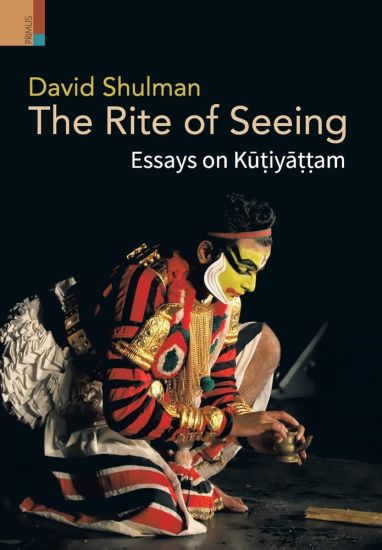
Kūṭiyāṭṭam, the only surviving live Sanskrit theatre in the world, was defined by UNESCO as 'a masterpiece of the oral and intangible heritage of humanity'. Full performances-almost always a single act taken from a multi-act Sanskrit play-range from 12 to 150 hours (in daily or nightly segments of several hours each) and display an aesthetic brilliance and dizzying complexity that are almost beyond description. Each such act constitutes an artistic whole with its own conceptual and thematic unity. The Rite of Seeing reflects the work of the Hebrew University Kūṭiyāṭṭam team and of our colleagues from T bingen, Paris, Groningen, and elsewhere, over many years of annual pilgrimages to Kerala to watch and study this art in action. It offers interpretations of seven classical performances in the light of the actors' traditional handbooks (Āṭṭaprakāram), the Sanskrit base text, and the artists' oral commentary that emerged naturally in the course of many days of attentive viewing. The essays are accompanied by links to extended performance moments, so that readers can see with their own eyes something of what we have seen in Mūḻikkuḷam and Kiḷḷimaṅgalam. Interpretative essays of this kind, although plentiful in studies of Sophocles, Shakespeare, and Chekhov, have never been attempted for Kūṭiyāṭṭam. The book is thus meant to introduce Kūṭiyāṭṭam to new audiences and to offer pathways for beginning to explore the riches of this unique and still vital tradition.
Introspection and Insight

Introspection and Insight

David Shulman

Primus Books
2023
pokkari
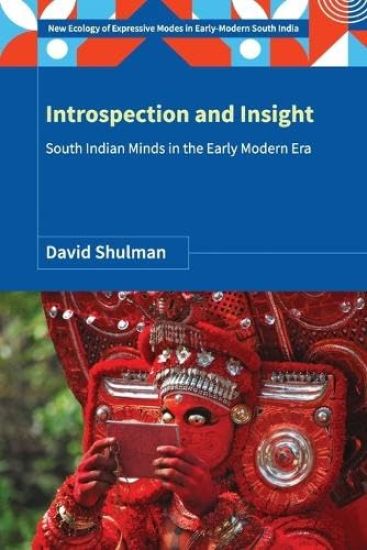
This is the first book of the New Ecology of Expressive Modes in Early-Modern South India (NEEM Series), edited by David Shulman.Introspection and Insight explores the literature, music, and graphic arts of south India between the late fifteenth and early nineteenth centuries, and focuses on their theoretical and philosophical foundations as well as the distinctive features that reveal a newly emergent concept of the individual self and novel models of the mind. This is contextualized as part of a wider civilizational shift throughout the southern regions of India, involving radical changes in taste and sensibility-signifying moments of major cultural innovation. Of these, music was, perhaps, the most eloquent vehicle for personal introspection at this time.