Kirjojen hintavertailu. Mukana 12 363 183 kirjaa ja 12 kauppaa.

Kirjahaku

Etsi kirjoja tekijän nimen, kirjan nimen tai ISBN:n perusteella.

7 kirjaa tekijältä David Skelton

Little Platoons

Little Platoons

David Skelton

Biteback Publishing
2019
nidottu
Brexit - a revolutionary moment in British politics. Voters in long-forgotten English towns made their disenchantment clear, overwhelmingly voting to `take back control' from a remote and defective economic system. Despite this decisive message in 2016, the concerns of these forgotten towns have continued to be all but ignored. David Skelton grew up in Consett, a north-eastern town where the steel industry has deep roots. When the steelworks closed almost forty years ago it lost everything, a story echoed in towns across England. Skelton uses Consett's experience to discuss what has gone wrong and how we can put it right. He considers a broken social contract and the economic and identity liberalism which has neglected the needs of a great bulk of the population. Little Platoons calls for a revival of One Nation to recognise the needs of people in such towns. It argues that a brave Tory Party can shatter decades-old boundaries and redraw the political map by marrying social reform with private enterprise, enhancing community values and allowing long-ignored voters to genuinely take back control.

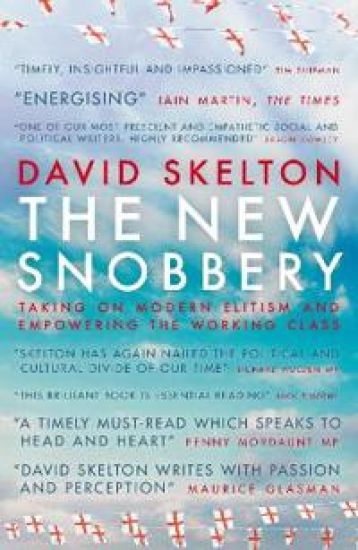
The New Snobbery

The New Snobbery

David Skelton

Biteback Publishing
2021
sidottu
An insidious snobbery has taken root in parts of progressive Britain. Working-class voters have flexed their political muscles and helped to change the direction of the country, but in doing so they have been met with disdain and even abuse from elites in politics, culture and business. They have been derided as uneducated, bigoted turkeys voting for Christmas, as Empire apologists patriotic to the point of delusion. At election time, we hear a lot about 'levelling up the Red Wall'. But when the votes have been counted, what can actually be done to meet the very real concerns of the 'left behind' in the UK's post-industrial towns? In these once vibrant hubs of progress, working-class voters now face the prospect of being minimised or ridiculed in cultural life, economically marginalised and abandoned educationally. In this rousing polemic, David Skelton explores the roots and reality of this new snobbery, calling for an end to the divisive culture war and the creation of a new politics of the common good, empowering workers, remaking the economy and placing communities centre stage. Above all, he argues that we now have a once-in-a-century opportunity to bring about permanent change.
The New Snobbery

The New Snobbery

David Skelton

Biteback Publishing
2023
pokkari
An insidious snobbery has taken root in parts of progressive Britain. Working-class voters have flexed their political muscles and helped to change the direction of the country, but in doing so they have been met with disdain and even abuse from elites in politics, culture and business. At election time, we hear a lot about 'levelling up the Red Wall'. But what can actually be done to meet the very real concerns of the 'left behind' in the UK's post-industrial towns? In these once vibrant hubs of progress, working-class voters now face the prospect of being minimised, marginalised and abandoned. In this new updated edition of his rousing polemic, David Skelton explores the roots and reality of this new snobbery, calling for an end to the divisive culture war and the creation of a new politics of the common good, empowering workers, remaking the economy and placing communities centre stage. Above all, he argues that we now have a once-in-a-century opportunity to bring about permanent change.
Triumph to Disaster

Triumph to Disaster

David Skelton

Biteback Publishing
2026
sidottu
In 2019, it looked like the electoral map of Britain had been changed forever, with once solidly Labour constituencies voting Conservative for the first time. An epochal realignment seemed to be in train that saw the Conservative electoral coalition become much more Northern and working class and Labour depending more on middle class voters in the South. Only a few years later, the realignment lies in ruins. The Red Wall has returned to Labour, and it's clear 2019 was a blip. Tories are now jostling amongst themselves to be seen as the heirs to Thatcher. It's almost like the promise of change and levelling up was a fever dream as political parties and voters revert to type. What happened? And what can be done? The Conservatives made a big promise to Red Wall voters in 2019, speaking openly about first-time Conservative voters 'lending' their support and promising. In reality, that was quickly forgotten and the realignment was put in the 'too difficult' box, in preference of Thatcherite cosplaying that appealed to a tiny core of Tory members but didn't address the real problems that the country faced. But the politics behind it cannot be ignored. This book will address what went wrong with the so-called realignment and what needs to be done to revive it. 'David Skelton is a brave and original thinker who gets it.' Tim Shipman, The Sunday Times
The Future Habit

The Future Habit

David Skelton

Biteback Publishing
2026
sidottu
We are living through a time of extraordinary technological advance, political turmoil and social upheaval. How can business leaders navigate these waves of disruption and uncertainty? How can citizens and politicians learn how to get ahead of perpetual change? By adopting The Future Habit and building it into their way of thinking, operating and seeing the world. In fostering The Future Habit, business leaders can develop the muscle memory to deal confidently with the future and give themselves a competitive advantage over those stuck in a status quo mindset. The Future Habit is a practical and provocative guide for building the one capability every organisation, team and leader needs: a disciplined habit of working with the future. Drawing on cognitive science, applied foresight and decades of strategic experience, the book introduces an actionable framework for developing ‘the future edge’ – a repeatable process of anticipating, adapting to and shaping emerging realities. Unlike most books that treat foresight as trendspotting or speculative fiction, The Future Habit insists on one thing: the future is not something we predict; it’s something we practice. It offers a methodical approach to working with the future in real-world contexts – through scenario work, predictions, pre-mortems, narrative exploration and the integration of AI. The authors have spent years embedding foresight in companies at the forefront of the tech revolution and use this experience to ensure that The Future Habit is a practical book that will make a positive difference to all readers who follow its lessons.