Kirjojen hintavertailu. Mukana 11 342 296 kirjaa ja 12 kauppaa.

Kirjahaku

Etsi kirjoja tekijän nimen, kirjan nimen tai ISBN:n perusteella.

15 kirjaa tekijältä David Solway

Lying about the Wolf

Lying about the Wolf

David Solway

McGill-Queen's University Press
1997
sidottu
Solway explains that the current generation of students, raised in a nonhistorical and iconic environment, do not live in time as an emergent, continuous medium in which the complexities of experience are parsed and organized. Their psychological world is largely devoid of syntax - of causal, differential, and temporal relations between events. The result is precisely what we see about us: a cultural world characterized by a vast subpopulation of young (and not so young) people for whom the past is an unsubstantiated rumour and the future an unacknowledged responsibility. Solway claims that contemporary educators have become cultural speculators who disregard a basic truth about how the mind develops: that it needs to be grounded in reality and time. In education, as in almost every other cultural institution, the sense of reality and the dynamic of time have "virtually" disappeared, leading to the deep disconnectedness we experience on every level of "human grammar," from the organization of the community to the organization of the sentence. Lying about the Wolf is not only an exploration of current pedagogical issues but also, and perhaps primarily, a cultural analysis for which the subject of education provides a focus. Solway argues that we cannot hope to solve the educational problem unless we are prepared to deal with the larger cultural predicament.
Random Walks

Random Walks

David Solway

McGill-Queen's University Press
1997
nidottu
The first section of the book develops Solway's approach to literature, starting from the assumption that genuine criticism requires the intellectual freedom to range at will across the literary landscape rather than restricting one's direction based on what is current, fashionable, or politically correct. Solway argues that advocating a theoretical school - postmodernism, poststructuralism, semiotics, new historicism, Marxist revisionism, or queer theory - generally involves abandoning the real critical project, which is the discovery of one's own undetermined motives, dispositions, and interests as reflected in the secret mirrors embedded in literary texts. Instead Solway pursues what he calls elective criticism, writing that enables the critical writer to freely discover his or her own identity - a concept that he claims cannot reasonably be diluted, relinquished, or deconstructed. In the second section Solway practices what he preaches, exploring a wide range of authors and subjects. His essays include an analysis of Franz Kafka's The Trial as a Jewish joke, a personal memoir of Irving Layton, an interpretation of Erin Moure's "Pronouns on the Main," an examination of language in William Shakespeare's romances, a reading of Robert Browning's "My Last Duchess" that is sympathetic to the Duke, an assertion that James Joyce has more in common with the traditional novelist than with the professional, (post-)modern alienator, and an exploration of Jonathan Swift's sartorial imagery that contends that form is the source of substantive identity.
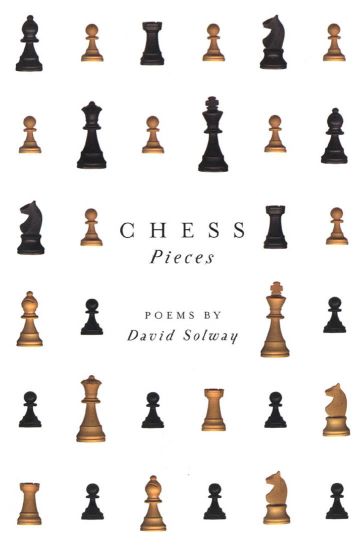
Chess Pieces

Chess Pieces

David Solway

McGill-Queen's University Press
1999
nidottu
From handling of the chessmen you infer the secret springs of human character. To pluck the enemy chessman between your fingers and replace it with your own reveals the cultivated, well-bred killer who cannot stand the sight of blood; knock the chessman over with a small click of wood on wood tells of an aesthetic craving for the fatal instrument, of one more passionate than violent; to push the piece from its intended square is signal of aggressive character and plainly indicates that power is the motive for committing murder; some will hold the captured piece and caress it nervously: these kill from cowardice; those who seem apologetic, taking pawns reluctantly, kill for noble reasons; and he who clears the board with one great sweep of his hand will kill from lack of hope, defeated by the prospect of defeat, as did my father only death could mate.
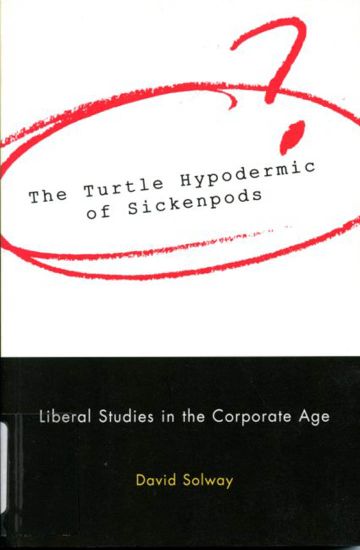
The Turtle Hypodermic of Sickenpods

The Turtle Hypodermic of Sickenpods

David Solway

McGill-Queen's University Press
2000
sidottu
A dominant theme that pervades this collection is the status of "theory" in the educational system. Solway claims that nothing of genuine and productive import comes out of theories. The manifold problems that bedevil the academy cannot be solved, or even rectified, by the usual onslaught of dogmas, reforms, and pseudo-revolutionary postulates that are produced in the misguided attempt to find the single, perfect, pedagogical system. Instead, we must embark on a stringent re-examination of the principles and assumptions on which our culture itself is predicated as reflected in contemporary practice. To do this, we need to develop an accurate killer heuristic to identify and monitor threats to our vocational well-being and effectiveness. This requires courage, a horror of sentimental credulity, and a willingness to learn from those in the educational trenches: the reference librarian should be questioned about the fate of the book, not the academic dean who has seldom read one; the teacher who has weathered innumerable classes should be heard, not the personnel director who is rarely in the building; the department secretary who is about to lose her job should be heeded while a jaundiced eye is turned on the omnipresent school coordinator. In almost every case, Solway believes those who deal directly with students will tell you the truth about what is happening to education while administrators will shuffle and mislead. The essays here are based on information from the trenches as well as from a significant minority of writers on educational and cultural themes. The Turtle Hypodermic of Sickenpods will be must reading for anyone interested in the fate of students and the education system.
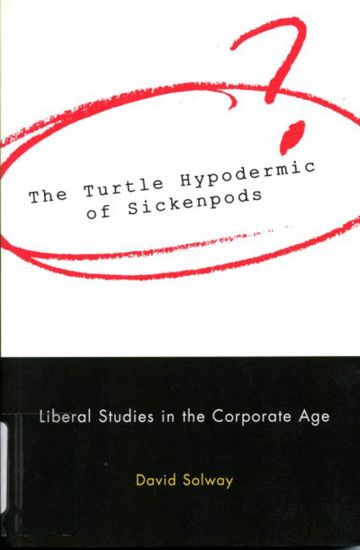
The Turtle Hypodermic of Sickenpods

The Turtle Hypodermic of Sickenpods

David Solway

McGill-Queen's University Press
2000
nidottu
A dominant theme that pervades this collection is the status of "theory" in the educational system. Solway claims that nothing of genuine and productive import comes out of theories. The manifold problems that bedevil the academy cannot be solved, or even rectified, by the usual onslaught of dogmas, reforms, and pseudo-revolutionary postulates that are produced in the misguided attempt to find the single, perfect, pedagogical system. Instead, we must embark on a stringent re-examination of the principles and assumptions on which our culture itself is predicated as reflected in contemporary practice. To do this, we need to develop an accurate killer heuristic to identify and monitor threats to our vocational well-being and effectiveness. This requires courage, a horror of sentimental credulity, and a willingness to learn from those in the educational trenches: the reference librarian should be questioned about the fate of the book, not the academic dean who has seldom read one; the teacher who has weathered innumerable classes should be heard, not the personnel director who is rarely in the building; the department secretary who is about to lose her job should be heeded while a jaundiced eye is turned on the omnipresent school coordinator. In almost every case, Solway believes those who deal directly with students will tell you the truth about what is happening to education while administrators will shuffle and mislead. The essays here are based on information from the trenches as well as from a significant minority of writers on educational and cultural themes. The Turtle Hypodermic of Sickenpods will be must reading for anyone interested in the fate of students and the education system.
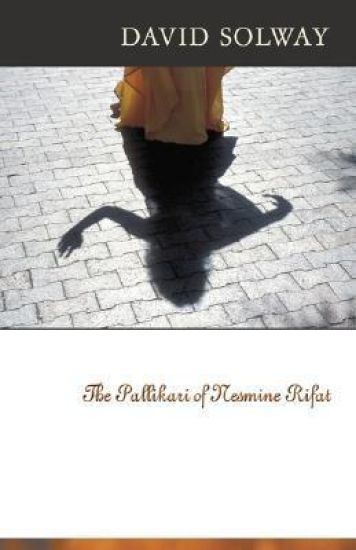
The Pallikari of Nesmine Rifat

The Pallikari of Nesmine Rifat

David Solway

Goose Lane Editions
2005
nidottu
In this sensuously defiant collection of new poems, the winner of the 2004 Grand Prix du Livre de Montréal expands and deepens a poetic ruse. In his critically acclaimed collections Saracen Island and Companion, David Solway took on the voice of a fictitious Greek poet named Andreas Karavis. The poems of these earlier two books were so artful and refreshingly immediate that many readers were convinced that they were authentic translations from the Greek. For The Pallikari of Nesmine Rifat, a new book of ostensible translations, Solway adopts the persona of Karavis's spurned lover, Turkish Cypriot poet Nesmine Rifat and explores the aftermath of one of Karavis's love affairs. Lushly sexual and sparkling with wit and intelligence, these passionate lyrics take the form of undelivered letters, written by Rifat in the wake of Karavis's desertion and his eventual marriage to her rival Anna Zoumi. Solway portrays, with subtlety and sensitivity, a powerful woman and gifted poet undergoing a turbulent emotional journey. Moving from wrath and arrogant disdain, through bitterness and grief, to an acceptance of the love she cannot subdue, his female poet grows in both strength and art. As an intimate record of one woman's anguish, The Pallikari of Nesmine Rifat is a remarkable achievement -- even more so when one recalls that the author is actually a man.
The Herb Garden

The Herb Garden

David Solway

Guernica Editions,Canada
2018
pokkari
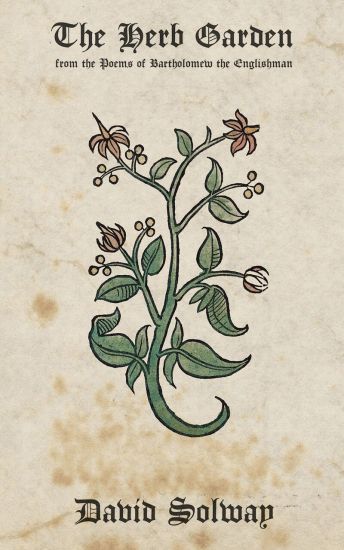
Bartholomew the Englishman was a 13th century Franciscan friar and scholar whose only surviving work, De proprietatibus rerum (The Properties of Things), was intended as an encyclopaedia of the world. The Herb Garden is an imaginary representation of what his herbarium might have looked like. The dialect of the collection is a mix of middle and modern English, a verbal florilegium meant to explore the exuberant richness of the English language that much of contemporary poetry has scanted or forgotten. The collection is also conceived as a kind of "sapiential book," a form of counsel literature or life manual with an emphasis on everyday practice and the poet's craft.
The Properties of Things

The Properties of Things

David Solway

Biblioasis
2007
pokkari
The Properties of Things continues David Solway's explorations in the realm of fictive translation, this time that of the obscure thirteenth century scholar Bartolomaeus Anglicus. The result is a poetic alphabetary, ranging from the bawdy to the sublime. David Solway has been called "an internationalist of the imagination." He remains one of the country's most brilliant and inventive poets.
Notes from a Derelict Culture

Notes from a Derelict Culture

David Solway

Black House Publishing
2019
pokkari
The essays in this book elaborate an overall view of the central predicament confronting the West today: a theologically-inspired terrorist movement, the left-liberal belief-system that dominates the Western sensibility, the plague of political correctness that devitalizes language and obscures truth, and the almost universal opprobrium in which America--and by extrapolation the historical endowment of Western civilization--is held by the official institutions of the international community and by liberal culture.For too many years now we have practiced the rites of evasion, craving asylum in blindness, conciliation, sophistry and equivocation. Many flinch from expressing their convictions plainly, fearing to offend their readers and imperil their professional credentials. There is no more pressing requirement for us today than the obligation to seek the truth and to speak clearly, boldly, and without compromise, an endeavor with which this book is fundamentally engaged.
Notes from a Derelict Culture

Notes from a Derelict Culture

David Solway

Black House Publishing
2019
sidottu
The essays in this book elaborate an overall view of the central predicament confronting the West today: a theologically-inspired terrorist movement, the left-liberal belief-system that dominates the Western sensibility, the plague of political correctness that devitalizes language and obscures truth, and the almost universal opprobrium in which America--and by extrapolation the historical endowment of Western civilization--is held by the official institutions of the international community and by liberal culture.For too many years now we have practiced the rites of evasion, craving asylum in blindness, conciliation, sophistry and equivocation. Many flinch from expressing their convictions plainly, fearing to offend their readers and imperil their professional credentials. There is no more pressing requirement for us today than the obligation to seek the truth and to speak clearly, boldly, and without compromise, an endeavor with which this book is fundamentally engaged.
Crossing the Jordan

Crossing the Jordan

David Solway

World Encounter Institute/New English Review Press
2023
sidottu
During these shocking times of war, violence, and hate many are now seeking answers to important questions. What are the bases of the claims of the Jewish people to the Holy Land? What are the foundations of the conflicts between Muslims and Jews? What does Western Culture and its decline have to do with Israel and the Muslims? How does the rise of extreme leftism in Canada and the United States facilitate and encourage extreme hate and violence at home and in the Middle East? These and many other questions are answered by David Solway in this timely collection of essays-- easily read, easily understood, and written with erudition, scholarship, and style. Solway's style is appropriate for general readers or those with long backgrounds of knowledge of Judaism, Islam, Israel, the Middle East, American and Canadian cultural and political radicalism and decline, the Jewish People, and the intersection of Judaism and Islam in the Middle East. The most recent horror for the Jews that began on October 7, 2023, can be better understood with a clear understanding of Israel, diaspora Jews, ancient and modern Jewish history, and the decline of the West into moral relativism, communism, and leftist utopianism. Times of strife and horror are best explained by clarity of thought and writing. Solway provides both in this important work that provides both context and background to the horrors seen recently in Israel, across Europe, in the United States, and across the world.
Crossing the Jordan

Crossing the Jordan

David Solway

World Encounter Institute/New English Review Press
2023
pokkari
During these shocking times of war, violence, and hate many are now seeking answers to important questions. What are the bases of the claims of the Jewish people to the Holy Land? What are the foundations of the conflicts between Muslims and Jews? What does Western Culture and its decline have to do with Israel and the Muslims? How does the rise of extreme leftism in Canada and the United States facilitate and encourage extreme hate and violence at home and in the Middle East? These and many other questions are answered by David Solway in this timely collection of essays-- easily read, easily understood, and written with erudition, scholarship, and style. Solway's style is appropriate for general readers or those with long backgrounds of knowledge of Judaism, Islam, Israel, the Middle East, American and Canadian cultural and political radicalism and decline, the Jewish People, and the intersection of Judaism and Islam in the Middle East. The most recent horror for the Jews that began on October 7, 2023, can be better understood with a clear understanding of Israel, diaspora Jews, ancient and modern Jewish history, and the decline of the West into moral relativism, communism, and leftist utopianism. Times of strife and horror are best explained by clarity of thought and writing. Solway provides both in this important work that provides both context and background to the horrors seen recently in Israel, across Europe, in the United States, and across the world.