Kirjojen hintavertailu. Mukana 11 342 296 kirjaa ja 12 kauppaa.

Kirjahaku

Etsi kirjoja tekijän nimen, kirjan nimen tai ISBN:n perusteella.

5 kirjaa tekijältä David T. Zabecki

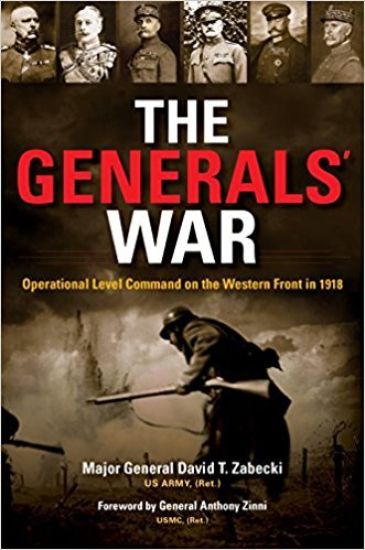
The Generals' War

The Generals' War

David T. Zabecki

Indiana University Press
2018
sidottu
Known as the War to End all Wars and the Great War, World War I introduced new forms of mass destruction and modern technological warfare. When the Bolsheviks pulled Russia out of the war in late 1917, the Germans turned their offensive efforts to the Western Front in an attempt to win the war in 1918. But as fresh American troops entered Europe, the strategic scales tipped against Germany.Much of how World War I played out turned on the plans and decisions of the senior-most German and Allied commanders. The Generals' War explores the military strategies of those generals during the last year of the Great War. These six very different men included Germany's Field Marshal Paul von Hindenburg and General Erich Ludendorff; France's Marshals Ferdinand Foch and Philippe Pétain; Great Britain's Field Marshal Sir Douglas Haig; and the United States' General John Pershing. Although history remembers none of them as great captains, these six officers determined for better or worse how World War I was fought on the battlefields of the Western Front between November 1917 and November 1918.The Generals' War is a landmark exploration of the generalship that shaped the very framework of modern warfare as we know it today and provides a comprehensive and detailed analysis on the senior commanders of the Great War.
Steel Wind

Steel Wind

David T. Zabecki

Praeger Publishers Inc
1994
nidottu
Steel Wind is a piece of historical detective work that explains how Colonel Georg Bruchmuller, an obscure German artillery officer recalled from retirement, played a pivotal role in the revolution of offensive tactics that took place in 1917-18. Ironically, the methods developed by Bruchmuller ultimately were rejected by the German Army of World War II, but they were taken up and applied with a vengeance by the emerging Red Army. The Soviets further developed Bruchmuller's principles and incorporated them into their doctrine, where they remain to this day. Through Soviet doctrine, they have become fundamental to the practice of many other armies. Bruchmuller's influence in shaping the former Soviet Army has also been mirrored in the shape of those armies designed to oppose it.
The German 1918 Offensives

The German 1918 Offensives

David T. Zabecki

Routledge
2006
sidottu
This is the first study of the Ludendorff Offensives of 1918 based extensively on key German records presumed to be lost forever after Potsdam was bombed in 1944. In 1997, David T. Zabecki discovered translated copies of these files in a collection of old instructional material at the U.S. Army Command and General Staff College at Fort Leavenworth, Kansas. He presents his findings here for the first time, with a thorough review of the surviving original operational plans and orders, to offer a wealth of fresh insights to the German Offensives of 1918. David T. Zabecki clearly demonstrates how the German failure to exploit the vulnerabilities in the BEF’s rail system led to the failure of the first two offensives, and how inadequacies in the German rail system determined the outcome of the last three offensives. This is a window into the mind of the German General Staff of World War I, with thorough analysis of the German planning and decision making processes during the execution of battles. This is also the first study in English or in German to analyze the specifics of the aborted Operation HAGEN plan. This is also the first study of the 1918 Offensives to focus on the ‘operational level of war’ and on the body of military activity known as ‘the operational art’, rather than on the conventional tactical or strategic levels.This book will be of great interest to all students of World War I, the German Army and of strategic studies and military theory in general.
The German 1918 Offensives

The German 1918 Offensives

David T. Zabecki

Routledge
2009
nidottu
This is the first study of the Ludendorff Offensives of 1918 based extensively on key German records presumed to be lost forever after Potsdam was bombed in 1944. In 1997, David T. Zabecki discovered translated copies of these files in a collection of old instructional material at the U.S. Army Command and General Staff College at Fort Leavenworth, Kansas. He presents his findings here for the first time, with a thorough review of the surviving original operational plans and orders, to offer a wealth of fresh insights to the German Offensives of 1918. David T. Zabecki clearly demonstrates how the German failure to exploit the vulnerabilities in the BEF’s rail system led to the failure of the first two offensives, and how inadequacies in the German rail system determined the outcome of the last three offensives. This is a window into the mind of the German General Staff of World War I, with thorough analysis of the German planning and decision making processes during the execution of battles. This is also the first study in English or in German to analyze the specifics of the aborted Operation HAGEN plan. This is also the first study of the 1918 Offensives to focus on the ‘operational level of war’ and on the body of military activity known as ‘the operational art’, rather than on the conventional tactical or strategic levels.This book will be of great interest to all students of World War I, the German Army and of strategic studies and military theory in general.
Steel Wind

Steel Wind

David T. Zabecki

Praeger Publishers Inc
1994
sidottu
Steel Wind is a piece of historical detective work that explains how Colonel Georg Bruchmuller, an obscure German artillery officer recalled from retirement, played a pivotal role in the revolution of offensive tactics that took place in 1917-18. Ironically, the methods developed by Bruchmuller ultimately were rejected by the German Army of World War II, but they were taken up and applied with a vengeance by the emerging Red Army. The Soviets further developed Bruchmuller's principles and incorporated them into their doctrine, where they remain to this day. Through Soviet doctrine, they have become fundamental to the practice of many other armies. Bruchmuller's influence in shaping the former Soviet Army has also been mirrored in the shape of those armies designed to oppose it.