Kirjojen hintavertailu. Mukana 11 699 587 kirjaa ja 12 kauppaa.

Kirjahaku

Etsi kirjoja tekijän nimen, kirjan nimen tai ISBN:n perusteella.

5 kirjaa tekijältä David Toews

Social Life and Political Life in the Era of Digital Media
Digital technology has vastly broadened and complexi?ed social life, levelling opportunities for communication and producing a new awareness of the importance of diversity of social relations, as well as of life on the planet. This book explores the ways in which social media, by encouraging human curiosity and sociability in relation to these developments, has highlighted for users their own nature as social beings who have discovered new ways to get along with each other, as well as new challenges. The complexity of networks on social media has created new kinds of con?icts, and new ways to mediate older kinds of con?icts, that have resulted in a demand for new forms of political participation, thus reinvigorating political activity, without extending the practice of ‘politics as usual’. However, with concerns for the planet in the back- ground, a tendency for elites and ordinary people alike to want to see a political solution to every problem in social life has become an unsustainable and troubling trend. This book argues that enthusiasms for social media can be tempered in a helpful manner through an engagement with studies of social media in relation to understandings of the history of modern social life provided by sources in classical and contemporary sociology and political theory. Social media makes possible new sociable opportunities and multiple publics, but at the same time represents important continuities with modern social life of earlier times, such as the respect in which it works to limit political action within the boundaries of a generalized public, thus constraining demagoguery and challenging the arrogance of elites who seek to impose certain forms of political life.Engaging with the work of Deleuze, Tarde, Simmel, Lazzarato, Latour, Harman, Heidegger, Arendt, Archer, Wellman, Bergson and others, Social Life and Political Life in the Era of Digital Media advances a new understanding of modernity o?ered by social media
Gabriel Tarde

Gabriel Tarde

David Toews

TAYLOR FRANCIS LTD
2022
sidottu
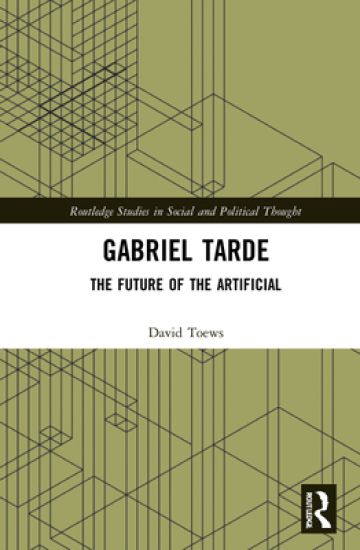
This book presents the core ideas of early sociologist Gabriel Tarde and suggests a new pathway for sociology based on his foundational work. Rejecting anthropocentrism, Tarde highlights the contrast between the natural and the artificial, uniquely emphasizing the positive significance of the artificial in an age in which people have come to distrust it profoundly. Recovering Tarde’s theory today in the context of contemporary as well as classical scholarship and recognizing how it fits with such phenomena as quantum physics and digital media, this book develops the concept of the cosmological imagination as the context for a critical Tardian analysis of artifice that can bring together what we know about our contemporary future-oriented global societies.How we know the universe, our place in it, the place of other animals and objects in it, our global socialities, our human claims of power and privilege within it, are pointed questions Tarde asks as he wonders whether a future temporality conducive to constant artifice has become our normal human way of life. Considering our ambivalence about modern products and modernity in general, our thinking about the future, and our tendency to forget what nature used to signify in its presentation of problems beyond our control, such as illnesses and epidemics, Gabriel Tarde: The Future of the Artificial demonstrates the reasons for which we need to return to Tarde’s work to rediscover its relevance for public debate as we seek to think through the new era and its societies in which culture and nature are no longer distinct. This book will appeal to scholars of social and political theory with interests in our digital age, new sociologies of materials and objects, neomonadology, and the thought of Gabriel Tarde.
Gabriel Tarde

Gabriel Tarde

David Toews

TAYLOR FRANCIS LTD
2024
nidottu
This book presents the core ideas of early sociologist Gabriel Tarde and suggests a new pathway for sociology based on his foundational work. Rejecting anthropocentrism, Tarde highlights the contrast between the natural and the artificial, uniquely emphasizing the positive significance of the artificial in an age in which people have come to distrust it profoundly. Recovering Tarde’s theory today in the context of contemporary as well as classical scholarship and recognizing how it fits with such phenomena as quantum physics and digital media, this book develops the concept of the cosmological imagination as the context for a critical Tardian analysis of artifice that can bring together what we know about our contemporary future-oriented global societies.How we know the universe, our place in it, the place of other animals and objects in it, our global socialities, our human claims of power and privilege within it, are pointed questions Tarde asks as he wonders whether a future temporality conducive to constant artifice has become our normal human way of life. Considering our ambivalence about modern products and modernity in general, our thinking about the future, and our tendency to forget what nature used to signify in its presentation of problems beyond our control, such as illnesses and epidemics, Gabriel Tarde: The Future of the Artificial demonstrates the reasons for which we need to return to Tarde’s work to rediscover its relevance for public debate as we seek to think through the new era and its societies in which culture and nature are no longer distinct. This book will appeal to scholars of social and political theory with interests in our digital age, new sociologies of materials and objects, neomonadology, and the thought of Gabriel Tarde.
How Digital Social Life Matters

How Digital Social Life Matters

David Toews

TAYLOR FRANCIS LTD
2025
sidottu
Focusing on two concepts that were central to modernism and continue to be important, albeit in different ways, this book explores the nature of the simple and the complex, and the relationship that exists between them. With attention to trends in big data and digital media, society, politics, and culture, and the shift from groups towards networks in social life, it considers how the simple is transformed by the new realities of the internet-powered, global society, and what its role might be in helping us to understand them, both from the point of view of methods in the social sciences and humanities, and in life. Rejecting the positivist idea that the simple remains a static background against which the open-ended complexity of our world continues to expand, the author contends that the growth in complexity is mirrored in the 'relativization of simplicity', a phenomenon that is highlighted by gradual social changes that the era of digital media is now making apparent.Through a series of questions raised by our new digital lives, How Digital Social Life Matters argues for significant changes in how we see the world. Focussing on the relationship between theory and methods, it offers a critical phenomenology of experiences associated with the network society and networked individualism in an era of ‘big data’. It uses an examination of the concept and phenomenon of the simple, unpacking its new dynamics, its new meanings and its new depth, as a way of demonstrating the need for new conceptions of the complex in such contexts as reality, the universe, and the cosmos. As such, it will appeal to social theorists, communication scholars, and philosophers with interests in the fields of relational sociology, digital media, and object-oriented ontology. It also engages more broadly with scholars with a sociologically-informed interest in reimagining the social roles of politics, science, nature, media, globalization, the environment, and social interaction for our new digital era.
Social Life and Political Life in the Era of Digital Media
Digital technology has vastly broadened and complexi?ed social life, levelling opportunities for communication and producing a new awareness of the importance of diversity of social relations, as well as of life on the planet. This book explores the ways in which social media, by encouraging human curiosity and sociability in relation to these developments, has highlighted for users their own nature as social beings who have discovered new ways to get along with each other, as well as new challenges. The complexity of networks on social media has created new kinds of con?icts, and new ways to mediate older kinds of con?icts, that have resulted in a demand for new forms of political participation, thus reinvigorating political activity, without extending the practice of ‘politics as usual’. However, with concerns for the planet in the back- ground, a tendency for elites and ordinary people alike to want to see a political solution to every problem in social life has become an unsustainable and troubling trend. This book argues that enthusiasms for social media can be tempered in a helpful manner through an engagement with studies of social media in relation to understandings of the history of modern social life provided by sources in classical and contemporary sociology and political theory. Social media makes possible new sociable opportunities and multiple publics, but at the same time represents important continuities with modern social life of earlier times, such as the respect in which it works to limit political action within the boundaries of a generalized public, thus constraining demagoguery and challenging the arrogance of elites who seek to impose certain forms of political life.Engaging with the work of Deleuze, Tarde, Simmel, Lazzarato, Latour, Harman, Heidegger, Arendt, Archer, Wellman, Bergson and others, Social Life and Political Life in the Era of Digital Media advances a new understanding of modernity o?ered by social media, re-establishing the autonomy of social life over and against political life and re-articulating the relationship between the social and political. As such, it will appeal to scholars of social and political theory and cultural and media studies.