Kirjojen hintavertailu. Mukana 11 342 296 kirjaa ja 12 kauppaa.

Kirjahaku

Etsi kirjoja tekijän nimen, kirjan nimen tai ISBN:n perusteella.

20 kirjaa tekijältä David Trotter

Cooking with Mud

Cooking with Mud

David Trotter

Oxford University Press
2000
sidottu
It seems safe to assume that people started to drop things as soon as they started to pick them up, and that even the most aboriginal litterings and spillages did not pass entirely without comment. Mess is age-old and universal, both as phenomenon and as topic. The evidence collected in this book suggests, however, that the second half of the nineteenth century saw the first stirrings in Western culture of a primary interest in mess for its own sake: a development which had something to do with the gradual fading, amid a great deal of reassertion, of doctrines of determinism; and something to do with democracy, which would be hard to imagine without litter. Messes, like modern identities, happen by accident; their representation, in painting and fiction, made it possible to think boldly and inventively about chance. Ranging widely–from Turner to Courbet, Cézanne, and Degas, and from Melville to Maupassant, Chekhov, Gissing, and the New Woman writers–this book outlines a style of commentary on modern life in which the ancient dichotomy of order and chaos (culture and anarchy) was supplanted, at least temporarily, by a distinction between different kinds and qualities of mess.
Paranoid Modernism

Paranoid Modernism

David Trotter

Oxford University Press
2001
sidottu
The early twentieth century notoriously saw an unprecedented wave of experiment in the arts. So intense was this activity that one can without exaggeration speak of a will to experiment (to 'make it new'). Where did that will to experiment come from? Why did it so insistently take the forms it took? Looking specifically at Modernism in England, David Trotter seeks answers in the careers of three novelists writing in the first decades of the century: Ford Madox Ford, D. H. Lawrence, and Wyndham Lewis. The context he proposes for their work is that of contemporary understandings of the function and value of expertise, and of the dilemmas peculiar to those possessing it. There is a certain madness about the expert's pursuit of expertise, and about his or her disappointment if expertise fails to yield adequate social recognition. The early psychiatric literature identified this madness as paranoia, and the textbooks and case-histories find an uncanny echo in Modernist fiction. In the obstinacy of their will to experiment, Ford, Lawrence, and Lewis wrote about, and lived, paranoia. To understand that obstinacy in its professional and psychiatric contexts is to approach from a new and unexpected angle the preoccupations with gender and with the politics of culture which currently characterize the study of Modernism. The energies it shook loose in their writing are energies which, evading absorption into the 'postmodern', continue to shape Western society and culture to this day.
The Literature of Connection

The Literature of Connection

David Trotter

Oxford University Press
2020
sidottu
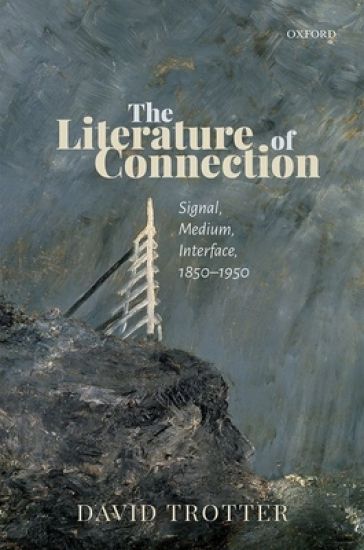
This book is about some of the ways in which the world got ready to be connected, long before the advent of the technologies and the concentrations of capital necessary to implement a global 'network society'. It investigates the prehistory not of the communications 'revolution' brought about by advances in electronic digital computing from 1950 onwards, but of the principle of connectivity which was to provide that revolution with its justification and rallying-cry. Connectivity's core principle is that what matters most in any act of telecommunication, and sometimes all that matters, is the fact of its having happened. During the nineteenth century, the principle gained steadily increasing traction by means not only of formal systems such as the telegraph, but of an array of improvised methods and signalling devices. These methods and devices fulfilled not just an ever more urgent need, but a fundamental recurring desire, for near-instantaneous real-time communication at a distance. Connectivity became an end in itself: a complex, vivid, unpredictable romance woven through the enduring human desire and need for remote intimacy. Its magical enhancements are the stuff of tragedy, comedy, satire, elegy, lyric, melodrama, and plain description; of literature, in short. The book develops the concepts of signal, medium, and interface to offer, in its first part, an alternative view of writing in Britain from George Eliot and Thomas Hardy to D.H. Lawrence, Hope Mirrlees, and Katherine Mansfield; and, in its second, case-studies of European and African-American fiction, and of interwar British cinema, designed to open the topic up for further enquiry.
Literature in the First Media Age

Literature in the First Media Age

David Trotter

Harvard University Press
2013
sidottu
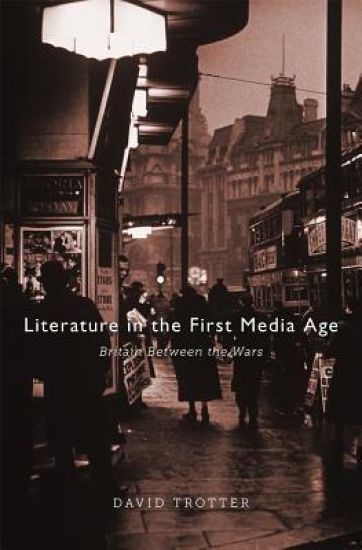
The period between the World Wars was one of the richest and most inventive in the long history of British literature. Interwar literature, David Trotter argues, stood apart by virtue of the sheer intelligence of the enquiries it undertook into the technological mediation of experience. After around 1925, literary works began to portray communication by telephone, television, radio, and sound cinema—and to examine the sorts of behavior made possible for the first time by virtual interaction. And they filled up, too, with the look, sound, smell, taste, and feel of the new synthetic and semi-synthetic materials that were reshaping everyday modern life.New media and new materials gave writers a fresh opportunity to reimagine both how lives might be lived and how literature might be written. Today, Trotter observes, such material and immaterial mediations have become even more decisive. Communications technology is an attitude before it is a machine or a set of codes. It is an idea about the prosthetic enhancement of our capacity to communicate. The writers who first woke up to this fact were not postwar, postmodern, or post-anything else: some of the best of them lived and wrote in the British Isles in the period between the World Wars. In defining what they achieved, this book creates a new literary canon of works distinguished formally and thematically by their alertness to the implications of new media and new materials.
English Novel in History, 1895-1920
Written especially for students and assuming no prior knowledge of the subject, David Trotter's "The English Novel in History 1895-1920" provides a comprehensive introduction to early 20th-century fiction This study embraces the whole range of early 20th-century fiction, from avant-garde innovations to popular mass-market genres. Separate sections are devoted to James, Conrad, Kipling, Bennett, Lawrence, Lewis, and Joyce. It establishes a classification of literary styles in the period. Based on this classification, it offers an account of the subject-matters which preoccupied writers of all kinds: gender, race, nationality, sexual psychology, production and consumption. "The English Novel in History" aims to redefine our understanding of literary Modernism, and should be useful reading for all students of modern English literature.
Cinema and Modernism

Cinema and Modernism

David Trotter

Wiley-Blackwell (an imprint of John Wiley Sons Ltd)
2007
nidottu
This study revolutionises our understanding of both literary modernism and early cinema. Trotter draws on the most recent scholarship in English and film studies to demonstrate how central cinema as a recording medium was to Joyce, Eliot and Woolf, and how modernist were the concerns of Chaplin and Griffith. This book rewrites the cultural history of the early twentieth century, showing how film technology and modernist aesthetics combined to explore the limits of the human. Offers major re-interpretations of key Modernist works, including Ulysses, The Waste Land, and To the Lighthouse Explores film and film-going in works by Henry James, Frank Norris, Rudyard Kipling, Katherine Mansfield, and Elizabeth Bowen Offers original analyses of crucial phases in the careers of two of the most celebrated film-makers of the silent era, D.W. Griffith and Charlie Chaplin
The Uses of Phobia

The Uses of Phobia

David Trotter

Wiley-Blackwell (an imprint of John Wiley Sons Ltd)
2010
nidottu
The essays brought together in this book understand phobia not as a pathology, but as a versatile moral, political, and aesthetic resource – and one with a history. They demonstrate that enquiry into strong feelings of aversion has enabled writers and film-makers to say and show things they could not otherwise have said or shown; and in this way to get profoundly and provocatively to grips with the modern condition. Makes extensive reference to original readings of a wide range of literary texts and films, from the 1850s to the presentPlaces a strong emphasis on the value phobia has held, in particular, for women activists, writers, and film-makersDiscusses a range of writers and film-makers from Dickens, Thackeray, and George Eliot through Hardy, Joyce, Ford and Woolf; from Jean Renoir through Hitchcock and Truffaut to Margarethe von Trotta and Pedro AlmodóvarIntervention in key debates in cultural theory and cultural history
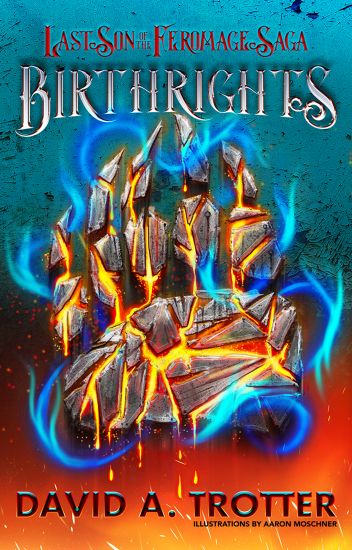
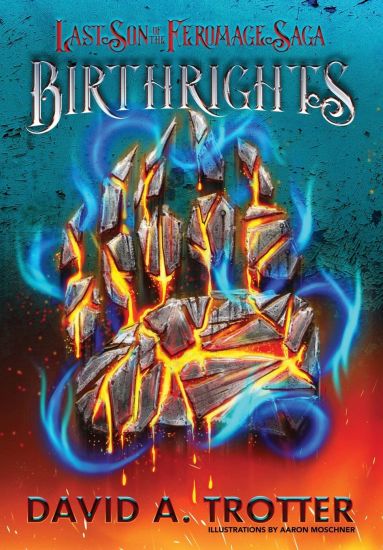
Birthrights

Birthrights

David Trotter

David Trotter
2021
sidottu
TUR'MOR, capital of the Republic of Ordiatea and the center of the modern world, is a vast city-state by the sea where the haze of industry and the glisten of steel draws in people from across the continent of Ethrea. At the heart of the Tur'Mor lies two governing authorities, that of the political figureheads and the Holy Council of the Church of Ordan. However, beneath it's cobbled-streets and immense markets, a cancer sucks at the city-state, threatening to overturn the tinder balance of it all. Cults, thieves, assassins, and robbers lurk, while the wealthy 'Uppers' leech off of the less fortunate.Burdened with guilt and remorse for his failings, a forgotten warrior finds himself trapped between the looming walls of Tur'Mor and a mysterious call to Find Them. His only hope is to learn to trust. But in a city where secrets and betrayal are the common language, and propaganda is being issued from those who should be helping, he is left to figure things out on his own.Meanwhile, in Southend of Tur'Mor, where the poor and despot cling on to whatever meager belongs they can scavenge, a group of misfits has banded together, headed by the charismatic Felik, calling themselves 'The Crew'. Diversity makes them unique, stronger than common street toughs of Southend. But, when everyone has secrets, someone is bound to get hurt.Worlds collide as progress press ever onward. Important realities are lost to history as the march to greater enlightenment tramples out the once sacred truths of the past. Magic and mystical creatures? Fairytales used to scare children. Arcane artifacts? Folklore to distract citizens from their responsibilities. The Church has verified this, and they do whatever it takes to ensure these facts. However, some of those darker truths should have never been allowed to be forgotten.
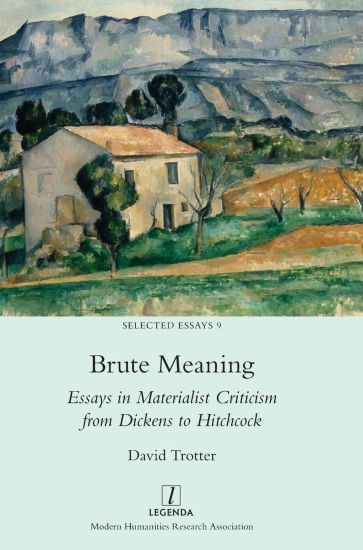
Brute Meaning

Brute Meaning

David Trotter

Legenda
2020
sidottu
The essays collected in this volume trace the evolution over a period of thirty years of a critical approach resembling what would now be described as the 'new materialism'. These essays insist that literature and film are never more vital than in their enactment of the 'brute meaning' Maurice Merleau-Ponty once found in the work of Paul C zanne: the crude sense we make, as creatures exercising an always already dispersed and relational agency, of the world we inhabit. This is a materialist criticism attentive at once to the forms brute meaning has taken in fiction and film, and to the history of its constitution by or in species, class, racial, and sexual difference.The essays in Part I concern renderings of embodied experience in fiction by Charles Dickens, George Eliot, Thomas Hardy, Radclyffe Hall, Sylvia Townsend Warner, and others; those in Part II, renderings of space in films by D.W. Griffith, John Ford, Jean Renoir, Marcel Carn , Alfred Hitchcock, and others. When the topic demands it, they engage directly with discipline-shaping initiatives from the New Historicism of the 1980s through postcolonial studies to more recent reflections on the 'posthuman' condition. Part III pairs old and new essays, one framing a materialist criticism for the 1980s, the other for 2020. The polemical thrust of Brute Meaning is that any materialism worthy of the name must remain resolutely secular in emphasis and tone.David Trotter is an emeritus professor of English literature at the University of Cambridge, and a Fellow of the British Academy. He has written widely about nineteenth- and twentieth-century literature and culture, and about aspects of the history and theory of media.
Brute Meaning

Brute Meaning

David Trotter

Legenda
2023
pokkari
The essays collected in this volume trace the evolution over a period of thirty years of a critical approach resembling what would now be described as the 'new materialism'. These essays insist that literature and film are never more vital than in their enactment of the 'brute meaning' Maurice Merleau-Ponty once found in the work of Paul C zanne: the crude sense we make, as creatures exercising an always already dispersed and relational agency, of the world we inhabit. This is a materialist criticism attentive at once to the forms brute meaning has taken in fiction and film, and to the history of its constitution by or in species, class, racial, and sexual difference.The essays in Part I concern renderings of embodied experience in fiction by Charles Dickens, George Eliot, Thomas Hardy, Radclyffe Hall, Sylvia Townsend Warner, and others; those in Part II, renderings of space in films by D.W. Griffith, John Ford, Jean Renoir, Marcel Carn , Alfred Hitchcock, and others. When the topic demands it, they engage directly with discipline-shaping initiatives from the New Historicism of the 1980s through postcolonial studies to more recent reflections on the 'posthuman' condition. Part III pairs old and new essays, one framing a materialist criticism for the 1980s, the other for 2020. The polemical thrust of Brute Meaning is that any materialism worthy of the name must remain resolutely secular in emphasis and tone.David Trotter is an emeritus professor of English literature at the University of Cambridge, and a Fellow of the British Academy. He has written widely about nineteenth- and twentieth-century literature and culture, and about aspects of the history and theory of media.
Start Something to End Trafficking: A Practical Guide to Help You Start a Project, Event, Campaign, or Organization
You're aware of human trafficking. Now what? Whether you're passionate about ending forced labor or sex trafficking, you can start "something" - a project, event, campaign, or organization - to help end trafficking in our world. You have the ability to rally friends, family, or your entire community to accomplish something world-changing. Whether it's putting on a fundraiser, hosting an awareness event, launching a new initiative at your university, or starting a fair trade business, you have access to all the resources you need to get started. Do you believe that? I do. Designed for college students, 20-somethings, and anyone passionate to help end human trafficking: Introduction - Don't Get Stuck in Traffick Chapter 1 - Why Do You Want to Start Something Chapter 2 - What Are You Trying to Accomplish? Chapter 3 - How to Launch a PROJECT Chapter 4 - How to Host an EVENT Chapter 5 - How to Raise Money Through a CAMPAIGN Chapter 6 - How to Start an ORGANIZATION Chapter 7 - Recruit and Motivate Your Team Chapter 8 - Market Your Something Chapter 9 - Refine, Replicate, Rejuvenate Through an easy to follow process and inspiring real-life examples, you'll be equipped and motivated to get started right away.