Kirjojen hintavertailu. Mukana 12 016 292 kirjaa ja 12 kauppaa.

Kirjahaku

Etsi kirjoja tekijän nimen, kirjan nimen tai ISBN:n perusteella.

22 kirjaa tekijältä David Vincent

The Culture of Secrecy

The Culture of Secrecy

David Vincent

Clarendon Press
1999
sidottu
The Culture of Secrecy is the first comprehensive study of the restriction of official information in modern British history. It seeks to understand why secrets have been kept, and how systems of control have been constructed - and challenged - over the past hundred and sixty years. The author transcends the conventional boundaries of political or social history in his wide-ranging diagnosis of the `British disease' - the legal forms and habits of mind which together have constituted the national tradition of discreet reserve. The chapters range across bureaucrats and ballots, gossip and gay rights, doctors and dole investigators in their exploration of the ethical basis of power in the public, professional, commercial and domestic spheres. Professor Vincent examines concepts such as privacy and confidentiality, honour and integrity, openness and freedom of expression, which have served as benchmarks in the development of the liberal state and society.
I Hope I Don't Intrude

I Hope I Don't Intrude

David Vincent

Oxford University Press
2015
sidottu
'I Hope I Don't Intrude' takes its title from the catch-phrase of the eponymous hero of the 1825 play Paul Pry, which was an immense success on the London stage and then rapidly in New York and around the English-speaking world. It tackles the complex, multi-faceted subject of privacy in nineteenth-century Britain by examining the way in which the tropes, language, and imagery of the play entered public discourse about privacy in the rest of the century. The volume is not just an account of a play, or of late Georgian and Victorian theatre. Rather it is a history of privacy, showing how the play resonated through Victorian society and revealed its concerns over personal and state secrecy, celebrity, gossip and scandal, postal espionage, virtual privacy, the idea of intimacy, and the evolution of public and private spheres. After 1825 the overly inquisitive figure of Paul Pry appeared everywhere - in songs, stories, and newspapers, and on everything from buttons and Staffordshire pottery to pubs, ships, and stagecoaches - and 'Paul-Prying' rapidly entered the language. 'I Hope I Don't Intrude' is an innovative kind of social history, using rich archival research to trace this cultural artefact through every aspect of its consumer context, and using its meanings to interrogate the largely hidden history of privacy in a period of major transformations in the role of the home, mass communication (particularly the new letter post, which delivered private messages through a public service), and the state. In vivid and entertaining detail, including many illustrations, David Vincent presents the most thorough account yet attempted of a recreational event in an era which saw a decisive shift in consumer markets. His study casts fresh light on the perennial tensions between curiosity and intrusion that were captured in Paul Pry and his catchphrase. Giving a new account of the communications revolution of the period, it re-evaluates the role of the state and the market in creating a new regime of privacy. And its critique of the concept and practice of surveillance looks forward to twenty-first-century concerns about the invasion of privacy through new technologies.
Literacy and Popular Culture

Literacy and Popular Culture

David Vincent

Cambridge University Press
1993
pokkari
In l750, half the population were unable to sign their names; by l9l4 England, together with a handful of advanced Western countries, had for the first time in history achieved a nominally literate society. This book seeks to understand how and why literacy spread into every corner of English society, and what impact it had on the lives and minds of the common people.
The Rise of Mass Literacy

The Rise of Mass Literacy

David Vincent

Polity Press
2000
sidottu
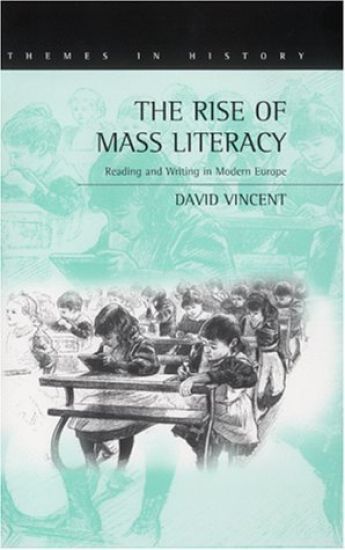
This important book provides a comparative study of the growth and impact of mass literacy across Europe between 1750 and 1950. The volume outlines the main features of the comparative growth of literacy, and relates them to the later growth of electronic media. It assesses the ways in which mass literacy has transformed ways of living and thinking, by exploring broader social and cultural issues such as gender, age, consciousness of time and space, and our relationship with the natural world. Vincent begins by considering the evolution of methods of teaching and learning across the centuries, and examines the relationship between literacy and economic growth, including the changing function of literacy in the workplace. He discusses the changing pattern of demand for and provision of reading matter, as well as the changing relationship between oral and written modes of generating and reproducing both information and fantasy. In later chapters, Vincent analyses the history of popular writing, and the relationship between print, language and national identity. The impact of literacy on democracy and political mobilization, and on the making of censorship and propaganda, is also discussed in this lively and accessible study.
The Rise of Mass Literacy

The Rise of Mass Literacy

David Vincent

Polity Press
2000
nidottu
This important book provides a comparative study of the growth and impact of mass literacy across Europe between 1750 and 1950. The volume outlines the main features of the comparative growth of literacy, and relates them to the later growth of electronic media. It assesses the ways in which mass literacy has transformed ways of living and thinking, by exploring broader social and cultural issues such as gender, age, consciousness of time and space, and our relationship with the natural world. Vincent begins by considering the evolution of methods of teaching and learning across the centuries, and examines the relationship between literacy and economic growth, including the changing function of literacy in the workplace. He discusses the changing pattern of demand for and provision of reading matter, as well as the changing relationship between oral and written modes of generating and reproducing both information and fantasy. In later chapters, Vincent analyses the history of popular writing, and the relationship between print, language and national identity. The impact of literacy on democracy and political mobilization, and on the making of censorship and propaganda, is also discussed in this lively and accessible study.
Privacy

Privacy

David Vincent

Polity Press
2016
sidottu
Privacy: A Short History provides a vital historical account of an increasingly stressed sphere of human interaction. At a time when the death of privacy is widely proclaimed, distinguished historian, David Vincent, describes the evolution of the concept and practice of privacy from the Middle Ages to the present controversy over digital communication and state surveillance provoked by the revelations of Edward Snowden. Deploying a range of vivid primary material, he discusses the management of private information in the context of housing, outdoor spaces, religious observance, reading, diaries and autobiographies, correspondence, neighbours, gossip, surveillance, the public sphere and the state. Key developments, such as the nineteenth-century celebration of the enclosed and intimate middle-class household, are placed in the context of long-term development. The book surveys and challenges the main currents in the extensive secondary literature on the subject. It seeks to strike a new balance between the built environment and world beyond the threshold, between written and face-to-face communication, between anonymity and familiarity in towns and cities, between religion and secular meditation, between the state and the private sphere and, above all, between intimacy and individualism. Ranging from the fourteenth century to the twenty-first, this book shows that the history of privacy has been an arena of contested choices, and not simply a progression towards a settled ideal. Privacy: A Short History will be of interest to students and scholars of history, and all those interested in this topical subject.
Privacy

Privacy

David Vincent

Polity Press
2016
nidottu
Privacy: A Short History provides a vital historical account of an increasingly stressed sphere of human interaction. At a time when the death of privacy is widely proclaimed, distinguished historian, David Vincent, describes the evolution of the concept and practice of privacy from the Middle Ages to the present controversy over digital communication and state surveillance provoked by the revelations of Edward Snowden. Deploying a range of vivid primary material, he discusses the management of private information in the context of housing, outdoor spaces, religious observance, reading, diaries and autobiographies, correspondence, neighbours, gossip, surveillance, the public sphere and the state. Key developments, such as the nineteenth-century celebration of the enclosed and intimate middle-class household, are placed in the context of long-term development. The book surveys and challenges the main currents in the extensive secondary literature on the subject. It seeks to strike a new balance between the built environment and world beyond the threshold, between written and face-to-face communication, between anonymity and familiarity in towns and cities, between religion and secular meditation, between the state and the private sphere and, above all, between intimacy and individualism. Ranging from the fourteenth century to the twenty-first, this book shows that the history of privacy has been an arena of contested choices, and not simply a progression towards a settled ideal. Privacy: A Short History will be of interest to students and scholars of history, and all those interested in this topical subject.
Nose Art of the 5th Air Force

Nose Art of the 5th Air Force

David Vincent

SCHIFFER PUBLISHING LTD
2025
sidottu
More than 1,000 images of the boldest aircraft nose artworks of the 5th Air Force during WWII; includes contextual information on individual artists and specific planes. This massive volume includes more than 1,150 vintage images of WWII aircraft nose art. The artwork appears on American planes in the Pacific theater, specifically from the US 5th Air Force. Readers will see all kinds of aircraft, from bombers to fighters and cargo planes. The artists range from amateurs to professionals, and the subjects include both the famous female "pin-ups" and more-aggressive militaristic or animal designs. The bulk of the photos are sourced from the author's private collection and are previously unpublished. Text accompanying the images includes combat histories of specific aircraft and crews, along with biographical information on prolific artists.
Bread, Knowledge and Freedom

Bread, Knowledge and Freedom

David Vincent

TAYLOR FRANCIS LTD
2023
sidottu
First published in 1981, Bread, Knowledge and Freedom is a study of 142 working class autobiographies all of which cover some part of the period between 1790 and 1850. It is a full-scale examination of a form of source material that is significantly extensive. The book illustrates many aspects of ordinary working-class family life as well as the working-class pursuit of knowledge and literacy and the attempts of the middle-class educators to impose their notion of ‘useful knowledge.’ Dr. Vincent concludes with an assessment of the contribution of autobiography to nineteenth century working class history. This book will be of interest to students of history, sociology and literature.
A History of Solitude

A History of Solitude

David Vincent

Polity Press
2020
sidottu
Solitude has always had an ambivalent status: the capacity to enjoy being alone can make sociability bearable, but those predisposed to solitude are often viewed with suspicion or pity. Drawing on a wide array of literary and historical sources, David Vincent explores how people have conducted themselves in the absence of company over the last three centuries. He argues that the ambivalent nature of solitude became a prominent concern in the modern era. For intellectuals in the romantic age, solitude gave respite to citizens living in ever more complex modern societies. But while the search for solitude was seen as a symptom of modern life, it was also viewed as a dangerous pathology: a perceived renunciation of the world, which could lead to psychological disorder and anti-social behaviour. Vincent explores the successive attempts of religious authorities and political institutions to manage solitude, taking readers from the monastery to the prisoner’s cell, and explains how western society’s increasing secularism, urbanization and prosperity led to the development of new solitary pastimes at the same time as it made traditional forms of solitary communion, with God and with a pristine nature, impossible. At the dawn of the digital age, solitude has taken on new meanings, as physical isolation and intense sociability have become possible as never before. With the advent of a so-called loneliness epidemic, a proper historical understanding of the natural human desire to disengage from the world is more important than ever. The first full-length account of its subject, A History of Solitude will appeal to a wide general readership.
A History of Solitude

A History of Solitude

David Vincent

Polity Press
2021
nidottu
Solitude has always had an ambivalent status: the capacity to enjoy being alone can make sociability bearable, but those predisposed to solitude are often viewed with suspicion or pity. Drawing on a wide array of literary and historical sources, David Vincent explores how people have conducted themselves in the absence of company over the last three centuries. He argues that the ambivalent nature of solitude became a prominent concern in the modern era. For intellectuals in the romantic age, solitude gave respite to citizens living in ever more complex modern societies. But while the search for solitude was seen as a symptom of modern life, it was also viewed as a dangerous pathology: a perceived renunciation of the world, which could lead to psychological disorder and anti-social behaviour. Vincent explores the successive attempts of religious authorities and political institutions to manage solitude, taking readers from the monastery to the prisoner’s cell, and explains how western society’s increasing secularism, urbanization and prosperity led to the development of new solitary pastimes at the same time as it made traditional forms of solitary communion, with God and with a pristine nature, impossible. At the dawn of the digital age, solitude has taken on new meanings, as physical isolation and intense sociability have become possible as never before. With the advent of a so-called loneliness epidemic, a proper historical understanding of the natural human desire to disengage from the world is more important than ever. The first full-length account of its subject, A History of Solitude will appeal to a wide general readership.
The Fatal Breath

The Fatal Breath

David Vincent

JOHN WILEY AND SONS LTD
2023
sidottu
The Fatal Breath is the first full-scale history of the Covid-19 pandemic in Britain. Deploying a rich archive of personal testimonies together with a wide range of research reports and official data, it presents a moving and challenging account of the crisis that enveloped Britain (and the world) in the spring of 2020. With sensitivity, care, and an historian’s critical eye, David Vincent places the pandemic in context. While much contemporary commentary has assumed people were forced to develop entirely new ways of living and working during lockdown, Vincent reveals how the population was able to draw upon a wealth of resources and coping strategies already seen over the centuries, often reacting far more quickly and effectively than slow-moving authorities. He tells the stories of doctors’ and nurses’ time on the frontlines, reveals the true extent of supply shortages, conspiracy theories, and vaccine resistance, and explores individuals’ newfound appreciation of nature and community in lockdown. The Fatal Breath will appeal to anyone seeking to reflect on the past few years and how the pandemic has changed Britain – for better and for worse.
2030: Your Children's Future in Islamic Britain: Europe's Great Immigration Disaster

2030: Your Children's Future in Islamic Britain: Europe's Great Immigration Disaster

David Vincent

Createspace Independent Publishing Platform
2015
nidottu
In 2015 a study produced by the Muslim Council of Britain (MCB) based on the 2011 census entitled British Muslims in Numbers revealed that between 2001 and 2011 Britain's Muslim population had increased by 75 per cent. It also revealed that 10 per cent of all children under-five in England and Wales are now Muslim.The Muslim birth-rate is not declining and the politicians who claimed that the birth-rates of Third World immigrants would eventually conform to the British average have been proved wrong. Because of political correctness and hate law legislation the welfare state is unable to record the true financial cost of resources used up by new migrants. Slowly at first but now with increasing rapidity every aspect of what we once viewed as our traditions and culture are being removed and replaced. Look around at those who now inhabit large areas of London, Liverpool, Manchester, Birmingham, Leeds, Bradford, Dewsbury and Rotherham and we see people who have no cultural or historic ties to Britain, many living in workless ghettos. Who decided that the British taxpayer would pay the bill for the Third World's poor and guarantee the human rights of the world's asylum seekers? Who decided our children had to be diversity brainwashed by the state school system in order to conform to foreign cultural norms? Where once the Labour Party said it could see no limit to the number of migrants it would be willing to allow into Britain it is now the European Left and the European Union (EU) that is facilitating a new wave of immigration from outside of Europe.The majority of the one million refugees now waiting to cross the Mediterranean from Libya into Italy and then on to the welfare states of Britain, Germany and Sweden are Islamic. Many of them could be terrorists intent on killing innocent citizens and yet they are encouraged to make the crossing with the help of the Royal Navy. How many millions more will continue to gain entry in reply to the open-ended invitation extended to all comers from the EU? What we have now is the next wave of open door refugee immigration into Europe from Asia and Africa, mandated by European bureaucrats. Can we remain safe in the land of our birth? That is the question all of us will want an answer to for the sake of our children and our children's children.