Kirjojen hintavertailu. Mukana 11 244 527 kirjaa ja 12 kauppaa.

Kirjahaku

Etsi kirjoja tekijän nimen, kirjan nimen tai ISBN:n perusteella.

3 kirjaa tekijältä David W. Bates

An Artificial History of Natural Intelligence

An Artificial History of Natural Intelligence

David W. Bates

THE UNIVERSITY OF CHICAGO PRESS
2024
sidottu
A new history of human intelligence that argues that humans know themselves by knowing their machines. We imagine that we are both in control of and controlled by our bodies—autonomous and yet automatic. This entanglement, according to David W. Bates, emerged in the seventeenth century when humans first built and compared themselves with machines. Reading varied thinkers from Descartes to Kant to Turing, Bates reveals how time and time again technological developments offered new ways to imagine how the body’s automaticity worked alongside the mind’s autonomy. Tracing these evolving lines of thought, An Artificial History of Natural Intelligence offers a new theorization of the human as a being that is dependent on technology and produces itself as an artificial automaton without a natural, outside origin.
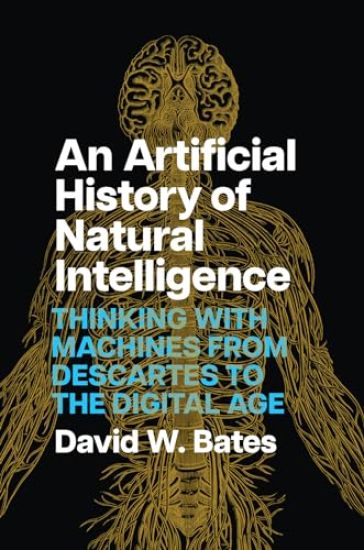
An Artificial History of Natural Intelligence

An Artificial History of Natural Intelligence

David W. Bates

THE UNIVERSITY OF CHICAGO PRESS
2026
nidottu
A new history of human intelligence that argues that humans know themselves by knowing their machines. We imagine that we are both in control of and controlled by our bodies—autonomous and yet automatic. This entanglement, according to David W. Bates, emerged in the seventeenth century when humans first built and compared themselves with machines. Reading varied thinkers from Descartes to Kant to Turing, Bates reveals how time and time again technological developments offered new ways to imagine how the body’s automaticity worked alongside the mind’s autonomy. Tracing these evolving lines of thought, An Artificial History of Natural Intelligence offers a new theorization of the human as a being that is dependent on technology and produces itself as an artificial automaton without a natural, outside origin.
Enlightenment Aberrations

Enlightenment Aberrations

David W. Bates

Cornell University Press
2002
sidottu
In Enlightenment Aberrations, David W. Bates shows that error was a complex, important, and by no means entirely negative concept in Enlightenment thought, one that had a decisive influence in revolutionary debates on political identity and national history. What can it mean to write a history of error? In Bates's view all philosophy, insofar as its project is the search for truth, begins in error. If truth is posited as a goal to be attained, not as a given of some kind, then error assumes a central role in the quest for truth. Going beyond both liberal celebrations and postmodern critiques of Enlightenment reason, Bates reveals just how crucial the problematic relation between human "wandering" and the mystery of truth was in eighteenth-century thought. The author draws on a wide range of Enlightenment thinkers, including Etienne Bonnot de Condillac, Jean d'Alembert, Marie-Jean-Antoine-Nicolas Caritat, Marquis de Condorcet, Jean-Jacques Rousseau, and Charles Bonnet, showing how they wrestled with the "risk and promise" of error. He then demonstrates how the concept of error and its dialectical relationship to truth played out in the political culture of the French Revolution, particularly in the Terror. In the final chapters, Bates looks at the post-revolutionary transformations of the Enlightenment discourse of error and its subsequent history in modern European thought.