Kirjojen hintavertailu. Mukana 11 342 296 kirjaa ja 12 kauppaa.

Kirjahaku

Etsi kirjoja tekijän nimen, kirjan nimen tai ISBN:n perusteella.

6 kirjaa tekijältä David W. Galenson

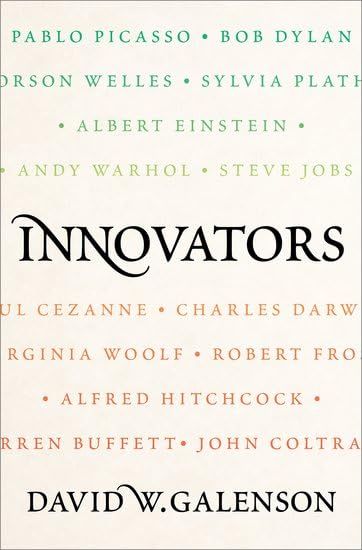
Innovators

Innovators

David W. Galenson

OXFORD UNIVERSITY PRESS INC
2025
sidottu
When in their lives are innovators most creative, and why? This book summarizes more than two decades of research prompted by this question. The result is an authoritative statement of a new unified theory of creativity, that overturns both popular and scholarly beliefs about the sources of human inventiveness. David Galenson shows that there are two distinctly different kinds of creativity in virtually every discipline. They result from very different goals and methods, and each produces a specific pattern of discovery over the life cycle. Conceptual innovators make bold leaps to formulate new ideas. The most radical conceptual innovations are made by brash young geniuses, who often lose their creativity thereafter. Great conceptual innovators analyzed in this book include Pablo Picasso, Albert Einstein, Orson Welles, Sylvia Plath, Andy Warhol, Bob Dylan, and Steve Jobs. Experimental innovators make discoveries gradually and unobtrusively, through careful observation and generalization. They gain knowledge over time, and make their greatest contributions late in their lives. Great experimental innovators considered in this book include Paul Cezanne, Charles Darwin, Virginia Woolf, Robert Frost, Alfed Hitchcock, John Coltrane, and Warren Buffett. From analysis of the careers of scores of artists, scholars, and entrepreneurs, this book provides a new understanding of the creative processes of great innovators, and reveals the systematic patterns that underlie the two life cycles of creativity. It will be of interest to anyone who seeks a deeper understanding of the sources of human creativity.
Conceptual Revolutions in Twentieth-Century Art

Conceptual Revolutions in Twentieth-Century Art

David W. Galenson

Cambridge University Press
2009
sidottu
From Picasso's Cubism and Duchamp's readymades to Warhol's silkscreens and Smithson's earthworks, the art of the twentieth century broke completely with earlier artistic traditions. A basic change in the market for advanced art produced a heightened demand for innovation, and young conceptual innovators – from Picasso and Duchamp to Rauschenberg and Warhol to Cindy Sherman and Damien Hirst – responded not only by creating dozens of new forms of art, but also by behaving in ways that would have been incomprehensible to their predecessors. Conceptual Revolutions in Twentieth-Century Art presents the first systematic analysis of the reasons for this discontinuity. David W. Galenson, whose earlier research has changed our understanding of creativity, combines social scientific methods with qualitative analysis to produce a fundamentally new interpretation of modern art that will give readers a far deeper appreciation of the art of the past century, and of today, than is available elsewhere.
White Servitude in Colonial America

White Servitude in Colonial America

David W. Galenson

Cambridge University Press
1982
pokkari
White servitude was one of the major institutions in the economy and society of early colonial British America. In fact more than half of all the white immigrants to the British colonies sold themselves into bondage for a period of years in order to migrate to the New World. Professor Galenson's study of the system of indentured servitude analyses rigourously the composition of this labour force and provides a quantitative description of the demographic, social and economic characteristics of more than 20,000 indentured immigrants. The author examines the interactions between indentured, free and slave labour and provides a framework for analysing why black slavery prevailed over white servitude in the British West Indies and the southern mainland colonies and why both types of bound labour declined to insignificance in the northern colonies of the mainland.
Traders, Planters and Slaves

Traders, Planters and Slaves

David W. Galenson

Cambridge University Press
2002
pokkari
The explosive growth of the Atlantic slave trade in the second half of the seventeenth century made the international trade in Africans one of the world’s largest industries. This book explores the operation of that industry in the late seventeenth and early eighteenth centuries, focusing on the market behaviour of the Royal African Company - the largest English company engaged in the slave trade - and the sugar planters of the Caribbean, who were the trade’s principal customers in English America. A richly detailed portrayal of the slave trade to English America emerges, one that shows it to have been a highly competitive and efficient transatlantic market. In revealing the existence of sophisticated and complex market behaviour in this early period of black slavery in the New World, the book adds to our understanding of the development of large-scale competitive markets, as well as to our knowledge of the efficiency of resource allocation in early English America.
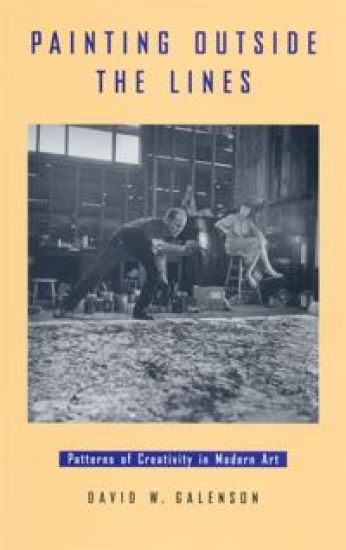
Painting outside the Lines

Painting outside the Lines

David W. Galenson

Harvard University Press
2002
sidottu
Why have some great modern artists—including Picasso—produced their most important work early in their careers while others—like Cézanne—have done theirs late in life? In a work that brings new insights, and new dimensions, to the history of modern art, David Galenson examines the careers of more than 100 modern painters to disclose a fascinating relationship between age and artistic creativity.Galenson’s analysis of the careers of figures such as Monet, Seurat, Matisse, Pollock, and Jasper Johns reveals two very different methods by which artists have made innovations, each associated with a very different pattern of discovery over the life cycle. Experimental innovators, like Cézanne, work by trial and error, and arrive at their most important contributions gradually. In contrast, Picasso and other conceptual innovators make sudden breakthroughs by formulating new ideas. Consequently, experimental innovators usually make their discoveries late in their lives, whereas conceptual innovators typically peak at an early age.A novel contribution to the history of modern art, both in method and in substance, Painting outside the Lines offers an enlightening glimpse into the relationship between the working methods and the life cycles of modern artists. The book’s explicit use of simple but powerful quantitative techniques allows for systematic generalization about large numbers of artists—and illuminates significant but little understood features of the history of modern art. Pointing to a new and richer understanding of that history, from Impressionism to Abstract Expressionism and beyond, Galenson’s work also has broad implications for future attempts to understand the nature of human creativity in general.
Old Masters and Young Geniuses

Old Masters and Young Geniuses

David W. Galenson

Princeton University Press
2007
pokkari
When in their lives do great artists produce their greatest art? Do they strive for creative perfection throughout decades of painstaking and frustrating experimentation, or do they achieve it confidently and decisively, through meticulous planning that yields masterpieces early in their lives? By examining the careers not only of great painters but also of important sculptors, poets, novelists, and movie directors, Old Masters and Young Geniuses offers a profound new understanding of artistic creativity. Using a wide range of evidence, David Galenson demonstrates that there are two fundamentally different approaches to innovation, and that each is associated with a distinct pattern of discovery over a lifetime. Experimental innovators work by trial and error, and arrive at their major contributions gradually, late in life. In contrast, conceptual innovators make sudden breakthroughs by formulating new ideas, usually at an early age. Galenson shows why such artists as Michelangelo, Rembrandt, Cezanne, Jackson Pollock, Virginia Woolf, Robert Frost, and Alfred Hitchcock were experimental old masters, and why Vermeer, van Gogh, Picasso, Herman Melville, James Joyce, Sylvia Plath, and Orson Welles were conceptual young geniuses. He also explains how this changes our understanding of art and its past. Experimental innovators seek, and conceptual innovators find. By illuminating the differences between them, this pioneering book provides vivid new insights into the mysterious processes of human creativity.