Kirjojen hintavertailu. Mukana 11 473 528 kirjaa ja 12 kauppaa.

Kirjahaku

Etsi kirjoja tekijän nimen, kirjan nimen tai ISBN:n perusteella.

5 kirjaa tekijältä David Wallace Adams

Three Roads to Magdalena

Three Roads to Magdalena

David Wallace Adams

University Press of Kansas
2016
sidottu
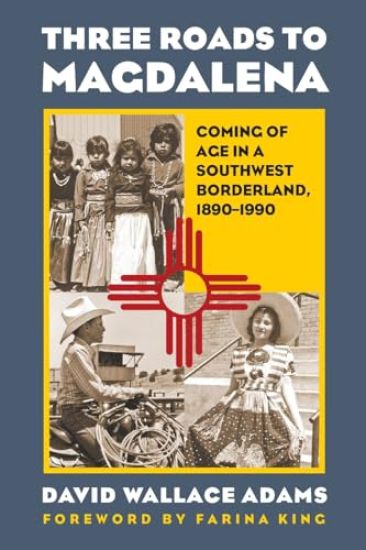
Someday,” Candelaria Garcia said to the author, “you will get all the stories.” It was a tall order in Magdalena, New Mexico, a once booming frontier town where Navajo, Anglo, and Hispanic peoplehave lived in shifting, sometimes separate, sometimes overlapping worlds for well over a hundred years. But these were the stories,and this was the world, that David Wallace Adams set out to map, in a work that would capture the intimate, complex history of growing up in a Southwest borderland. At the intersection of memory, myth, andhistory, his book asks what it was like to be a child in a land of ethnic and cultural boundaries. The answer, as close to “all thestories” as one might hope to get, captures the diverse, ever-changing experience of a Southwest community defined by culturalborders—and the nature and role of children in defending and crossing those borders.In this book, we listen to the voices of elders who knew Magdalena nearly a century ago, and the voices of a younger generation who negotiated the community’s shifting boundaries. Their stories take us to sheep and cattle ranches, Navajo ceremonies, Hispanic fiestas, mining camps, First Communion classes, ranch house dances, Indian boarding school drill fields, high school social activities, and children’s rodeos. Here we learn how class, religion, language, and race influenced the creation of distinct identities and ethnic boundaries, but also provided opportunities for crossculturalinteractions and intimacies. And we see the critical importance of education in both reinforcing differences and opening a shared space for those differences to be experienced and bridged. Adams’s workoffers a close-up view of the transformation of one multicultural community, but also of the transformation of childhood itself overthe course of the twentieth century. A unique blend of oral, social, and childhood history, Three Roads to Magdalena is a rare living document of conflict and accommodation across ethnic boundaries in our ever-evolving multicultural society.
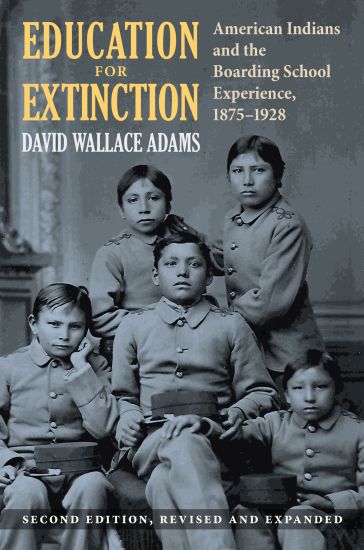
Education for Extinction

Education for Extinction

David Wallace Adams

University Press of Kansas
2020
sidottu
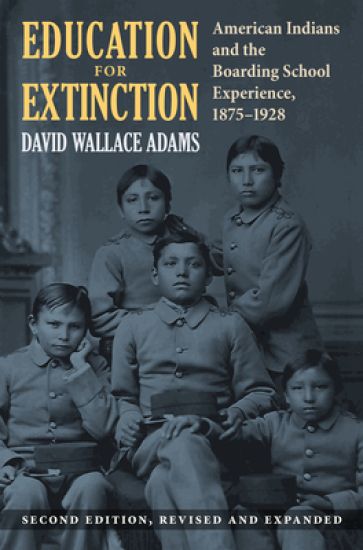
The last 'Indian War' was fought against Native American children in the dormitories and classrooms of government boarding schools. Only by removing Indian children from their homes for extended periods of time, policymakers reasoned, could white "civilization" take root while childhood memories of 'savagism' gradually faded to the point of extinction. In the words of one official: 'Kill the Indian and save the man.'This fully revised edition of Education for Extinction offers the only comprehensive account of this dispiriting effort, and incorporates the last twenty-five years of scholarship. Much more than a study of federal Indian policy, this book vividly details the day-to-day experiences of Indian youth living in a 'total institution' designed to reconstruct them both psychologically and culturally. The assault on identity came in many forms: the shearing off of braids, the assignment of new names, uniformed drill routines, humiliating punishments, relentless attacks on native religious beliefs, patriotic indoctrinations, suppression of tribal languages, Victorian gender rituals, football contests, and industrial training.Especially poignant is Adams's description of the ways in which students resisted or accommodated themselves to forced assimilation. Many converted to varying degrees, but others plotted escapes, committed arson, and devised ingenious strategies of passive resistance. Adams also argues that many of those who seemingly cooperated with the system were more than passive players in this drama, that the response of accommodation was not synonymous with cultural surrender. This is especially apparent in his analysis of students who returned to the reservation. He reveals the various ways in which graduates struggled to make sense of their lives and selectively drew upon their school experience in negotiating personal and tribal survival in a world increasingly dominated by white men.The discussion comes full circle when Adams reviews the government's gradual retreat from the assimilationist vision. Partly because of persistent student resistance, but also partly because of a complex and sometimes contradictory set of progressive, humanitarian, and racist motivations, policymakers did eventually come to view boarding schools less enthusiastically.Based upon extensive use of government archives, Indian and teacher autobiographies, and school newspapers, Adams's moving account is essential reading for scholars and general readers alike interested in Western history, Native American studies, American race relations, education history, and multiculturalism.
Education for Extinction

Education for Extinction

David Wallace Adams

University Press of Kansas
2020
nidottu
The last 'Indian War' was fought against Native American children in the dormitories and classrooms of government boarding schools. Only by removing Indian children from their homes for extended periods of time, policymakers reasoned, could white "civilization" take root while childhood memories of 'savagism' gradually faded to the point of extinction. In the words of one official: 'Kill the Indian and save the man.'This fully revised edition of Education for Extinction offers the only comprehensive account of this dispiriting effort, and incorporates the last twenty-five years of scholarship. Much more than a study of federal Indian policy, this book vividly details the day-to-day experiences of Indian youth living in a 'total institution' designed to reconstruct them both psychologically and culturally. The assault on identity came in many forms: the shearing off of braids, the assignment of new names, uniformed drill routines, humiliating punishments, relentless attacks on native religious beliefs, patriotic indoctrinations, suppression of tribal languages, Victorian gender rituals, football contests, and industrial training.Especially poignant is Adams's description of the ways in which students resisted or accommodated themselves to forced assimilation. Many converted to varying degrees, but others plotted escapes, committed arson, and devised ingenious strategies of passive resistance. Adams also argues that many of those who seemingly cooperated with the system were more than passive players in this drama, that the response of accommodation was not synonymous with cultural surrender. This is especially apparent in his analysis of students who returned to the reservation. He reveals the various ways in which graduates struggled to make sense of their lives and selectively drew upon their school experience in negotiating personal and tribal survival in a world increasingly dominated by white men.The discussion comes full circle when Adams reviews the government's gradual retreat from the assimilationist vision. Partly because of persistent student resistance, but also partly because of a complex and sometimes contradictory set of progressive, humanitarian, and racist motivations, policymakers did eventually come to view boarding schools less enthusiastically.Based upon extensive use of government archives, Indian and teacher autobiographies, and school newspapers, Adams's moving account is essential reading for scholars and general readers alike interested in Western history, Native American studies, American race relations, education history, and multiculturalism.
Three Roads to Magdalena

Three Roads to Magdalena

David Wallace Adams

UNIVERSITY PRESS OF KANSAS
2016
nidottu
Winner: David J. Weber-William P. Clements PrizeWinner: Robert G. Athearn AwardChoice Outstanding Academic Title“Someday,” Candelaria Garcia said to the author, “you will get all the stories.” It was a tall order, in Magdalena, New Mexico, a once booming frontier town where Navajo, Anglo, and Hispanic people have lived in shifting, sometimes separate, sometimes overlapping worlds for well over a hundred years. But these were the stories, and this was the world, that David Wallace Adams set out to map, in a work that would capture the intimate, complex history of growing up in a Southwest borderland. At the intersection of memory, myth, and history, his book asks what it was like to be a child in a land of ethnic and cultural boundaries. The answer, as close to “all the stories” as one might hope to get, captures the diverse, ever-changing experience of a Southwest community defined by cultural borders—and the nature and role of children in defending and crossing those borders.In this book, we listen to the voices of elders who knew Magdalena nearly a century ago, and the voices of a younger generation who negotiated the community’s shifting boundaries. Their stories take us to sheep and cattle ranches, Navajo ceremonies, Hispanic fiestas, mining camps, First Communion classes, ranch house dances, Indian boarding school drill fields, high school social activities, and children’s rodeos. Here we learn how class, religion, language, and race influenced the creation of distinct identities and ethnic boundaries, but also provided opportunities for cross-cultural interactions and intimacies. And we see the critical importance of education, in both reinforcing differences and opening a shared space for those differences to be experienced and bridged. In this, Adams’s work offers a close-up view of the transformation of one multicultural community, but also of the transformation of childhood itself over the course of the twentieth century.A unique blend of oral, social, and childhood history, Three Roads to Magdalena is a rare living document of conflict and accommodation across ethnic boundaries in our ever-evolving multicultural society.Published in Cooperation with the William P. Clements Center for Southwest Studies, Southern Methodist University
To Educate American Indians

To Educate American Indians

David Wallace Adams

University of Nebraska Press
2024
sidottu
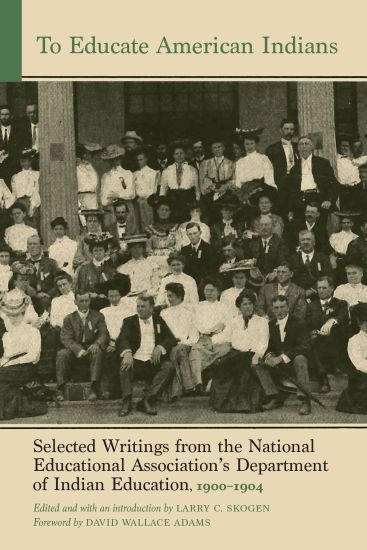
To Educate American Indians presents the most complete versions of papers presented at the National Educational Association’s Department of Indian Education meetings during a time when the debate about how best to “civilize” Indigenous populations dominated discussions. During this time two philosophies drove the conversation. The first, an Enlightenment era–influenced universalism, held that through an educational alchemy American Indians would become productive, Christianized Americans, distinguishable from their white neighbors only by the color of their skin. Directly confronting the assimilationists’ universalism were the progressive educators who, strongly influenced by the era’s scientific racism, held the notion that American Indians could never become fully assimilated. Despite these differing views, a frightening ethnocentrism and an honor-bound dedication to “gifting” civilization to Native students dominated the writings of educators from the NEA’s Department of Indian Education. For a decade educators gathered at annual meetings and presented papers on how best to educate Native students. Though the NEA Proceedings published these papers, strict guidelines often meant they were heavily edited before publication. In this volume Larry C. Skogen presents many of these unedited papers and gives them historical context for the years 1900 to 1904.