Kirjojen hintavertailu. Mukana 11 342 296 kirjaa ja 12 kauppaa.

Kirjahaku

Etsi kirjoja tekijän nimen, kirjan nimen tai ISBN:n perusteella.

24 kirjaa tekijältä David Webster

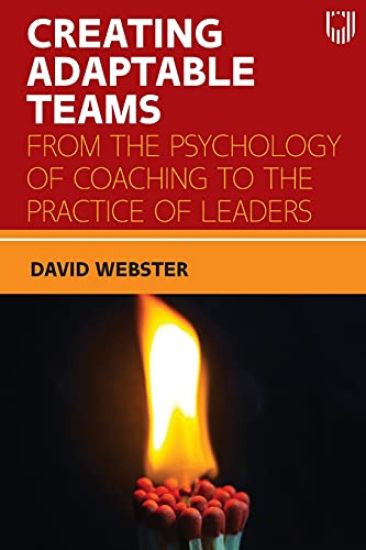
Creating Adaptable Teams: From the Psychology of Coaching to the Practice of Leaders
This practical guide for coaches, leaders and team members will help readers create team success in a modern context. Adaptability has now become a core skill and adaptable teams create foundations that withstand the increasing speed of change, allowing for quality in performance to be sustained. This book defines the core components of the Adaptable Team™ Framework, to embed the principles and practice of team support.As teams can often work in a range of volatile, uncertain and ambiguous environments, this book offers numerous tips for readers on their quest for team excellence:-Supporting the team coach and coaching psychologist in their preparation and design for team interventions, by providing both theory and practical application of evidenced-based approaches-Guiding leaders looking to coach their own teams and managers to lead success-Highlighting each leader’s unique contribution-Providing team members a map by which to navigate their professional development as leaders and team members“There are pearls of wisdom on every page which are invaluable to every leader, coach and team.”Professor Karen Middleton CBE, FCSP, MA, Chief Executive, The Chartered Society of Physiotherapy“Whether you’re a CEO or CHRO working on team dynamics, or a coach seeking to deepen your practice, you’ll find excellent food for thought on every page.”Caroline Webb, Author of global best seller ‘How To Have A Good Day’ and Senior Adviser to McKinsey & Company“David has a profound understanding of what makes teams resilient in change and positioned to perform in the modern world.”Andrew Shebbeare, Managing Partner, Counteract“Possibly the best book on teams and coaching I have read."Jonathan Passmore, Director, Henley Centre for Coaching & Behavioural Change David Webster is Founding Partner at Centre for Teams, UK and an award-winning coaching psychologist, specialising in senior teams. A former Chair of the British Psychological Society’s Coaching Psychology Group, and a martial art black belt, David can also be found hill walking with his dog Molly, cycling and enjoying live music and theatre.
The Philosophy of Desire in the Buddhist Pali Canon
David Webster explores the notion of desire as found in the Buddhist Pali Canon. Beginning by addressing the idea of a 'paradox of desire', whereby we must desire to end desire, the varieties of desire that are articulated in the Pali texts are examined. A range of views of desire, as found in Western thought, are presented as well as Hindu and Jain approaches. An exploration of the concept of ditthi(view or opinion) is also provided, exploring the way in which 'holding views' can be seen as analogous to the process of desiring. Other subjects investigated include the mind-body relationship, the range of Pali terms for desire, and desire's positive spiritual value. A comparative exploration of the various approaches completes the work.
The Philosophy of Desire in the Buddhist Pali Canon
David Webster explores the notion of desire as found in the Buddhist Pali Canon. Beginning by addressing the idea of a 'paradox of desire', whereby we must desire to end desire, the varieties of desire that are articulated in the Pali texts are examined. A range of views of desire, as found in Western thought, are presented as well as Hindu and Jain approaches. An exploration of the concept of ditthi(view or opinion) is also provided, exploring the way in which 'holding views' can be seen as analogous to the process of desiring. Other subjects investigated include the mind-body relationship, the range of Pali terms for desire, and desire's positive spiritual value. A comparative exploration of the various approaches completes the work.
Parachute Infantry: An American Paratrooper's Memoir of D-Day and the Fall of the Third Reich
David Kenyon Webster's memoir is a clear-eyed, emotionally charged chronicle of youth, camaraderie, and the chaos of war. Relying on his own letters home and recollections he penned just after his discharge, Webster gives a first hand account of life in E Company, 101st Airborne Division, crafting a memoir that resonates with the immediacy of a gripping novel. From the beaches of Normandy to the blood-dimmed battlefields of Holland, here are acts of courage and cowardice, moments of irritating boredom punctuated by moments of sheer terror, and pitched urban warfare. Offering a remarkable snapshot of what it was like to enter Germany in the last days of World War II, Webster presents a vivid, varied cast of young paratroopers from all walks of life, and unforgettable glimpses of enemy soldiers and hapless civilians caught up in the melee. Parachute Infantry is at once harsh and moving, boisterous and tragic, and stands today as an unsurpassed chronicle of war--how men fight it, survive it, and remember it.
Uniforms of the Soviet Union 1918-1945

Uniforms of the Soviet Union 1918-1945

David Webster

Schiffer Publishing Ltd
1998
sidottu
For the first time a photographic study of the Soviet uniforms from the Revolution, Civil War, Purges, and the Great Patriotic War. Hundreds of full color highly detailed photographs of actual uniforms are combined with period black and white photographs. Actual uniforms of Marshals of the Soviet Union, to private soldiers of all services are to be found in this extensive volume.
Fire and the Full Moon

Fire and the Full Moon

David Webster

University of British Columbia Press
2009
sidottu
The history of Canada's postwar foreign policy is dominated by Cold War narratives – the Gouzenko Affair, UN peacekeeping missions, and the Cuban Missile Crisis. By contrast, the story of Canada's response to decolonization in the Global South is less well known.Fire and the Full Moon explores Canadian-Indonesian relations to determine whether Canada's postwar foreign policy was guided by an overarching set of principles. Canada, a loyal member of the Western alliance, wanted developing countries to follow a non-revolutionary model of decolonization and paid little attention to violations of human rights. Webster's reassessment of Canada's foreign-policy objectives in Indonesia, and of its own national image, will appeal to students of diplomatic history interested in Asia and the developing world.
Fire and the Full Moon

Fire and the Full Moon

David Webster

University of British Columbia Press
2010
pokkari
The history of Canada's postwar foreign policy is dominated by Cold War narratives – the Gouzenko Affair, UN peacekeeping missions, and the Cuban Missile Crisis. By contrast, the story of Canada's response to decolonization in the Global South is less well known.Fire and the Full Moon explores Canadian-Indonesian relations to determine whether Canada's postwar foreign policy was guided by an overarching set of principles. Canada, a loyal member of the Western alliance, wanted developing countries to follow a non-revolutionary model of decolonization and paid little attention to violations of human rights. Webster's reassessment of Canada's foreign-policy objectives in Indonesia, and of its own national image, will appeal to students of diplomatic history interested in Asia and the developing world.
Challenge the Strong Wind

Challenge the Strong Wind

David Webster

University of British Columbia Press
2020
sidottu
In 1975, Indonesian forces overran East Timor, just days after it declared independence from Portugal. Canadian officials knew the invasion was coming and endorsed Indonesian rule in the ensuing occupation. Challenge the Strong Wind recounts the evolution of Canadian government policy toward East Timor from 1975 to its 1999 independence vote. During this time, Canadian civil society groups and NGOs worked in support of Timorese independence activists by promoting an alternative Canadian foreign policy that focused on self-determination and human rights. After following the lead of key pro-Indonesian allies in the 1970s and '80s, Ottawa eventually yielded to pressure from these NGOs and pushed like-minded countries to join it in supporting Timorese self-rule. David Webster draws on previously untapped government and non-government archival sources to demonstrate that a clear-eyed view of international history must include both state and non-state perspectives. The East Timor conflict serves as a model of multilevel dialogue, citizen diplomacy, and novel approaches to resolving complex disputes.
Challenge the Strong Wind

Challenge the Strong Wind

David Webster

University of British Columbia Press
2020
pokkari
In 1975, Indonesian forces overran East Timor, just days after it declared independence from Portugal. Canadian officials knew the invasion was coming and endorsed Indonesian rule in the ensuing occupation. Challenge the Strong Wind recounts the evolution of Canadian government policy toward East Timor from 1975 to its 1999 independence vote. During this time, Canadian civil society groups and NGOs worked in support of Timorese independence activists by promoting an alternative Canadian foreign policy that focused on self-determination and human rights. After following the lead of key pro-Indonesian allies in the 1970s and '80s, Ottawa eventually yielded to pressure from these NGOs and pushed like-minded countries to join it in supporting Timorese self-rule. David Webster draws on previously untapped government and non-government archival sources to demonstrate that a clear-eyed view of international history must include both state and non-state perspectives. The East Timor conflict serves as a model of multilevel dialogue, citizen diplomacy, and novel approaches to resolving complex disputes.
COVID-19 Track and Trace Diary

COVID-19 Track and Trace Diary

David Webster

Lulu.com
2020
pokkari
Do you know where you were last week? Who were you with? Where you visited? Don't rely on your memory; make a note as you go in this COVID-19 Track and Trace Diary. As we come out of lockdown and venture back into the COVID-19 version of normal, now more than ever it is essential to know where you have been, when and with whom. Despite taking the precautions of social distancing and wearing a face covering, if you get the telephone call, can you be sure when and where you were? Don't guess, track it in this useful diary. Contains 62 pages, with three location entries per page, allowing you to record: ● Date ● Location ● Time ● Who you were with ● Who you encountered All in a handy-sized book.
The Population of Tikal: Implications for Maya Demography
The Classic Maya (AD 250-900) of central and southern Yucatan were long seen as exceptional in many ways. We now know that they did not invent Mesoamerican writing or calendars, that they were just as warlike as other ancient peoples, that many innovations in art and architecture attributed to them had diverse origins, and that their celebrated “collapse” is not what it seems. One exceptionalist claim stubbornly persists: the Maya were canny tropical ecologists who managed their fragile tropical environments in ways that supported extremely large and dense populations and still guaranteed resilience and sustainability. Archaeologists commonly assert that Maya populations far exceeded those of other ancient civilizations in the Old and New Worlds. The great center of Tikal, Guatemala, has been central to our conceptions of Maya demography since the 1960s. Re-evaluation of Tikal’s original settlement data and its implications, supplemented by much new research there and elsewhere, allows a more modest and realistic demographic evaluation. The peak Classic population probably was on the order of 1,000,000 people. This population scale helps resolve debates about how the Maya made a living, the nature of their sociopolitical systems, how they created an impressive built environment, and places them in plausible comparative context with what we know about other ancient complex societies.
I am Edison

I am Edison

David Webster

TROUBADOR PUBLISHING
2022
nidottu
When Edison Maksim Nathaniel Vincent got up that morning, he never expected to get this lost. Sure, when you're a new kid, you get lost, but as he wanders ever deeper into the woods, he soon realises this is no ordinary forest and things he'd never imagined were possible are all too real - and maybe even deadly. He takes the logical path and decides to keep going in a straight line, hoping he may come across something or someone that may help. And he does, but not in the way he thought! Edison has never given any real thought to what his names mean, but as he walks through the forest, the Great Oak, the Winged Lion, the Winged Ox and an Angel all reveal that his names carry special meanings that will propel him into success, greatness and prosperity. However, when he succumbs to the temptations of the Serpent, who will rescue him from its evil coils? Who will make the sacrifice required and will he ever really learn who he truly is? Perfect for ages 8 - 12, this coming of age fantasy helps show young readers who can't see the forest for the trees that growing up is an adventure all its own.
The Skyband Group, Copan Honduras

The Skyband Group, Copan Honduras

David Webster

Archaeopress
2023
pokkari
The Skyband Group is an impressive elite site in the urban core of Copán, Honduras, which is dominated by the palatial compounds of Maya sub-royal nobles. Such grandees often bore court titles showing that they were clients and officials of kings, but also competitors for political power, especially just before the dynastic collapse around AD 800. Penn State University excavations in 1990 and 1997 revealed large vaulted buildings, richly embellished with facade sculpture, and an elaborate carved throne in the form of a sky band, replete with celestial images of the sun, moon, and Venus. Artifacts and burials retrieved from these buildings and smaller ancillary structures are characteristic of elite residences, but the iconography of the facades and the throne also reveals connections with Copán’s royal dynasty and efforts by the last ruler to shore up his faltering kingdom. Activity at the Skyband Group and other sites in the Copán valley continued after the abrupt political debacle, an example of the ‘slow collapse’ process that is increasingly evident among the great Maya centers in the southern lowlands of Mesoamerica.