Kirjojen hintavertailu. Mukana 11 342 296 kirjaa ja 12 kauppaa.

Kirjahaku

Etsi kirjoja tekijän nimen, kirjan nimen tai ISBN:n perusteella.

5 kirjaa tekijältä Debbie Levitt

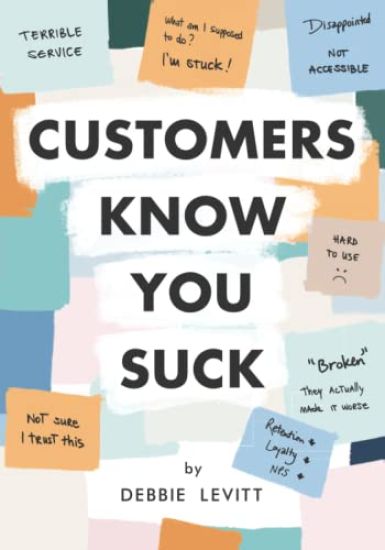
Customers Know You Suck

Customers Know You Suck

Debbie Levitt

Delta CX Media
2022
pokkari
Customers Know You Suck is the how-to manual for customer-centric product-market fit. Its highly actionable models, maps, and processes empower everyone to improve the Customer Experience (CX). Learn how to investigate, diagnose, and act on what's blocking teams. Gather the evidence and data that better inform decisions, leading to increased satisfaction, conversion, and loyalty. Use our governance model for implementing and monitoring the progress, success, and failure of internal process changes and experiments.We've all been in that meeting: something we thought users would want or do didn't happen as expected. How did we get that wrong and how do we keep that from happening again? Too often, product and service decisions are not guided by customer intelligence data. Where we lack knowledge, we work from guesses and assumptions, introducing or increasing risk.Customers expect high quality and value from every interaction with your company. People notice when we don't meet their quality standards. Our reviews, stock price, support tickets, and customer attrition clearly show that what we thought was "good enough" isn't. If you lose potential or current customers in one channel, you've probably lost them in every channel.But transforming toward customer-centricity strengthens customer relationships and increases revenue. Save money, reduce risk, work more efficiently, and improve culture while increasing customer satisfaction and loyalty.-----Who should read this book? Managers, leaders, and execs. Strategists and analysts. Product, Marketing, Support, Engineering, Data, CX, UX, and everybody else. This book is about creating change. Where you don't have that authority, please bring ideas to those above you in your org.-----"Every chapter in Customers Know You Suck has something that makes me think, "If only that annoying person in my company understood this." The book contains a lot of principles and practical advice, and can be easily skimmed if you need to go deeper into one of the topics. It's a manual, and I mean this in a very positive way: it's deep, it's comprehensive, and it's chunked in a way that allows me to find the answer to a specific question the moment I need it. There are a lot of short paragraphs with precise titles, boxes with specific examples, and separate chapters for interviews. It's super helpful, and easy to find topics I want to explore." - Ilaria Fioravanti, UX Designer-----Advice from authors, speakers, trainers, big consulting companies, webinars, and white papers is often high-level. You might hear the following and still have no idea what to do: * Deliver innovative products and services.* Be product-led, use product discovery techniques, and validate ideas for product-market fit.* Be Agile and Lean. Increase efficiency and velocity.* Value privacy, safety, ethics, diversity, inclusion, and accessibility.* Aim for continuous discovery, continuous delivery, continuous improvement, and continuous learning.* Convince the execs and get buy-in.* Create positive customer and employee experiences.* Lead with empathy and create empathy* Talk to customers, listen to them, and walk in their shoes.* Design a customer journey map.* Experiment, innovate, and disrupt* Use NPS, measure customer satisfaction, and do whatever it takes to lift those scores.* Run some surveys, A/B tests, talk to a few customers, and find out what they need.* Pursue customer feedback.* Brainstorm using workshops, design thinking, design sprints, Lean UX, and LEGO.This book takes a critical thinking look at the above advice, and guides readers to action.
Customers Know You Suck

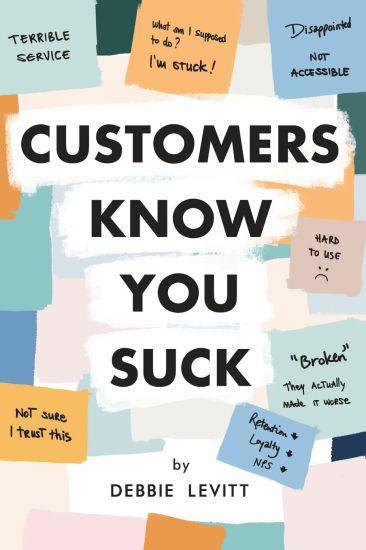
Customers Know You Suck

Debbie Levitt

Delta CX Media
2022
sidottu
Customers Know You Suck is the how-to manual for customer-centric product-market fit. Its highly actionable models, maps, and processes empower everyone to improve the Customer Experience (CX). Learn how to investigate, diagnose, and act on what's blocking teams. Gather the evidence and data that better inform decisions, leading to increased satisfaction, conversion, and loyalty. Use our governance model for implementing and monitoring the progress, success, and failure of internal process changes and experiments.We've all been in that meeting: something we thought users would want or do didn't happen as expected. How did we get that wrong and how do we keep that from happening again? Too often, product and service decisions are not guided by customer intelligence data. Where we lack knowledge, we work from guesses and assumptions, introducing or increasing risk.Customers expect high quality and value from every interaction with your company. People notice when we don't meet their quality standards. Our reviews, stock price, support tickets, and customer attrition clearly show that what we thought was "good enough" isn't. If you lose potential or current customers in one channel, you've probably lost them in every channel.But transforming toward customer-centricity strengthens customer relationships and increases revenue. Save money, reduce risk, work more efficiently, and improve culture while increasing customer satisfaction and loyalty."Transforming Toward Customer-Centricity" is the live interactive workshop version of some of the key points and exercises in the book. https: //deltacx.link/ttcc-training-----Who should read this book? Mid-level, senior, lead, principal, manager, director, or higher. Juniors and those new to their careers are welcome, but might not have enough frame of reference for some of the advice and exercises. CX, UX, and Design; Business Analysts; Engineering; Product Managers; Project Managers; Lean Evangelists; Scrum Masters and Agile Coaches; Marketing; Sales; Business Transformation Leaders; Consultants; Strategists. -----"Every chapter in Customers Know You Suck has something that makes me think, "If only that annoying person in my company understood this." The book contains a lot of principles and practical advice, and can be easily skimmed if you need to go deeper into one of the topics. It's a manual, and I mean this in a very positive way: it's deep, it's comprehensive, and it's chunked in a way that allows me to find the answer to a specific question the moment I need it. There are a lot of short paragraphs with precise titles, boxes with specific examples, and separate chapters for interviews. It's super helpful, and easy to find topics I want to explore." - Ilaria Fioravanti, UX Designer-----Advice from authors, speakers, trainers, big consulting companies, webinars, and white papers is often high-level. You might hear the following and still have no idea what to do: * Be product-led, use product discovery techniques, and validate ideas for product-market fit.* Be Agile and Lean. Increase efficiency and velocity.* Aim for continuous discovery, continuous delivery, and continuous improvement.* Lead with empathy and create empathy.* Talk to customers, listen to them, and walk in their shoes.* Design a customer journey map.* Experiment, innovate, and disrupt* Use NPS, measure customer satisfaction, and do whatever it takes to lift those scores.* Run some surveys, A/B tests, talk to a few customers, and find out what they need.* Brainstorm using workshops, design thinking, design sprints, Lean UX, and LEGO.This book takes a critical thinking look at the above advice, and guides readers to action.
Life After Tech (printed by Ingram Spark)

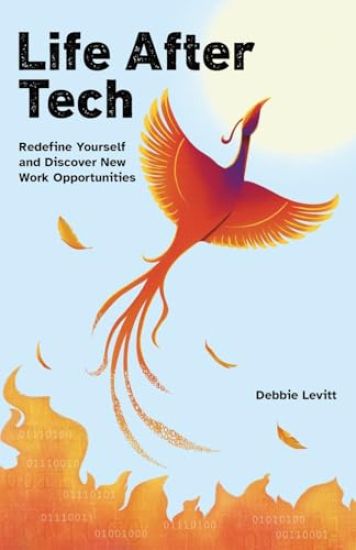
Life After Tech (printed by Ingram Spark)

Debbie Levitt

Delta CX Media
2024
pokkari
(For other formats for this book, please see https: //lat.link/book)You are the phoenix. It's never too early to plan what you'll do when you're done with tech... or tech is done with you. You might not be ready to change careers, but you're curious about adding non-tech work or growing your own business. After decades of building a tech career, author Debbie Levitt is one of many people with questions, anxieties, and doubts. As a mentor and coach, the employed and unemployed often ask her, "What happened to tech jobs?" and "What will I do next?"Life After Tech is your personal and proactive journey. Eighteen introspective exercises-plus templates and examples-make Life After Tech a guide and a workbook. Use the "Phoenix Flight Plan" to get grounded, plan, rise, and soar.Debbie addresses common career change emotions and fears through sensitivity, critical thinking, humor, and vulnerability. She provides fresh advice and perspectives while avoiding the toxic positivity that plagues job struggles.- - - - - - -This topic is so stigmatized that Life After Tech is one of the first books-and possibly the first book-specifically about leaving technology jobs and careers. Life After Tech is for everybody considering a career or work change.The Life After Tech Discord community, membership website, and other resources make Life After Tech more than a book. https: //LifeAfterTech.info It's a support system that welcomes everybody no matter where they are on the ever-changing working in tech/not working in tech spectrum. You can also find the PDF, EPUB, and audiobook on our website.
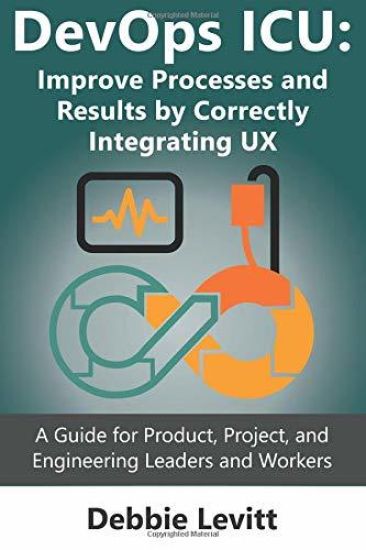
Devops ICU: Improve Processes and Results by Correctly Integrating Ux: A Guide for Product, Project, and Engineering Leaders and Workers
Software development methodologies lack the details of how UX fits into organizations, teams, and projects. Some suggest that a Product Manager describing features is enough, UX should train others to do their work, or excluding UX solves them being "too siloed." This happens with no other role in software development. It's hurting culture, efficiency, and productivity, and creating poor products for customers.Your customer only sees your UX, not your 1000 developers or if you were Agile or Lean. Companies are figuring out that UX specialists and the User-Centered Design process are high-ROI and irreplaceable. Recent highly-publicized UX failures remind us that skimping on UX can alienate customers, create negative media attention, and burn millions of dollars.Learn how the UX process fits into Agile and Lean; augments DevOps goals; increases customer satisfaction; and saves time, money, and sanity... all before developers write a line of code.--------------------------------------------------Across companies of all sizes, there is a clear pattern: People don't understand UX and they're not sure how it works into their organizations.You've probably had conflicts with UX practitioners. They don't seem Lean or Agile. In fact, they're throwing off your Agile train so badly you want to throw them under it They're killing ideas, timelines, and budgets. Their work looks easy, why can't you just do it yourselves? UX seems like a black box disappearing for weeks or months and then just telling us what to build. Where are the communication and collaboration?UX practitioners are keenly aware of these conflicts and how they are seen as the problem. Non-UX roles have many misunderstandings and myths about UX including these issues: -Agile methodologies often don't mention UX at all, as if the people designing what Engineering will build are not important or necessary.-Everybody thinks UX is just wireframes and "anybody can draw boxes on a page," but it's far from that. -UX isn't formalized and doesn't have defined processes or approaches; it's whatever the designer "feels like." False -Companies select the wrong people for a job that HR and hiring managers don't understand. They think these roles require artists, but UX is not an art job.-Teams are sure they don't need UX or can't afford it, often without knowing what UX work and tools actually cost.-Product managers often want to "do UX work" before or during a project. However, they don't realize that what they are doing isn't really UX.-Developers often aren't sure what UX is or believe those are the workers who A/B test things after release. That's too late for user testing. Wouldn't engineers like to know before they code that what they're working on has been validated as being a good product or feature for customers? Yes, they often think that idea sounds great You'll learn to dispel these UX myths, misunderstandings, and more in this book. Let's get your DevOps out of the ICU. Learning goals include:1) The correct integration of UX saves time, money, increases efficiency, keeps engineering's changes to a minimum, & creates the best product for users.2) UX specialists conduct research, design the entire product, learn from testing, iterate to fix flaws, & deliver vetted blueprints so engineers build once.3) How User-Centered Design fits into project timelines and development methodologies including Agile and Lean.4) The benefits of bringing UX specialists in early during portfolio planning and management.--------------------------------------------------"If you're a member of an Agile team and you're struggling to understand how best to partner with UX, DevOps ICU is the book for you. Debbie's real-life stories and experiences will light your path. And the book is pretty funny, too." - Travis Bjorklund, Senior Manager, Product Management and Agile Transformation
Canetti Perfetti

Canetti Perfetti

Debbie Levitt

Delta CX Media
2024
pokkari
The true adventures of five dogs in the Italian countryside. The "Canetti Perfetti" family are Olivia and her brother Romeo, plus three of Olivia's pups: Diana, Pisolo, and Teseo.Book #1 is three books in one: "Meet The Family," "Meet Our Friends," and "How to Steal Pancakes." Our dogs' friends include other neighborhood dogs, Grandma's cat, and some donkeys who like to visit our house. "How to Steal Pancakes" is a step-by-step photographic adventure about that time Diana sat nicely at the table, but couldn't resist what Daddy was eating.Our blended dog family includes five very different personalities: Free-spirited Olivia has a large group of friends she likes to visit. Sometimes they come to see her too.Foreman Romeo wants to be involved in everybody's projects, and is bad at keeping secrets.Patient Teseo is happy to wait his turn, and is a daydreamer imagining adventures only he can see.Wacky Pisolo is a clown and wants a lot of attention. He copies and follows others, but sometimes comes up with something clever on his own.Genius Diana is a planner and a leader even though she's the smallest of our dogs. She always has an idea and solution.This full-color picture book is aimed at children mostly age 8 and younger. It's a fun read for English speakers and English learners reading at a lower primary or elementary school level. Most pages have fewer than 20 words. With some of the dogs telling their own stories, it's an opportunity for parents, caretakers, and children to invent voices for the animals.https: //CanettiPerfetti.com for the (less expensive) PDF version of the book, merchandise, other fun stuff, and a free download of activity pages (word games and coloring sheets). Follow the dogs and their friends on Instagram @CanettiPerfettiNo AI was used in this book. We wrote the text and we took the photos. None of the photos were staged or posed. We capture our dogs - and other local animals - naturally being themselves.