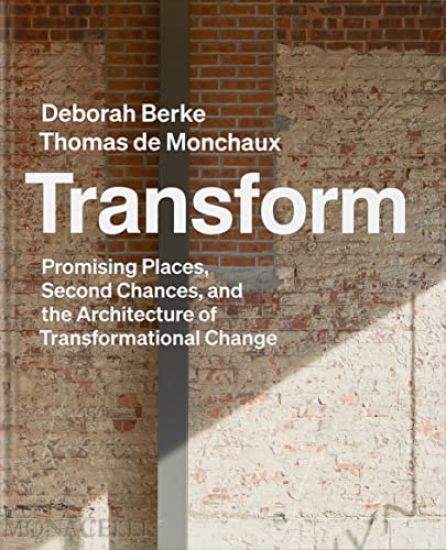
'Beautifully presented and accompanied by abundant photographs and plan diagrams, the entry masterfully explores Berke’s modernist inclinations, her minimalist style, and her firm’s savvy handling of spaces and materials. Architectural students and practitioners will find much to appreciate.' - Publishers Weekly TenBerke publishes Transform with Monacelli, an argument for the regenerative reuse of old buildings. ?Adaptive Reuse is how architecture helps us grow into a changing world. It combines the best of old and new—through renovation, restoration, regeneration, reimagination, and repair. A practice of sensitive stewardship and creative conservation, it is what turns the obsolete into the germane. With TenBerke’s most recent publication with Monacelli, Transform: Promising Places, Second Chances, and the Architecture of Transformational Change, the studio shows that creatively and visibly repurposed places are also where people feel especially empowered to make new beginnings in their own lives. Transform illustrates how TenBerke, in all its transformative designs, reveals the signs and signatures of adaptation, composes a continuity in which the after doesn’t erase the before, and designs places where people are able to leave new traces—and make their mark. The adaptive reuse in Transform goes beyond the usual before and after of renovation and conversion, into the long and lively places of buildings, which are always being remade by the people who use them. Transform includes Against Historic Preservation, an argument for the creative reuse of old buildings by Deborah Berke, founder of TenBerke and dean of the Yale School of Architecture; along with Promise, a critical narrative essay by award-winning design writer Thomas de Monchaux. It also includes The Environmental Case for Adapting Buildings at Scale, a report by urban scientist Karen C. Seto who looks to building reuse as a means to manage the untenable rate of urbanization of our natural environments. Transform includes, in the words of artist Titus Kaphar, “Time Is That Collaborator. . .” a conversation between himself and Berke inspired by TenBerke’s design for NXTHVN, a community arts center that he founded in New Haven Connecticut, bringing former industrial buildings to new life. With editorial and creative direction from TenBerke Senior Principal Arthi Krishnamoorthy, Transform presents accessible and actionable case studies of adaptive reuse projects, revealing the thinking that guides each one: from NXTHVN, where an arts incubator and community center was born out of disused factories; to the Yale School of Art, where an old swimming pool became a gallery and classroom; to the pioneering 122 Community Arts Center in downtown Manhattan, where an old public school became a new performance space and civic crossroads, to the 21c hotel in Oklahoma City, where one of the Ford Motor Company’s first assembly plants became a hotel and event space, catalyzing the revitalization of a new livable neighborhood. In Transform, we see that the architecture of adaptation offers a new approach to old places that is at once sensitive and bold, at once conscious of histories and legacies, yet optimistically forward-looking to new possibilities. This is the architecture of second chances, of promising places, and of transformational change.