
Kirjojen hintavertailu. Mukana 11 244 527 kirjaa ja 12 kauppaa.

Kirjahaku

Etsi kirjoja tekijän nimen, kirjan nimen tai ISBN:n perusteella.

3 kirjaa tekijältä Deborah Boyle

Mary Shepherd

Mary Shepherd

Deborah Boyle

OXFORD UNIVERSITY PRESS INC
2023
nidottu
Scottish philosopher Lady Mary Shepherd (1777-1847) wrote two books that she conceived as one unified project: Essay Upon the Relation of Cause and Effect (1824) and Essays on the Perception of an External Universe (1827). While they were well received in her day, Shepherd's insightful philosophical writings have been neglected for some 150 years and are only now receiving the scholarly attention they deserve. Mary Shepherd: A Guide by Deborah Boyle, part of the Oxford Guides to Philosophy series, navigates students of philosophy or general readers through Shepherd's two significant works. The first four chapters address topics raised in the 1824 Essay: Shepherd's arguments for two key causal principles, her objections to Hume and her alternative accounts of causation and causal inference; her theory of objects as bundles of qualities; her critique of Thomas Brown's defence of Humean causation; and her discussion of London surgeon William Lawrence's accounts of sentience and life, which Shepherd treats as a case study of how Humean theory can lead to errors in scientific reasoning. Chapter 5 covers topics central to both of Shepherd's books: what she means by "sensation," "idea," "will," "imagination," "understanding," "reasoning," and "latent reasoning." The remaining five chapters proceed systematically through Shepherd's 1827 book, where she seeks to prove, against Berkeleian idealism, that we can know that an external world of mind-independent matter exists. Boyle discusses Shepherd's proofs for such an external world, her responses to various sceptical challenges, and her specific objections to Berkeley. Each chapter ends with a list of works for further reading and a glossary of terms that explain Shepherd's sometimes idiosyncratic philosophical vocabulary, resulting in an essential guide to a philosopher who exerted considerable influence during her time.
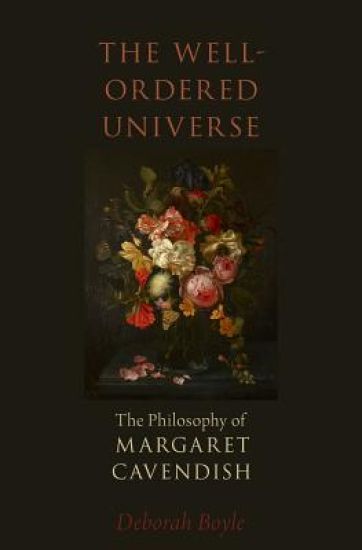
The Well-Ordered Universe

The Well-Ordered Universe

Deborah Boyle

Oxford University Press Inc
2017
sidottu
The prolific Margaret Cavendish (1623-1673) published books on natural philosophy as well as stories, plays, poems, orations, allegories, and letters. Her mature philosophical system offered a unique panpsychist theory of Nature as composed of a continuous, non-atomistic, perceiving, knowing matter. In contrast to the dominant philosophical thinking of her day, Cavendish argued that all matter has free will and can choose whether or not to follow Nature's rules. The Well-Ordered Universe explores the development of Cavendish's natural philosophy from the atomism of her 1653 poems to the panpsychist materialism of her 1668 Grounds of Natural Philosophy. Deborah Boyle argues that her natural philosophy, her medical theories, and her social and political philosophy are all informed by an underlying concern with order, regularity, and rule-following. This focus on order reveals interesting connections among apparently disparate elements of Cavendish's philosophical program, including her views on gender, on animals and the environment, and on sickness and health. Focusing on the role of order in Cavendish's philosophy also helps reveal key differences between her natural philosophy and her more conservative social and political philosophy. Cavendish believed that humans' special desire for public recognition often leads to an unruly ambition, causing humans to disrupt society in ways not seen in the rest of Nature. Thus, The Well-Ordered Universe defends Cavendish as a royalist who endorsed absolute monarchy and a rigid social hierarchy for maintaining order in human society.
Mary Shepherd

Mary Shepherd

Deborah Boyle

OXFORD UNIVERSITY PRESS INC
2023
sidottu
Scottish philosopher Lady Mary Shepherd (1777-1847) wrote two books that she conceived as one unified project: Essay Upon the Relation of Cause and Effect (1824) and Essays on the Perception of an External Universe (1827). While they were well received in her day, Shepherd's insightful philosophical writings have been neglected for some 150 years and are only now receiving the scholarly attention they deserve. Mary Shepherd: A Guide by Deborah Boyle, part of the Oxford Guides to Philosophy series, navigates students of philosophy or general readers through Shepherd's two significant works. The first four chapters address topics raised in the 1824 Essay: Shepherd's arguments for two key causal principles, her objections to Hume and her alternative accounts of causation and causal inference; her theory of objects as bundles of qualities; her critique of Thomas Brown's defence of Humean causation; and her discussion of London surgeon William Lawrence's accounts of sentience and life, which Shepherd treats as a case study of how Humean theory can lead to errors in scientific reasoning. Chapter 5 covers topics central to both of Shepherd's books: what she means by "sensation," "idea," "will," "imagination," "understanding," "reasoning," and "latent reasoning." The remaining five chapters proceed systematically through Shepherd's 1827 book, where she seeks to prove, against Berkeleian idealism, that we can know that an external world of mind-independent matter exists. Boyle discusses Shepherd's proofs for such an external world, her responses to various sceptical challenges, and her specific objections to Berkeley. Each chapter ends with a list of works for further reading and a glossary of terms that explain Shepherd's sometimes idiosyncratic philosophical vocabulary, resulting in an essential guide to a philosopher who exerted considerable influence during her time.