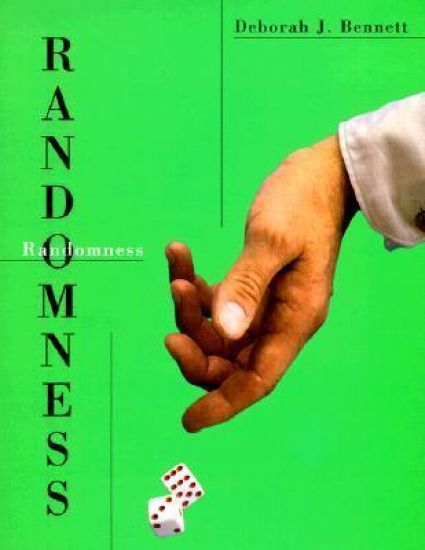
From the ancients’ first readings of the innards of birds to your neighbor’s last bout with the state lottery, humankind has put itself into the hands of chance. Today life itself may be at stake when probability comes into play—in the chance of a false negative in a medical test, in the reliability of DNA findings as legal evidence, or in the likelihood of passing on a deadly congenital disease—yet as few people as ever understand the odds. This book is aimed at the trouble with trying to learn about probability. A story of the misconceptions and difficulties civilization overcame in progressing toward probabilistic thinking, Randomness is also a skillful account of what makes the science of probability so daunting in our own day.To acquire a (correct) intuition of chance is not easy to begin with, and moving from an intuitive sense to a formal notion of probability presents further problems. Author Deborah Bennett traces the path this process takes in an individual trying to come to grips with concepts of uncertainty and fairness, and also charts the parallel path by which societies have developed ideas about chance. Why, from ancient to modern times, have people resorted to chance in making decisions? Is a decision made by random choice “fair”? What role has gambling played in our understanding of chance? Why do some individuals and societies refuse to accept randomness at all? If understanding randomness is so important to probabilistic thinking, why do the experts disagree about what it really is? And why are our intuitions about chance almost always dead wrong?Anyone who has puzzled over a probability conundrum is struck by the paradoxes and counterintuitive results that occur at a relatively simple level. Why this should be, and how it has been the case through the ages, for bumblers and brilliant mathematicians alike, is the entertaining and enlightening lesson of Randomness.