
Kirjojen hintavertailu. Mukana 12 083 983 kirjaa ja 12 kauppaa.

Kirjahaku

Etsi kirjoja tekijän nimen, kirjan nimen tai ISBN:n perusteella.

2 kirjaa tekijältä Debra Hershkowitz

Valerius Flaccus' Argonautica

Valerius Flaccus' Argonautica

Debra Hershkowitz

Clarendon Press
1998
sidottu
Valerius Flaccus' unfinished and unjustly neglected epic, recounting the Argonauts' quest for the Golden Fleece and the early stages of the love affair of Jason and Medea, has been relegated to the outer fringes of classical scholarship for many years. No full-length study devoted to the Argonautica has been published in English for over 100 years. This book seeks to redress the balance. The author aims to provide readers who have not yet encountered Valerius Flaccus' work with a general introduction to this multi-faceted epic poem. At the same time Hershkowitz offers those already familiar with the Argonautica an in-depth re-evaluation of the work, contextualizing it within both an historical and a literary framework, and focusing in particular on its intertextual relationship with Apollonius' Argonautica and Virgil's Aeneid. Using Valerius' epic as a test-case, Dr. Hershkowitz hopes to challenge many of the critical assumptions about the nature of Silver Latin literature.
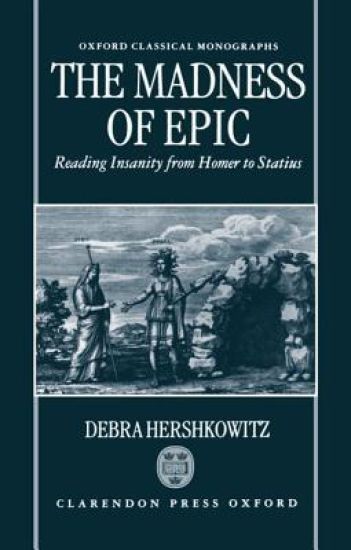
The Madness of Epic

The Madness of Epic

Debra Hershkowitz

Clarendon Press
1998
sidottu
Madness plays a vital role in many ancient epics: not only do characters go mad, but madness also often occupies a central thematic position in the texts. In this book, Debra Hershkowitz examines from a variety of theoretical angles the representation and poetic function of madness in Greek and Latin epic from Homer through the Flavians, including individual chapters devoted to the Iliad and Odyssey, Virgil's Aeneid, Ovid's Metamorphoses, Lucan's Bellum Civile, and Statius' Thebaid. The study also addresses the difficulty of defining madness, and discusses how each epic explores this problem in a different way, finding its own unique way of conceptualizing madness. Epic madness interacts with ancient models of madness, but also, even more importantly, with previous representations of madness in the literary tradition. Likewise, the reader's response to epic madness is influenced by both ancient and modern views of madness, as well as by an awareness of intertextuality.