Kirjojen hintavertailu. Mukana 11 699 587 kirjaa ja 12 kauppaa.

Kirjahaku

Etsi kirjoja tekijän nimen, kirjan nimen tai ISBN:n perusteella.

9 kirjaa tekijältä Deepak Tripathi

Imperial Designs

Imperial Designs

Deepak Tripathi

Potomac Books Inc
2013
sidottu
Since the age of Alexander the Great, waves of foreign armies have invaded the Middle East and South Asia to plunder their vast treasures. In Imperial Designs, Deepak Tripathi offers a powerful and unique analysis of how this volatile region has endured the manipulation and humiliation of such wars. He argues that these foreign invasions to gain access to others’ wealth and the consequent ignominy of the defeated peoples of the regions have had far-reaching consequences. Over the centuries, again and again, the conquered peoples have been left helpless, their shame on display. The victims’ collective frustration has strengthened their will to resist and avenge the wrongs done to them-all according to their own values and in their own time. Displaying a keen awareness of Middle Eastern and South Asian cultures, Tripathi argues that this enduring theme resonates throughout the region’s history and informs the present. Referring to declassified official documents and scholarly works, Imperial Designs offers an authoritative analysis of Middle Eastern history since World War I and the fall of the Ottoman Empire. Scholars, policymakers, and concerned citizens should read this book, for it tells us how the shame of defeat radicalizes nations and societies, and often makes future conflict inevitable.

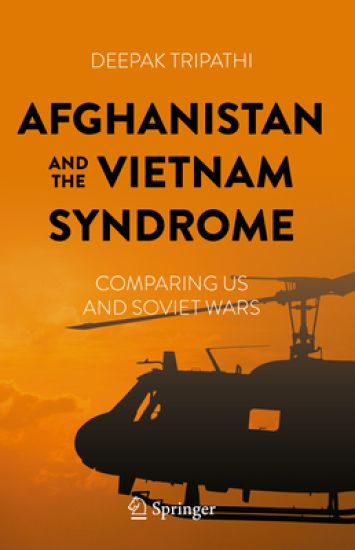
Afghanistan and the Vietnam Syndrome

Afghanistan and the Vietnam Syndrome

Deepak Tripathi

Springer International Publishing AG
2023
sidottu
Great powers have often found that military adventurism to force their will in distant lands comes with the risk of spending excessive military, economic, and moral capital to the extent that war is no longer sustainable. Written by a former BBC Afghanistan correspondent who set up the corporation’s bureau in Kabul in the early 1990s, this book draws both from scholarly knowledge as well as first-hand insights on how the Americans met that fate in Vietnam, and the Soviets and Americans in Afghanistan. America’s 1975 retreat from Vietnam was a consequential event, prompting US commentators to explain it as reluctance to get involved in foreign wars, a mindset described as the Vietnam Syndrome. As Deepak Tripathi points out, the Vietnam experience made the Americans determined to give the Soviets their own Vietnam. The 1979 Soviet invasion of Afghanistan, and retreat after a decade of occupation, represented the revenge America sought. However, President George W. Bush’s decision to invade Afghanistan after the 9/11 attacks was the beginning of a long military venture that ended in retreat in 2021. Addressing an academic as well as a general audience, Tripathi explores parallels between wars in Afghanistan and Vietnam, and shows how the United States and the Soviet Union met the same fate.
Afghanistan and the Vietnam Syndrome

Afghanistan and the Vietnam Syndrome

Deepak Tripathi

Springer International Publishing AG
2024
nidottu
Great powers have often found that military adventurism to force their will in distant lands comes with the risk of spending excessive military, economic, and moral capital to the extent that war is no longer sustainable. Written by a former BBC Afghanistan correspondent who set up the corporation’s bureau in Kabul in the early 1990s, this book draws both from scholarly knowledge as well as first-hand insights on how the Americans met that fate in Vietnam, and the Soviets and Americans in Afghanistan. America’s 1975 retreat from Vietnam was a consequential event, prompting US commentators to explain it as reluctance to get involved in foreign wars, a mindset described as the Vietnam Syndrome. As Deepak Tripathi points out, the Vietnam experience made the Americans determined to give the Soviets their own Vietnam. The 1979 Soviet invasion of Afghanistan, and retreat after a decade of occupation, represented the revenge America sought. However, President George W. Bush’s decision to invade Afghanistan after the 9/11 attacks was the beginning of a long military venture that ended in retreat in 2021. Addressing an academic as well as a general audience, Tripathi explores parallels between wars in Afghanistan and Vietnam, and shows how the United States and the Soviet Union met the same fate.
Modern Populism

Modern Populism

Deepak Tripathi

Springer International Publishing AG
2023
sidottu
This book sheds light on modern populism and discusses the link between populism and identity politics against the backdrop of populist leaders asserting the identity of their own group, while maintaining the separation from others. Written by former BBC correspondent and commentator Deepak Tripathi, the book explains how populism has a long history with early discernable origins in the Tsarist Russian Empire and North America in the nineteenth century, spreading to Latin America, Europe, and elsewhere in the following century. The book analyzes various forms of populism, its causes and consequences. It further looks at how industrialization, economic growth, and movement of people led to conditions which contributed to inequalities, fueling populist sentiments and social conflict around the globe. Tripathi concludes that populism has moved from the fringes to the mainstream of politics, and is here to stay, given factors such as growing competition for resources, population increase, climate change, and migration. The book will appeal to students, scholars, and researchers of political science and neighboring disciplines, as well as policy-makers interested in a better understanding of modern populism and its roots. Written in a graceful, informative style, this book explores the rise of populism on the global scene and exposes its dangers. Mark Juergensmeyer, Distinguished Professor Emeritus of Sociology and Global Studies, University of California, Santa Barbara, and author of Global Rebellion: Religious Challenges to the Secular State Deepak Tripathi provides the first lucid and comprehensive analysis of a political phenomenon that engulfs many states and societies today. Ilan Pappe, Professor of History, and Director of the European Centre for Palestine Studies, University of Exeter This wide-ranging and clear-sighted book gives a historically-informed account of how populism went mainstream. It is a fascinating read. Richard Toye, Professor of Modern History, University of Exeter
Modern Populism

Modern Populism

Deepak Tripathi

Springer International Publishing AG
2024
nidottu
This book sheds light on modern populism and discusses the link between populism and identity politics against the backdrop of populist leaders asserting the identity of their own group, while maintaining the separation from others. Written by former BBC correspondent and commentator Deepak Tripathi, the book explains how populism has a long history with early discernable origins in the Tsarist Russian Empire and North America in the nineteenth century, spreading to Latin America, Europe, and elsewhere in the following century. The book analyzes various forms of populism, its causes and consequences. It further looks at how industrialization, economic growth, and movement of people led to conditions which contributed to inequalities, fueling populist sentiments and social conflict around the globe. Tripathi concludes that populism has moved from the fringes to the mainstream of politics, and is here to stay, given factors such as growing competition for resources, population increase, climate change, and migration. The book will appeal to students, scholars, and researchers of political science and neighboring disciplines, as well as policy-makers interested in a better understanding of modern populism and its roots. Written in a graceful, informative style, this book explores the rise of populism on the global scene and exposes its dangers. Mark Juergensmeyer, Distinguished Professor Emeritus of Sociology and Global Studies, University of California, Santa Barbara, and author of Global Rebellion: Religious Challenges to the Secular State Deepak Tripathi provides the first lucid and comprehensive analysis of a political phenomenon that engulfs many states and societies today. Ilan Pappe, Professor of History, and Director of the European Centre for Palestine Studies, University of Exeter This wide-ranging and clear-sighted book gives a historically-informed account of how populism went mainstream. It is a fascinating read. Richard Toye, Professor of Modern History, University of Exeter
The Impact of Wars on World Politics, 1775–2023

The Impact of Wars on World Politics, 1775–2023

Deepak Tripathi

Springer International Publishing AG
2024
sidottu
In a study of cyclical history, this book presents a grand sweep of modern history and how decades of savage wars, and turbulence, led to a brief era of exhilaration and hope, followed by despair in the new century. The collapse of the Berlin Wall (1989) and the Soviet Union (1991), marking the end of the Cold War, were celebrated with great euphoria. The book points out that the defeat of Soviet communism by the Western allies was one of the most consequential outcomes of great power conflict in the twentieth century, comparable to the defeat of fascism in the Second World War, and of the Central Powers led by Germany and Austria-Hungary in the First World War. However, optimistic predictions of a peaceful and orderly world after the Cold War proved wrong, and new challenges emerged across the globe such as international and regional conflicts, climate change, and mass migration. The book explains how the initial excitement and hope after the collapse of the Soviet Union turned to new challenges, and despair, continuing the cycle of history. Tripathi's scholarly rigor, combined with his journalistic clarity, makes this book a landmark publication that stands out for its depth, relevance, and the urgent message it conveys about the necessity of learning from history to navigate the challenges of the future. Ashok Swain, Professor & Head, Department of Peace and Conflict Research, Uppsala University This book is a strong, well-written, and explorative testimony of war and conflict, their roots and dynamics, as well as consequences and impact on politics and human lives. Nora Sveaass, Professor Emeritus, Department of Psychology, University of Oslo
Kriege und Weltordnung

Kriege und Weltordnung

Deepak Tripathi

Springer Nature Switzerland AG
2026
sidottu
Ausgehend von der Idee einer zyklisch verlaufenden Geschichte entfaltet dieses Buch einen weiten historischen Bogen der Moderne. Es zeigt, wie auf Jahrzehnte brutaler Kriege und gesellschaftlicher Ersch tterungen eine kurze Phase der Euphorie und Hoffnung folgte, die schlie lich mit der Jahrhundertwende von Ern chterung und Verzweiflung abgel st wurde. Der Fall der Berliner Mauer im Jahr 1989 und der Zusammenbruch der Sowjetunion im Jahr 1991, die das Ende des Kalten Krieges markierten, wurden weltweit mit gro er Euphorie gefeiert. Das Buch legt dar, dass die Niederlage des sowjetischen Kommunismus durch die westlichen Alliierten zu den folgenreichsten Ergebnissen der Gro m chtekonflikte des 20. Jahrhunderts z hlt - vergleichbar mit der berwindung des Faschismus im Zweiten Weltkrieg sowie der Niederlage der Mittelm chte unter F hrung Deutschlands und sterreich-Ungarns im Ersten Weltkrieg. Doch die Hoffnung auf eine friedliche und geordnete Welt nach dem Ende des Kalten Krieges erf llte sich nicht. Vielmehr traten neue globale Herausforderungen hervor: internationale und regionale Konflikte, der fortschreitende Klimawandel sowie weltweite Migrationsbewegungen. Das Buch zeigt, wie die anf ngliche Begeisterung und Zuversicht nach dem Zusammenbruch der Sowjetunion rasch neuen Problemen und einer erneuten Phase der Verunsicherung und Verzweiflung wichen und somit den historischen Zyklus fortsetzten. Tripathis wissenschaftliche Genauigkeit in Verbindung mit seiner journalistischen Klarheit macht dieses Buch zu einer wegweisenden Ver ffentlichung, die sich durch ihre Tiefe, Relevanz und die dringende Botschaft auszeichnet, dass wir aus der Geschichte lernen m ssen, um die Herausforderungen der Zukunft zu meistern. Ashok Swain, Professor und Leiter des Instituts f r Friedens- und Konfliktforschung, Universit t Uppsala Dieses Buch ist ein eindringliches, gut geschriebenes und aufschlussreiches Zeugnis ber Krieg und Konflikte, ihre Ursachen und Dynamiken sowie ihre Folgen und Auswirkungen auf Politik und menschliches Leben. Nora Sveaass, emeritierte Professorin, Institut f r Psychologie, Universit t Oslo