Kirjojen hintavertailu. Mukana 12 085 713 kirjaa ja 12 kauppaa.

Kirjahaku

Etsi kirjoja tekijän nimen, kirjan nimen tai ISBN:n perusteella.

8 kirjaa tekijältä Dennis Baron

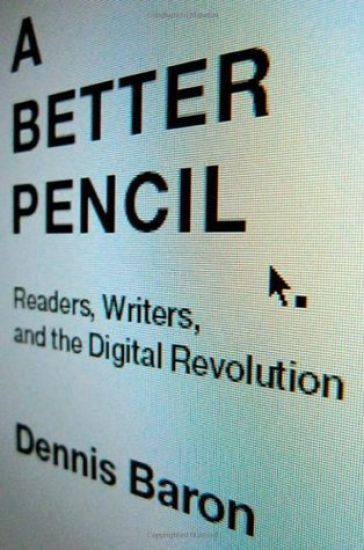
A Better Pencil

A Better Pencil

Dennis Baron

Oxford University Press Inc
2009
sidottu
A Better Pencil examines the digital revolution in light of the history of writing technology. Baron looks at how we love, fear, actually use our writing machines-not just computers but typewriters, pencils, and clay tablets-how we deploy them to replicate the old ways of doing things while actively generating new modes of mass expression; how we learn to trust new technology and the new and strange sorts of texts that it produces; hwo we expand the notion of who can write and who can't; and how we free our readers and writers while at the same time trying to regulate their activities.
A Better Pencil

A Better Pencil

Dennis Baron

Oxford University Press Inc
2012
nidottu
Computers, now the writer's tool of choice, are still blamed by skeptics for a variety of ills, from speeding writing up to the point of recklessness, to complicating or trivializing the writing process, to destroying the English language itself. A Better Pencil puts our complex, still-evolving hate-love relationship with computers and the internet into perspective, describing how the digital revolution influences our reading and writing practices, and how the latest technologies differ from what came before. The book explores our use of computers as writing tools in light of the history of communication technology, a history of how we love, fear, and actually use our writing technologies--not just computers, but also typewriters, pencils, and clay tablets. Dennis Baron shows that virtually all writing implements--and even writing itself--were greeted at first with anxiety and outrage: the printing press disrupted the "almost spiritual connection" between the writer and the page; the typewriter was "impersonal and noisy" and would "destroy the art of handwriting." Both pencils and computers were created for tasks that had nothing to do with writing. Pencils, crafted by woodworkers for marking up their boards, were quickly repurposed by writers and artists. The computer crunched numbers, not words, until writers saw it as the next writing machine. Baron also explores the new genres that the computer has launched: email, the instant message, the web page, the blog, social-networking pages like MySpace and Facebook, and communally-generated texts like Wikipedia and the Urban Dictionary, not to mention YouTube. Here then is a fascinating history of our tangled dealings with a wide range of writing instruments, from ancient papyrus to the modern laptop. With dozens of illustrations and many colorful anecdotes, the book will enthrall anyone interested in language, literacy, or writing.
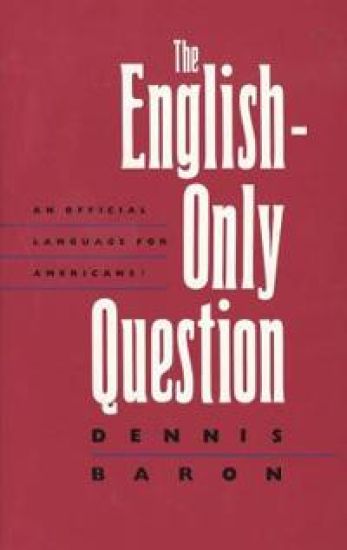
The English-Only Question

The English-Only Question

Dennis Baron

Yale University Press
1992
pokkari
Should the United States declare English its official language? The "English-only" question, which has plagued American citizens since the founding of the country, has once again become the focus of heated debate, with an English Language Amendment to the Constitution pending in Congress since 1981. In this lively and engrossing book, an often-quoted authority on the English language provides the first comprehensive, historically based discussion of this troubling issue. Dennis Baron dispassionately explores the philosophical, legal, political, educational, and sociological implications of the official-English movement, tracing the history of American attitudes toward English and minority languages during the past two centuries. Baron describes how battles to save English or minority languages have been fought in the press, the schools, the courts, and the legislatures of the country. According to Baron, the impulse to impose English and limit other languages has repeatedly arisen during periods of political or economic ferment, when non-English speakers have been targeted as subversive, unemployable, or otherwise resistant to assimilation. However, says Baron, many supporters of the English Language Amendment are not xenophobic but are people who believe in the ideal of one language for one nation and who argue that mastery of English is the only way to succeed in America. Baron discusses the recent background of the English Language Amendment, explains the arguments on each side, and assesses its future. His book will enable policymakers, voters, legislators, and educators to better understand the complex issues that surround the question of an official language for America.
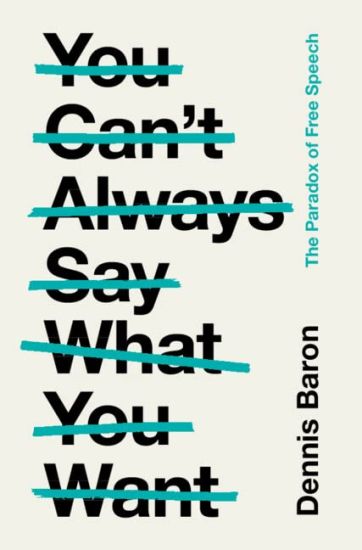
You Can't Always Say What You Want

You Can't Always Say What You Want

Dennis Baron

Cambridge University Press
2023
sidottu
The freedom to think what you want and to say what you think has always generated a pushback of regulation and censorship. This raises the thorny question: to what extent does free speech actually endanger speech protection? This book examines today's calls for speech legislation and places it into historical perspective, using fascinating examples from the past 200 years, to explain the historical context of laws regulating speech. Over time, the freedom to speak has grown, the ways in which we communicate have evolved due to technology, and our ideas about speech protection have been challenged as a result. Now more than ever, we are living in a free speech paradox: powerful speakers weaponize their rights in order to silence those less-powerful speakers who oppose them. By understanding how this situation has developed, we can stand up to these threats to the freedom of speech.
What's Your Pronoun?

What's Your Pronoun?

Dennis Baron

Liveright Publishing Corporation
2020
sidottu
Like trigger warnings and gender-neutral bathrooms, pronouns spark debate, prompting new policies about what pronouns to use. More than a by-product of the culture wars, gender-neutral pronouns are, however, nothing new. Pioneering linguist Dennis Baron puts them in historical context, noting that Shakespeare used singular they, women invoked the generic use of he to assert the right to vote (while those opposed to women’s rights asserted that he did not include she) and people have been coining new gender pronouns for centuries. An essential work in understanding how 21st century culture has evolved, What’s Your Pronoun? chronicles the story of the role pronouns have played—and continue to play—in establishing both our rights and our identities.
What's Your Pronoun?

What's Your Pronoun?

Dennis Baron

Liveright Publishing Corporation
2021
nidottu
Like trigger warnings and gender-neutral bathrooms, pronouns spark debate, prompting new policies about what pronouns to use. More than a by-product of the culture wars, gender-neutral pronouns are, however, nothing new. Pioneering linguist Dennis Baron puts them in historical context, noting that Shakespeare used singular they, women invoked the generic use of he to assert the right to vote (while those opposed to women’s rights asserted that he did not include she) and people have been coining new gender pronouns for centuries. An essential work in understanding how 21st century culture has evolved, What’s Your Pronoun? chronicles the story of the role pronouns have played—and continue to play—in establishing both our rights and our identities.