Kirjojen hintavertailu. Mukana 12 390 323 kirjaa ja 12 kauppaa.

Kirjahaku

Etsi kirjoja tekijän nimen, kirjan nimen tai ISBN:n perusteella.

9 kirjaa tekijältä Dennis R. Jenkins

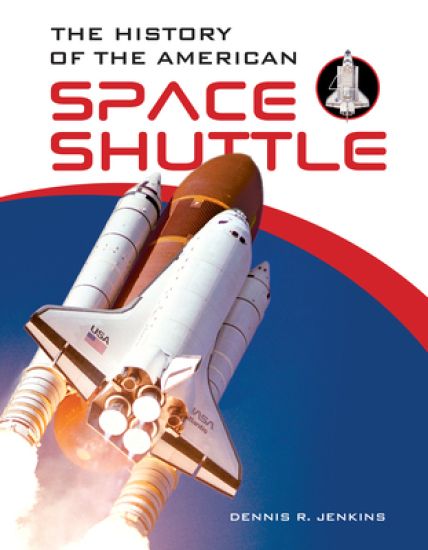
The History of the American Space Shuttle

The History of the American Space Shuttle

Dennis R. Jenkins

Schiffer Publishing Ltd
2019
sidottu
The flight campaign for the American space shuttle began on April 12, 1981, with the launch of STS-1 from the Kennedy Space Center, Florida, and ended on July 21, 2011, with wheels stop of STS-135. During the 30 years and 135 missions in between, the program experienced triumphs and tragedies, amazed the world with its orbital exploits, and was frequently the subject of admiration, condemnation, pride, and despair. This book provides a detailed overview of the history of winged spacecraft and the development of the vehicle we call the "space shuttle," and provides a technical description of the orbiter, main engines, external tank, and solid rocket boosters. Two pages are dedicated to each of the 135 missions flown by the American space shuttle, including technical data, crew names, and photos of each mission. The Challenger and Columbia accidents are discussed, along with a discussion of what NASA did to fix the flaws and continue flying. The book concludes by covering the retirement of the vehicle and the delivery of the four remaining orbiters to their final display sites.
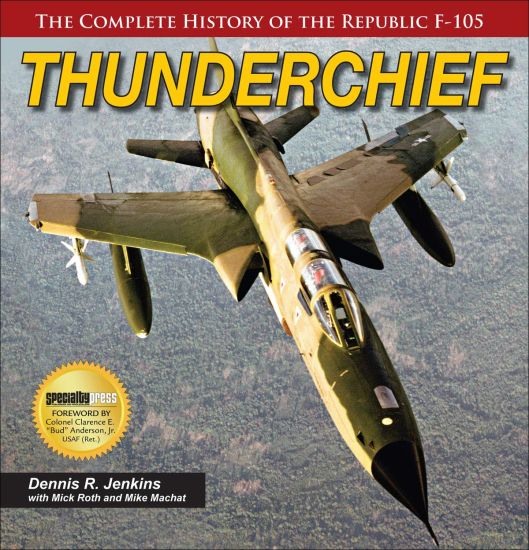
Thunderchief

Thunderchief

Dennis R. Jenkins

SPECIALTY PRESS
2019
sidottu
Forward by Colonel Clarence E. Bud Anderson, Jr USAF (Ret.)Provides a level of detail unseen in any previous work on the F-105, including the complete history of this airplane in every sense of the term.Reveals new recently declassified Air Force material about the F-105's unique and highly dangerous Wild Weasel missions during the Vietnam War. Authored by one of America's top aviation writers, this book continues the story of Republic's Mach-2 F-105 Thunderchief where previous books on this aircraft left off. The Republic F-105 Thunderchief gained fame in the skies over Southeast Asia, carrying weapons it was not designed to use in a war it was not supposed to fight. It had been conceived to carry the new tactical nuclear weapons designed by the national laboratories during the early 1950s. Its target would be the Soviet Union during the height of the cold war, operating from well-equipped bases in Germany and Japan. Instead, it found itself in the jungles of Thailand, surrounded by heat and humidity, trying to fight a war as dictated by politicians 7,000 miles away. Too many missions were flown with only a few bombs per aircraft, simply so Washington could count sorties. Too many crews never came back. This is the complete history of the Republic F-105 Thunderchief, from its inception in the early 1950s to its retirement in the mid-1980s.The F-105 holds the distinction of being the only American combat aircraft withdrawn from service simply because there were not enough of them remaining to be tactically useful. The Thunderchiefs flew 159,795 combat missions in Southeast Asia, resulting in the loss of 334 aircraft, most of them to North Vietnamese anti-aircraft fire. This was almost half the combat-capable F-105s built. One hundred fifty-six crewmembers were listed as killed in action or missing in action. Two pilots received the Medal of Honor. After the Air Force withdrew them from Southeast Asia, leaving the war to the newer and more plentiful McDonnell Douglas F-4 Phantom II, the remaining Thuds settled into a quiet routine stateside until they were finally retired on 25 February 1984. By then, only 221 airframes were left of the 833 produced.In 2018, there is not a single flyable Thunderchief, although at least 100 of them are in museums, available to be admired at one's leisure.
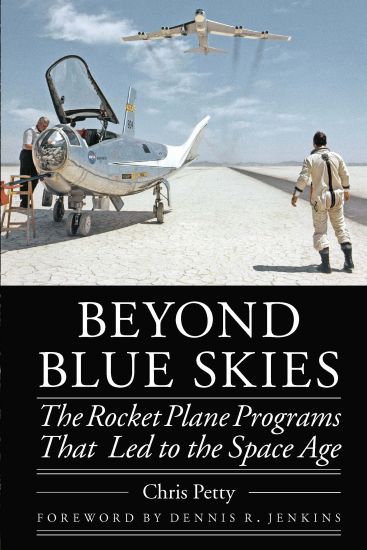
Beyond Blue Skies

Beyond Blue Skies

Chris Petty; Dennis R. Jenkins

University of Nebraska Press
2020
sidottu
Chris Petty has written a book that covers much of the unheralded research into high-speed flight that helped set the stage for human spaceflight. I recommend this book to anyone who has an interest in the early history of rocket flight.-Al Worden, command module pilot for Apollo 15In 1945 some experts still considered the so-called sound barrier an impenetrable wall, while winged rocket planes remained largely relegated to science fiction. But soon a series of unique rocket-powered research aircraft and the dedicated individuals who built, maintained, and flew them began to push the boundaries of flight in aviation’s quest to move ever higher, ever faster, toward the unknown. Beyond Blue Skies examines the thirty-year period after World War II during which aviation experienced an unprecedented era of progress that led the United States to the boundaries of outer space. Between 1946 and 1975, an ancient dry lakebed in California’s High Desert played host to a series of rocket-powered research aircraft built to investigate the outer reaches of flight. The western Mojave’s Rogers Dry Lake became home to Edwards Air Force Base, NASA’s Flight Research Center, and an elite cadre of test pilots. Although one of them-Chuck Yeager-would rank among the most famous names in history, most who flew there during those years played their parts away from public view. The risks they routinely accepted were every bit as real as those facing NASA’s astronauts, but no magazine stories or free Corvettes awaited them-just long days in a close-knit community in the High Desert. The role of not only the test pilots but the engineers, aerodynamicists, and support staff in making supersonic flight possible has been widely overlooked. Beyond Blue Skies charts the triumphs and tragedies of the rocket-plane era and the unsung efforts of the men and women who made amazing achievements possible.
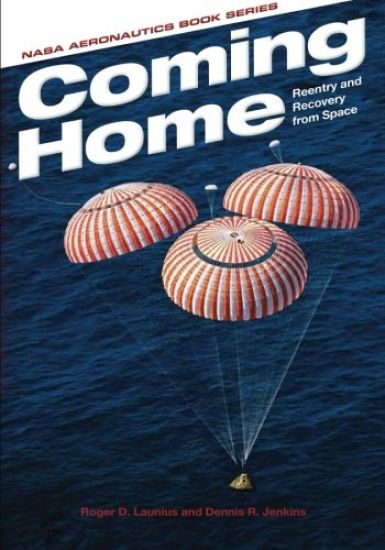
Coming Home: Reentry and Recovery from Space

Coming Home: Reentry and Recovery from Space

Roger D. Launius; Dennis R. Jenkins; National Aeronautics and Administration

Createspace Independent Publishing Platform
2013
nidottu
This study represents a means of highlighting the myriad of technological developments that made possible the safe reentry and return from space and the landing on Earth. This story extends back at least to the work of Walter Hohmann and Eugen S nger in Germany in the 1920s and involved numerous aerospace engineers at the National Advisory Committee for Aeronautics (NACA)/NASA Langley and the Lewis (now the John H. Glenn Research Center at Lewis Field) and Ames Research Centers. For example, researchers such as H. Julian Allen and Alfred J. Eggers, Jr., at Ames pioneered blunt-body reentry techniques and ablative thermal protection systems in the 1950s, while Francis M. Rogallo at Langley developed creative parasail concepts that informed the development of the recovery systems of numerous reentry vehicles. The chapters that follow relate in a chronological manner the way in which NASA has approached the challenge of reentering the atmosphere after a space mission and the technologies associated with safely dealing with the friction of this encounter and the methods used for landing safely on Earth.