Kirjojen hintavertailu. Mukana 12 016 292 kirjaa ja 12 kauppaa.

Kirjahaku

Etsi kirjoja tekijän nimen, kirjan nimen tai ISBN:n perusteella.

10 kirjaa tekijältä Derek Offord

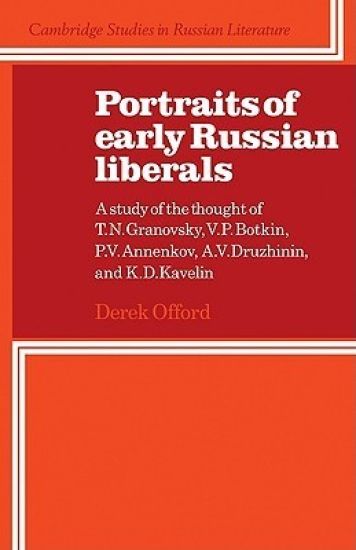
Portraits of Early Russian Liberals

Portraits of Early Russian Liberals

Derek Offord

Cambridge University Press
2009
pokkari
This book studies the work of five Russian liberal thinkers who were active in the period 1840–60 against the general background of Russian history, literature and thought in that period. All five thinkers (to each of whom a separate chapter is devoted) played an important part in the flowering of Russian letters in the 1840s, and were involved in the attempt of the intelligentsia, the conscience of the nation, to bring more humane and enlightened values to their backward and semi-feudal country. By the 1850s, when a more radical wing began to emerge in the intelligentsia, the moderation of these liberals became more apparent. While the radicals were prepared to countenance revolutionary upheaval, the liberals counselled patience, toleration, and gradualism. In his conclusion Dr Offord explores the possible reasons for the failure of the liberal tendency, represented by these thinkers, to establish itself properly in Russia.

The Russian Revolutionary Movement in the 1880s

The Russian Revolutionary Movement in the 1880s

Derek Offord

Cambridge University Press
1986
sidottu
The book deals with the various revolutionary groups active in Russia in the 1880s. The first chapter attempts a definition of Populism, examines the main strategies on which revolutionary activity was based in the 1870s, traces the development of the main organisations of that decade and discusses their relationship to the prevailing theories. The three following chapters examine the history of the organisations of the 1880s in the light of this discussion and against the background of a reactionary political atmosphere, cultural stagnation, despondency in the intelligentsia, and industrial development. The early political activity and sympathies of Lenin are also discussed at some length. The conclusion assesses the significance of the organisations of the 1880s in the larger history of the Russian revolutionary movement.
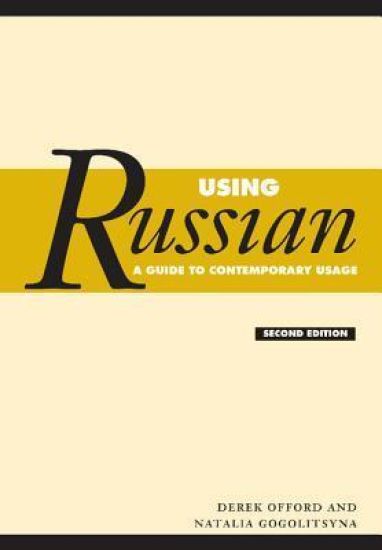
Using Russian

Using Russian

Derek Offord

Cambridge University Press
2005
pokkari
Using Russian is a guide to Russian usage for those who have already acquired the basics of the language and wish to extend their knowledge. Unlike conventional grammars, it gives special attention to those areas of vocabulary and grammar which cause most difficulty to English speakers, and focuses on questions of style and register which are all too often ignored. Clear, readable and easy to consult, it will prove invaluable to students seeking to improve their fluency and confidence in Russian. This second edition has been substantially revised and expanded to incorporate fresh material and up-to-date information. Many of the original chapters have been rewritten and one brand new chapter has been added, providing a clear picture of Russian usage in the 21st century.
The Russian Revolutionary Movement in the 1880s

The Russian Revolutionary Movement in the 1880s

Derek Offord

Cambridge University Press
2004
pokkari
The book deals with the various revolutionary groups active in Russia in the 1880s. The first chapter attempts a definition of Populism, examines the main strategies on which revolutionary activity was based in the 1870s, traces the development of the main organisations of that decade and discusses their relationship to the prevailing theories. The three following chapters examine the history of the organisations of the 1880s in the light of this discussion and against the background of a reactionary political atmosphere, cultural stagnation, despondency in the intelligentsia, and industrial development. The early political activity and sympathies of Lenin are also discussed at some length. The conclusion assesses the significance of the organisations of the 1880s in the larger history of the Russian revolutionary movement.
Nineteenth-Century Russia

Nineteenth-Century Russia

Derek Offord

Routledge
2015
sidottu
This new Seminar Study provides students with a rewarding introduction to nineteenth-century Russia. This period of Russian history is, of course, characterised by the flowering of an enormously rich intellectual and cultural life, the origins of which lie in the intelligentsia¿s opposition to autocratic rule. Here, Professor Offord introduces the reader to the period while focusing particularly on the rise of radicalism.The book opens with two scene-setting chapters: one looking at the political and social structure peculiar to Russia, and the second looking at the cultural and intellectual background. Then, within a chronological framework, the author examines all the great 'events' in the history of Russian radicalism - from the Decembrist Revolt in 1825, to the 'going to the people' in 1874, and the assassination of Alexander II in 1881. However, throughout the text sustained attention is given to the intellectual dimension of nineteenth-century Russian history. Professor Offord examines all the major schools of thought and looks in detail at all the great thinkers of the day, including Chaadaev, Belinsky, Herzen, Chernyshevsky, Bakunin and Tolstoy.This new book will provide essential reading for anyone studying nineteenth-century Russia. Lucid, accessible and immensely readable, it is a formidable achievement.
Ayn Rand and the Russian Intelligentsia

Ayn Rand and the Russian Intelligentsia

Derek Offord

BLOOMSBURY PUBLISHING PLC
2022
nidottu
This book examines the writings of the American novelist Ayn Rand, especially The Fountainhead (1943) and Atlas Shrugged (1957), which Rand considered her definitive statement about the need for an unregulated free market in which superior humans could fully realize themselves by living for no-one but themselves. It explores Rand’s conception of American identity, which exalted individualism and capitalism, and her solution for saving the modern American nation, which she believed was losing the spirit of its 18th- and 19th-century founders and frontiersmen, having been degraded morally and economically by the rampant socialism of the mid-20th-century world.Derek Offord crucially goes on to analyse how Rand’s writings functioned as a vehicle in which she, a Russian-Jewish writer born in St Petersburg in 1905, engaged with ideas that had long animated the Russian intelligentsia. Her conception of human nature and of a utopian community capable of satisfying its needs; her reversal of conventional valuations of self-sacrifice and selfishness; her division of humans into an extraordinary minority and the ordinary mass; her comparison of competing civilizations – in all these areas, Offord argues that Rand drew on Russian debates and transposed them to a different context. Even the type of novel she writes, the novel of ideas, is informed by the polemical methods and habits of the Russian intelligentsia. The book concludes that her search for a brave new world continues to have topicality in the 21st century, with its populist critiques of liberal democracies and acrimonious debates about countries’ moral, social, and economic priorities and their identities, inequalities, and social tensions.
Ayn Rand and the Russian Intelligentsia

Ayn Rand and the Russian Intelligentsia

Derek Offord

BLOOMSBURY PUBLISHING PLC
2022
sidottu
This book examines the writings of the American novelist Ayn Rand, especially The Fountainhead (1943) and Atlas Shrugged (1957), which Rand considered her definitive statement about the need for an unregulated free market in which superior humans could fully realize themselves by living for no-one but themselves. It explores Rand’s conception of American identity, which exalted individualism and capitalism, and her solution for saving the modern American nation, which she believed was losing the spirit of its 18th- and 19th-century founders and frontiersmen, having been degraded morally and economically by the rampant socialism of the mid-20th-century world.Derek Offord crucially goes on to analyse how Rand’s writings functioned as a vehicle in which she, a Russian-Jewish writer born in St Petersburg in 1905, engaged with ideas that had long animated the Russian intelligentsia. Her conception of human nature and of a utopian community capable of satisfying its needs; her reversal of conventional valuations of self-sacrifice and selfishness; her division of humans into an extraordinary minority and the ordinary mass; her comparison of competing civilizations – in all these areas, Offord argues that Rand drew on Russian debates and transposed them to a different context. Even the type of novel she writes, the novel of ideas, is informed by the polemical methods and habits of the Russian intelligentsia. The book concludes that her search for a brave new world continues to have topicality in the 21st century, with its populist critiques of liberal democracies and acrimonious debates about countries’ moral, social, and economic priorities and their identities, inequalities, and social tensions.
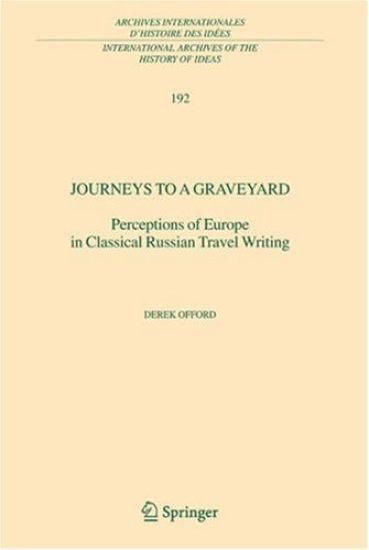
Journeys to a Graveyard

Journeys to a Graveyard

Derek Offord

Springer-Verlag New York Inc.
2006
sidottu
Journeys to a Graveyard examines the descriptions provided by eight Russian writers of journeys made to western European countries between 1697 and 1880. The descriptions reveal the mentality and preoccupations of the Russian social and intellectual elites during this period. The travellers' perceptions of western European countries are treated here as an ambivalent response to a civilization with which Russia was belatedly coming into close contact as a result of the imperial ambition of the Russian state and the westernization of the Russian elites. The travellers perceived the most advanced European countries as superior to Russia in terms of material achievement and the maturity and refinement of their cultures, but they also promoted a view of Russia as in other respects superior to the western nations. Heavily influenced from the late eighteenth century by Romanticism and by the rise of nationalism in the west, they tended to depict European civilization as moribund. By this means they managed to define their own emergent nation in a contrastive way as having youth and promising futurity.
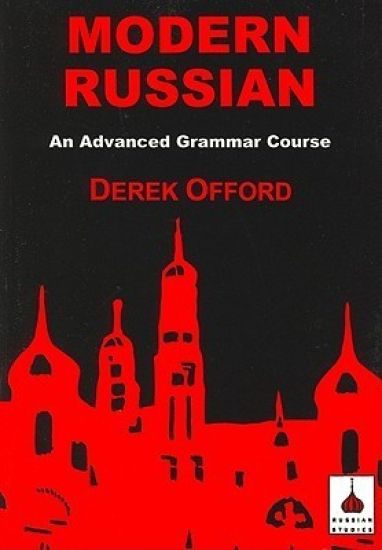
Modern Russian

Modern Russian

Derek Offord

Bristol Classical Press
1998
nidottu
This course book is aimed primarily at students in higher education who have some prior knowledge of Russian. It is divided into 64 lessons covering all the main areas of Russian, including the declension of nouns, the conjugation of verbs, the use of cases, the forms and use of adjectives; pronouns, numerals and verbs of motion; verbal prefixes; gerunds and participles. It provides the solid grammatical foundation which is essential for students go on to read, write and speak Russian well.The book includes many exercises and over 500 examples taken from the recent Soviet/Russian press, introducing useful contemporary vocabulary in areas such as politics, economics, social problems, ecology, medicine, and cultural and military affairs.
Journeys to a Graveyard

Journeys to a Graveyard

Derek Offord

Springer
2010
nidottu
Journeys to a Graveyard examines the descriptions provided by eight Russian writers of journeys made to western European countries between 1697 and 1880. The descriptions reveal the mentality and preoccupations of the Russian social and intellectual elites during this period. The travellers' perceptions of western European countries are treated here as an ambivalent response to a civilization with which Russia was belatedly coming into close contact as a result of the imperial ambition of the Russian state and the westernization of the Russian elites. The travellers perceived the most advanced European countries as superior to Russia in terms of material achievement and the maturity and refinement of their cultures, but they also promoted a view of Russia as in other respects superior to the western nations. Heavily influenced from the late eighteenth century by Romanticism and by the rise of nationalism in the west, they tended to depict European civilization as moribund. By this means they managed to define their own emergent nation in a contrastive way as having youth and promising futurity.