Kirjojen hintavertailu. Mukana 11 342 296 kirjaa ja 12 kauppaa.

Kirjahaku

Etsi kirjoja tekijän nimen, kirjan nimen tai ISBN:n perusteella.

8 kirjaa tekijältä Derek Sayer

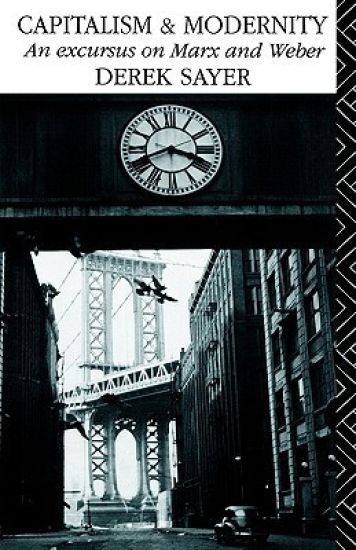
Capitalism and Modernity

Capitalism and Modernity

Derek Sayer

Routledge
1990
nidottu
First Published in 2004. The nature of modernity, and its connection with capitalism, are questions at the forefront of contemporary sociological debate. Derek Sayer re-examines the answers given by Karl Marx and Max Weber, authors of two of the most profound sociological critiques of modernity. His reassessment of Marx and Weber on capitalism and modernity provides a new reading which reveals the remarkable consonances between their sociologies of the modern condition. Going beyond the well-known stereotypes of ‘the Marx-Weber debate’, Professor Sayer shows that both Marx and Weber produced a challenging critique of the nature of power and subjectivity in modern society, a critique which retains all its intellectual force and moral relevance today. A major work of original scholarship, Capitalism and Modernity is clearly and accessibly written. It is an authoritative and provocative commentary on a debate central to modern sociology and politics and will be a key text in social theory for students of sociology, politics and philosophy.

The Coasts of Bohemia

The Coasts of Bohemia

Derek Sayer

Princeton University Press
2000
pokkari
In The Winter's Tale, Shakespeare gave the landlocked country of Bohemia a coastline--a famous and, to Czechs, typical example of foreigners' ignorance of the Czech homeland. Although the lands that were once the Kingdom of Bohemia lie at the heart of Europe, Czechs are usually encountered only in the margins of other people's stories. In The Coasts of Bohemia, Derek Sayer reverses this perspective. He presents a comprehensive and long-needed history of the Czech people that is also a remarkably original history of modern Europe, told from its uneasy center. Sayer shows that Bohemia has long been a theater of European conflict. It has been a cradle of Protestantism and a bulwark of the Counter-Reformation; an Austrian imperial province and a proudly Slavic national state; the most easterly democracy in Europe; and a westerly outlier of the Soviet bloc. The complexities of its location have given rise to profound (and often profoundly comic) reflections on the modern condition. Franz Kafka, Jaroslav Hasek, Karel Capek and Milan Kundera are all products of its spirit of place. Sayer describes how Bohemia's ambiguities and contradictions are those of Europe itself, and he considers the ironies of viewing Europe, the West, and modernity from the vantage point of a country that has been too often ignored. The Coasts of Bohemia draws on an enormous array of literary, musical, visual, and documentary sources ranging from banknotes to statues, museum displays to school textbooks, funeral orations to operatic stage-sets, murals in subway stations to censors' indexes of banned books. It brings us into intimate contact with the ever changing details of daily life--the street names and facades of buildings, the heroes figured on postage stamps--that have created and recreated a sense of what it is to be Czech. Sayer's sustained concern with questions of identity, memory, and power place the book at the heart of contemporary intellectual debate. It is an extraordinary story, beautifully told.
Prague, Capital of the Twentieth Century

Prague, Capital of the Twentieth Century

Derek Sayer

Princeton University Press
2015
pokkari
Setting out to recover the roots of modernity in the boulevards, interiors, and arcades of the "city of light," Walter Benjamin dubbed Paris "the capital of the nineteenth century." In this eagerly anticipated sequel to his acclaimed Coasts of Bohemia: A Czech History, Derek Sayer argues that Prague could well be seen as the capital of the much darker twentieth century. Ranging across twentieth-century Prague's astonishingly vibrant and always surprising human landscape, this richly illustrated cultural history describes how the city has experienced (and suffered) more ways of being modern than perhaps any other metropolis. Located at the crossroads of struggles between democratic, communist, and fascist visions of the modern world, twentieth-century Prague witnessed revolutions and invasions, national liberation and ethnic cleansing, the Holocaust, show trials, and snuffed-out dreams of "socialism with a human face." Yet between the wars, when Prague was the capital of Europe's most easterly parliamentary democracy, it was also a hotbed of artistic and architectural modernism, and a center of surrealism second only to Paris. Focusing on these years, Sayer explores Prague's spectacular modern buildings, monuments, paintings, books, films, operas, exhibitions, and much more. A place where the utopian fantasies of the century repeatedly unraveled, Prague was tailor-made for surrealist Andre Breton's "black humor," and Sayer discusses the way the city produced unrivaled connoisseurs of grim comedy, from Franz Kafka and Jaroslav Hasek to Milan Kundera and Vaclav Havel. A masterful and unforgettable account of a city where an idling flaneur could just as easily be a secret policeman, this book vividly shows why Prague can teach us so much about the twentieth century and what made us who we are.
Postcards from Absurdistan

Postcards from Absurdistan

Derek Sayer

PRINCETON UNIVERSITY PRESS
2022
sidottu
A sweeping history of a twentieth-century Prague torn between fascism, communism, and democracy—with lessons for a world again threatened by dictatorshipPostcards from Absurdistan is a cultural history of Prague from 1938, when the Nazis destroyed Czechoslovakia’s artistically vibrant liberal democracy, to 1989, when the country’s socialist regime collapsed after more than four decades of communist party rule. Derek Sayer shows that Prague’s twentieth century, far from being a story of inexorable progress toward some “end of history,” whether fascist, communist, or democratic, was a tragicomedy of recurring nightmares played out in a land Czech dissidents dubbed Absurdistan. Situated in the eye of the storms that shaped the modern world, Prague holds up an unsettling mirror to the absurdities and dangers of our own times.In a brilliant narrative, Sayer weaves a vivid montage of the lives of individual Praguers—poets and politicians, architects and athletes, journalists and filmmakers, artists, musicians, and comedians—caught up in the crosscurrents of the turbulent half century following the Nazi invasion. This is the territory of the ideologist, the collaborator, the informer, the apparatchik, the dissident, the outsider, the torturer, and the refugee—not to mention the innocent bystander who is always looking the other way and Václav Havel’s greengrocer whose knowing complicity allows the show to go on. Over and over, Prague exposes modernity’s dreamworlds of progress as confections of kitsch.In a time when democracy is once again under global assault, Postcards from Absurdistan is an unforgettable portrait of a city that illuminates the predicaments of the modern world.
Postcards from Absurdistan

Postcards from Absurdistan

Derek Sayer

PRINCETON UNIVERSITY PRESS
2024
pokkari
A sweeping history of a twentieth-century Prague torn between fascism, communism, and democracy—with lessons for a world again threatened by dictatorshipPostcards from Absurdistan is a cultural history of Prague from 1938, when the Nazis destroyed Czechoslovakia’s artistically vibrant liberal democracy, to 1989, when the country’s socialist regime collapsed after more than four decades of communist party rule. Derek Sayer shows that Prague’s twentieth century, far from being a story of inexorable progress toward some “end of history,” whether fascist, communist, or democratic, was a tragicomedy of recurring nightmares played out in a land Czech dissidents dubbed Absurdistan. Situated in the eye of the storms that shaped the modern world, Prague holds up an unsettling mirror to the absurdities and dangers of our own times.In a brilliant narrative, Sayer weaves a vivid montage of the lives of individual Praguers—poets and politicians, architects and athletes, journalists and filmmakers, artists, musicians, and comedians—caught up in the crosscurrents of the turbulent half century following the Nazi invasion. This is the territory of the ideologist, the collaborator, the informer, the apparatchik, the dissident, the outsider, the torturer, and the refugee—not to mention the innocent bystander who is always looking the other way and Václav Havel’s greengrocer whose knowing complicity allows the show to go on. Over and over, Prague exposes modernity’s dreamworlds of progress as confections of kitsch.In a time when democracy is once again under global assault, Postcards from Absurdistan is an unforgettable portrait of a city that illuminates the predicaments of the modern world.
Making Trouble – Surrealism and the Human Sciences

Making Trouble – Surrealism and the Human Sciences

Derek Sayer

Prickly Paradigm Press, LLC
2017
nidottu
Surrealism was not merely an artistic movement to its adherents but an "instrument of knowledge," an attempt to transform the way we see the world by unleashing the unconscious as a radical, new means of constructing reality. Born out of the crisis of civilization brought about by World War I, it presented a sustained challenge to scientific rationalism as a privileged mode of knowing. In certain ways, surrealism's critique of white, Western civilization anticipated many later attempts at producing feminist and postcolonial epistemologies. With Making Trouble, sociologist and cultural historian Derek Sayer explores what it might mean to take surrealism's critique of civilization seriously. Drawing on a remarkable range of sources, Sayer first establishes surrealism as an important intellectual antecedent to the study of the human sciences today. He then makes a compelling and well-written argument for rethinking surrealism as a contemporary methodological resource for all those who still look to the human sciences not only as a way to interpret the world, but also to change it.
Capitalism and Modernity

Capitalism and Modernity

Derek Sayer

Routledge
2015
sidottu
First Published in 2004. The nature of modernity, and its connection with capitalism, are questions at the forefront of contemporary sociological debate. Derek Sayer re-examines the answers given by Karl Marx and Max Weber, authors of two of the most profound sociological critiques of modernity. His reassessment of Marx and Weber on capitalism and modernity provides a new reading which reveals the remarkable consonances between their sociologies of the modern condition. Going beyond the well-known stereotypes of ‘the Marx-Weber debate’, Professor Sayer shows that both Marx and Weber produced a challenging critique of the nature of power and subjectivity in modern society, a critique which retains all its intellectual force and moral relevance today. A major work of original scholarship, Capitalism and Modernity is clearly and accessibly written. It is an authoritative and provocative commentary on a debate central to modern sociology and politics and will be a key text in social theory for students of sociology, politics and philosophy.

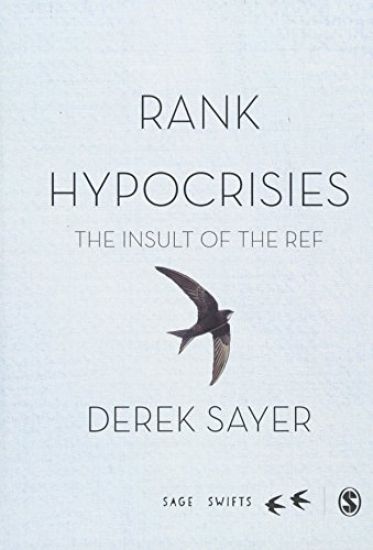
Rank Hypocrisies

Rank Hypocrisies

Derek Sayer

SAGE Publications Ltd
2015
sidottu
"In crystalline text steeped in cold rage, Sayer takes aim at the REF’s central claim, that it is a legitimate process of expert peer review. He critiques university and national-level REF processes against actual practices of scholarly review as found in academic journals, university presses, and North American tenure procedures. His analysis is damning. If the REF fails as scholarly review, how can academics and universities continue to participate? And how can government use its rankings as a basis for public policy?" - Tarak Barkawi, London School of Economics "Sayer makes a compelling argument that the Research Excellence Framework is not only expensive and divisive, but is also deeply flawed as an evaluation exercise. Rank Hypocrisies is a rigorous and scholarly evaluation of the REF, yet written in a lively and engaging style that makes it highly readable." - Dorothy Bishop, University of Oxford Few decisions are as consequential for the funding and reputation of Britain's universities as those of REF panels. Not only do REF rankings determine the levels of research funding universities receive from the state. They equally affect institutions' ability to attract external grants, top-flight faculty, and graduate students. Whatever benefit the UK's periodic research assessment exercises may have brought to research productivity, the REF has been widely criticized for its enormous costs in taxpayers' money and academics' time, its discouragement of innovative (and especially interdisciplinary) research, and its negative effects on collegiality and staff morale. Derek Sayer extends these arguments, notably through his discussion of the questionable staff selection processes used in REF2014 within his own university. Where Rank Hypocrisies goes beyond previous critiques is in its open challenge to the REF's claim to provide 'expert review of the outputs' - the very heart of its legitimacy. Examining the composition and operation of REF disciplinary subpanels in forensic detail, Sayer paints a picture in which overburdened assessors assign vaguely defined grades in fields that are frequently not their own while ignoring all external indicators of the academic influence of the publications they are appraising, and then shred all records of their deliberations. Judged against international norms of peer review, the REF is an elaborate charade - and an insult to the core values of the academy.