Kirjojen hintavertailu. Mukana 11 342 296 kirjaa ja 12 kauppaa.

Kirjahaku

Etsi kirjoja tekijän nimen, kirjan nimen tai ISBN:n perusteella.

3 kirjaa tekijältä Dewey W. Hall

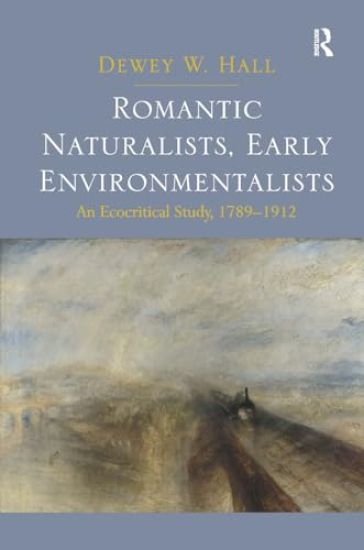
Romantic Naturalists, Early Environmentalists

Romantic Naturalists, Early Environmentalists

Dewey W. Hall

TAYLOR FRANCIS LTD
2024
nidottu
In his study of Romantic naturalists and early environmentalists, Dewey W. Hall asserts that William Wordsworth and Ralph Waldo Emerson were transatlantic literary figures who were both influenced by the English naturalist Gilbert White. In Part 1, Hall examines evidence that as Romantic naturalists interested in meteorology, Wordsworth and Emerson engaged in proto-environmental activity that drew attention to the potential consequences of the locomotive's incursion into Windermere and Concord. In Part 2, Hall suggests that Wordsworth and Emerson shaped the early environmental movement through their work as poets-turned-naturalists, arguing that Wordsworth influenced Octavia Hill’s contribution to the founding of the United Kingdom’s National Trust in 1895, while Emerson inspired John Muir to spearhead the United States’ National Parks movement in 1890. Hall’s book traces the connection from White as a naturalist-turned-poet to Muir as the quintessential early environmental activist who camped in Yosemite with President Theodore Roosevelt. Throughout, Hall raises concerns about the growth of industrialization to make a persuasive case for literature's importance to the rise of environmentalism.
Romantic Naturalists, Early Environmentalists

Romantic Naturalists, Early Environmentalists

Dewey W. Hall

Ashgate Publishing Limited
2014
sidottu
In his study of Romantic naturalists and early environmentalists, Dewey W. Hall asserts that William Wordsworth and Ralph Waldo Emerson were transatlantic literary figures who were both influenced by the English naturalist Gilbert White. In Part 1, Hall examines evidence that as Romantic naturalists interested in meteorology, Wordsworth and Emerson engaged in proto-environmental activity that drew attention to the potential consequences of the locomotive's incursion into Windermere and Concord. In Part 2, Hall suggests that Wordsworth and Emerson shaped the early environmental movement through their work as poets-turned-naturalists, arguing that Wordsworth influenced Octavia Hill’s contribution to the founding of the United Kingdom’s National Trust in 1895, while Emerson inspired John Muir to spearhead the United States’ National Parks movement in 1890. Hall’s book traces the connection from White as a naturalist-turned-poet to Muir as the quintessential early environmental activist who camped in Yosemite with President Theodore Roosevelt. Throughout, Hall raises concerns about the growth of industrialization to make a persuasive case for literature's importance to the rise of environmentalism.
Materialist Romanticism

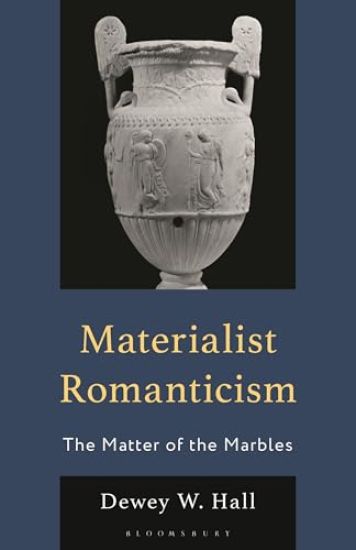
Materialist Romanticism

Dewey W. Hall

BLOOMSBURY PUBLISHING PLC
2026
sidottu
A matter-based approach to the study of nineteenth-century Romantic artifacts centering on the removal of the Parthenon sculptures from Athens, Greece by Thomas Bruce, the 7th Earl of Elgin, and sale of the prized artifacts to the British Parliament for £35,000 in 1816. Dewey W. Hall delves into the intrigue surrounding the famed sculptures by reaching back in time to Democritus (460–370 B.C.), Aristotle (384–322 B.C.), and Epicurus (341–271 B.C.) who theorized about the atom—the basis for the materialist tradition—and Lucretius’s notion of the swerve in De Rerum Natura (Of the Nature of Things) (c. 55–49 B.C.). This study includes various artistic responses to the Parthenon sculptures via the verbal and visual as represented through George Gordon, Lord Byron’s Curse of Minerva (1811) and Childe Harold’s Pilgrimage (1812), Benjamin Robert Haydon’s sketches of the horse of Selene (1809) held at the British Museum, and John Keats’s Endymion (1818) and “Ode on a Grecian Urn” (1819).