Kirjojen hintavertailu. Mukana 11 244 527 kirjaa ja 12 kauppaa.

Kirjahaku

Etsi kirjoja tekijän nimen, kirjan nimen tai ISBN:n perusteella.

10 kirjaa tekijältä Diane Coyle

The Soulful Science

The Soulful Science

Diane Coyle

Princeton University Press
2009
pokkari
For many, Thomas Carlyle's put-down of economics as "the dismal science" rings true--especially in the aftermath of the crash of 2008. But Diane Coyle argues that economics today is more soulful than dismal, a more practical and human science than ever before. The Soulful Science describes the remarkable creative renaissance in economics, how economic thinking is being applied to the paradoxes of everyday life. This revised edition incorporates the latest developments in the field, including the rise of behavioral finance, the failure of carbon trading, and the growing trend of government bailouts. She also discusses such major debates as the relationship between economic statistics and presidential elections, the boundary between private choice and public action, and who is to blame for today's banking crisis.
The Economics of Enough

The Economics of Enough

Diane Coyle

Princeton University Press
2011
sidottu
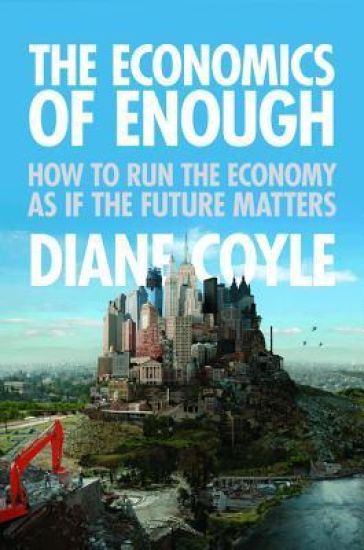
The world's leading economies are facing not just one but many crises. The financial meltdown may not be over, climate change threatens major global disruption, economic inequality has reached extremes not seen for a century, and government and business are widely distrusted. At the same time, many people regret the consumerism and social corrosion of modern life. What these crises have in common, Diane Coyle argues, is a reckless disregard for the future - especially in the way the economy is run. How can we achieve the financial growth we need today without sacrificing a decent future for our children, our societies, and our planet? How can we realize what Coyle calls 'the Economics of Enough'? Running the economy for tomorrow as well as today will require a wide range of policy changes. The top priority must be ensuring that we get a true picture of long-term economic prospects, with the development of official statistics on national wealth in its broadest sense, including natural and human resources. Saving and investment will need to be encouraged over current consumption. Above all, governments will need to engage citizens in a process of debate about the difficult choices that lie ahead and rebuild a shared commitment to the future of our societies. Creating a sustainable economy - having enough to be happy without cheating the future - won't be easy. But "The Economics of Enough" starts a profoundly important conversation about how we can begin - and the first steps we need to take.
The Economics of Enough

The Economics of Enough

Diane Coyle

Princeton University Press
2012
pokkari
Why our economy is cheating the future—and what we can do about itThe world's leading economies are facing not just one but many crises. The financial meltdown may not be over, climate change threatens major global disruption, economic inequality has reached extremes not seen for a century, and government and business are widely distrusted. At the same time, many people regret the consumerism and social corrosion of modern life. What these crises have in common, Diane Coyle argues, is a reckless disregard for the future—especially in the way the economy is run. How can we achieve the financial growth we need today without sacrificing a decent future for our children, our societies, and our planet? How can we realize what Coyle calls "the Economics of Enough"?Running the economy for tomorrow as well as today will require a wide range of policy changes. The top priority must be ensuring that we get a true picture of long-term economic prospects, with the development of official statistics on national wealth in its broadest sense, including natural and human resources. Saving and investment will need to be encouraged over current consumption. Above all, governments will need to engage citizens in a process of debate about the difficult choices that lie ahead and rebuild a shared commitment to the future of our societies.Creating a sustainable economy—having enough to be happy without cheating the future—won't be easy. But The Economics of Enough starts a profoundly important conversation about how we can begin—and the first steps we need to take.
GDP

GDP

Diane Coyle

Princeton University Press
2015
pokkari
Why did the size of the U.S. economy increase by 3 percent on one day in mid-2013--or Ghana's balloon by 60 percent overnight in 2010? Why did the U.K. financial industry show its fastest expansion ever at the end of 2008--just as the world's financial system went into meltdown? And why was Greece's chief statistician charged with treason in 2013 for apparently doing nothing more than trying to accurately report the size of his country's economy? The answers to all these questions lie in the way we define and measure national economies around the world: Gross Domestic Product. This entertaining and informative book tells the story of GDP, making sense of a statistic that appears constantly in the news, business, and politics, and that seems to rule our lives--but that hardly anyone actually understands. Diane Coyle traces the history of this artificial, abstract, complex, but exceedingly important statistic from its eighteenth- and nineteenth-century precursors through its invention in the 1940s and its postwar golden age, and then through the Great Crash up to today. The reader learns why this standard measure of the size of a country's economy was invented, how it has changed over the decades, and what its strengths and weaknesses are. The book explains why even small changes in GDP can decide elections, influence major political decisions, and determine whether countries can keep borrowing or be thrown into recession. The book ends by making the case that GDP was a good measure for the twentieth century but is increasingly inappropriate for a twenty-first-century economy driven by innovation, services, and intangible goods.
The Measure of Progress

The Measure of Progress

Diane Coyle

PRINCETON UNIVERSITY PRESS
2025
sidottu
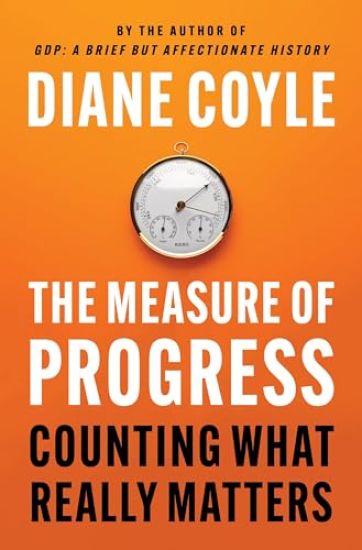
Why do we use eighty-year-old metrics to understand today’s economy?The ways that statisticians and governments measure the economy were developed in the 1940s, when the urgent economic problems were entirely different from those of today. In The Measure of Progress, Diane Coyle argues that the framework underpinning today’s economic statistics is so outdated that it functions as a distorting lens, or even a set of blinkers. When policymakers rely on such an antiquated conceptual tool, how can they measure, understand, and respond with any precision to what is happening in today’s digital economy? Coyle makes the case for a new framework, one that takes into consideration current economic realities.Coyle explains why economic statistics matter. They are essential for guiding better economic policies; they involve questions of freedom, justice, life, and death. Governments use statistics that affect people’s lives in ways large and small. The metrics for economic growth were developed when a lack of physical rather than natural capital was the binding constraint on growth, intangible value was less important, and the pressing economic policy challenge was managing demand rather than supply. Today’s challenges are different. Growth in living standards in rich economies has slowed, despite remarkable innovation, particularly in digital technologies. As a result, politics is contentious and democracy strained.Coyle argues that to understand the current economy, we need different data collected in a different framework of categories and definitions, and she offers some suggestions about what this would entail. Only with a new approach to measurement will we be able to achieve the right kind of growth for the benefit of all.
Markets, State, and People

Markets, State, and People

Diane Coyle

PRINCETON UNIVERSITY PRESS
2020
sidottu
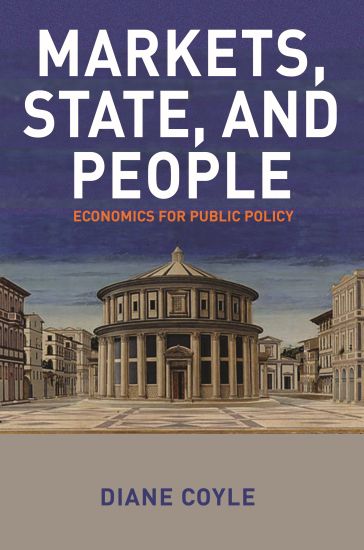
A textbook that examines how societies reach decisions about the use and allocation of economic resourcesWhile economic research emphasizes the importance of governmental institutions for growth and progress, conventional public policy textbooks tend to focus on macroeconomic policies and on tax-and-spend decisions. Markets, State, and People stresses the basics of welfare economics and the interplay between individual and collective choices. It fills a gap by showing how economic theory relates to current policy questions, with a look at incentives, institutions, and efficiency. How should resources in society be allocated for the most economically efficient outcomes, and how does this sit with society’s sense of fairness?Diane Coyle illustrates the ways economic ideas are the product of their historical context, and how events in turn shape economic thought. She includes many real-world examples of policies, both good and bad. Readers will learn that there are no panaceas for policy problems, but there is a practical set of theories and empirical findings that can help policymakers navigate dilemmas and trade-offs. The decisions faced by officials or politicians are never easy, but economic insights can clarify the choices to be made and the evidence that informs those choices. Coyle covers issues such as digital markets and competition policy, environmental policy, regulatory assessments, public-private partnerships, nudge policies, universal basic income, and much more.Markets, State, and People offers a new way of approaching public economics.A focus on markets and institutionsPolicy ideas in historical contextReal-world examplesHow economic theory helps policymakers tackle dilemmas and choices
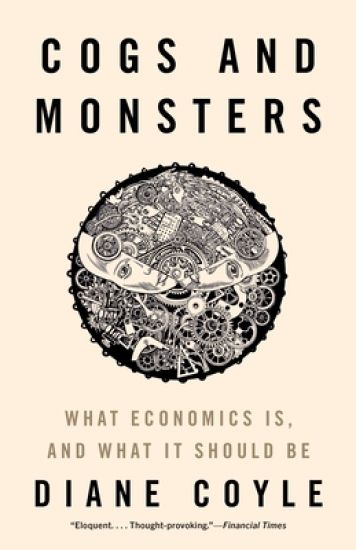
Cogs and Monsters

Cogs and Monsters

Diane Coyle

PRINCETON UNIVERSITY PRESS
2021
sidottu
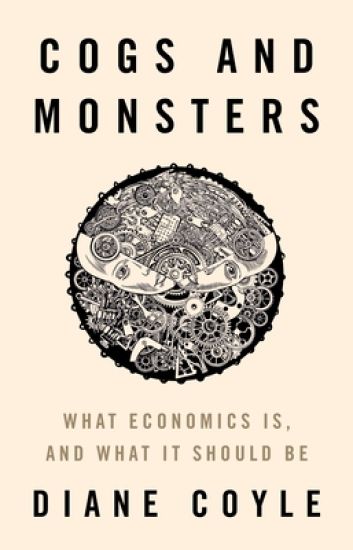
How economics needs to change to keep pace with the twenty-first century and the digital economyDigital technology, big data, big tech, machine learning, and AI are revolutionizing both the tools of economics and the phenomena it seeks to measure, understand, and shape. In Cogs and Monsters, Diane Coyle explores the enormous problems—but also opportunities—facing economics today and examines what it must do to help policymakers solve the world’s crises, from pandemic recovery and inequality to slow growth and the climate emergency.Mainstream economics, Coyle says, still assumes people are “cogs”—self-interested, calculating, independent agents interacting in defined contexts. But the digital economy is much more characterized by “monsters”—untethered, snowballing, and socially influenced unknowns. What is worse, by treating people as cogs, economics is creating its own monsters, leaving itself without the tools to understand the new problems it faces. In response, Coyle asks whether economic individualism is still valid in the digital economy, whether we need to measure growth and progress in new ways, and whether economics can ever be objective, since it influences what it analyzes. Just as important, the discipline needs to correct its striking lack of diversity and inclusion if it is to be able to offer new solutions to new problems.Filled with original insights, Cogs and Monsters offers a road map for how economics can adapt to the rewiring of society, including by digital technologies, and realize its potential to play a hugely positive role in the twenty-first century.
Cogs and Monsters

Cogs and Monsters

Diane Coyle

PRINCETON UNIVERSITY PRESS
2023
pokkari
How economics needs to change to keep pace with the twenty-first century and the digital economyDigital technology, big data, big tech, machine learning, and AI are revolutionizing both the tools of economics and the phenomena it seeks to measure, understand, and shape. In Cogs and Monsters, Diane Coyle explores the enormous problems—but also opportunities—facing economics today and examines what it must do to help policymakers solve the world’s crises, from pandemic recovery and inequality to slow growth and the climate emergency.Mainstream economics, Coyle says, still assumes people are “cogs”—self-interested, calculating, independent agents interacting in defined contexts. But the digital economy is much more characterized by “monsters”—untethered, snowballing, and socially influenced unknowns. What is worse, by treating people as cogs, economics is creating its own monsters, leaving itself without the tools to understand the new problems it faces. In response, Coyle asks whether economic individualism is still valid in the digital economy, whether we need to measure growth and progress in new ways, and whether economics can ever be objective, since it influences what it analyzes. Just as important, the discipline needs to correct its striking lack of diversity and inclusion if it is to be able to offer new solutions to new problems.Filled with original insights, Cogs and Monsters offers a road map for how economics can adapt to the rewiring of society, including by digital technologies, and realize its potential to play a hugely positive role in the twenty-first century.
Governing the World Economy

Governing the World Economy

Diane Coyle

Polity Press
2000
sidottu
The global financial crisis of 1997-8 revealed that emerging market nations as well as the developed economies are vulnerable to the forces of globalization. It highlighted the need for the governance of the world economy to catch up with the pace and degree of integration through trade and financial markets. This book argues passionately in favour of the benefits of free markets, despite the crisis. Coyle argues that the freedom to exchange and invest is valuable in itself, like other freedoms, and that it is also the only sure route to economic development. Further liberalization of trade and investment, appropriately regulated, is essential if developing countries are to attain higher living standards. Economic growth, in turn, will slow population growth and create a constituency for environmental action in the developing world. Coyle also makes the case for a reassessment of the role and capabilities of the international financial institutions. She argues that these need to reflect a more even balance of power, despite the dominance of the US in today's world economy, and that they need to live up to their own rhetoric of transparency and accountability. Chapters on trade and financial markets look in particular at the role of the WTO and IMF, the key villains on the world stage in the eyes of many progressive development campaigners. The book also addresses the shifting political economy of international governance, looking at the way information technology has led to the development of a global opposition to the inter-governmental organizations. This book will be read by students of economics and politics, and all those interested in debates about the nature and trajectory of the world economy.
Governing the World Economy

Governing the World Economy

Diane Coyle

Polity Press
2000
nidottu
The global financial crisis of 1997-8 revealed that emerging market nations as well as the developed economies are vulnerable to the forces of globalization. It highlighted the need for the governance of the world economy to catch up with the pace and degree of integration through trade and financial markets. This book argues passionately in favour of the benefits of free markets, despite the crisis. Coyle argues that the freedom to exchange and invest is valuable in itself, like other freedoms, and that it is also the only sure route to economic development. Further liberalization of trade and investment, appropriately regulated, is essential if developing countries are to attain higher living standards. Economic growth, in turn, will slow population growth and create a constituency for environmental action in the developing world. Coyle also makes the case for a reassessment of the role and capabilities of the international financial institutions. She argues that these need to reflect a more even balance of power, despite the dominance of the US in today's world economy, and that they need to live up to their own rhetoric of transparency and accountability. Chapters on trade and financial markets look in particular at the role of the WTO and IMF, the key villains on the world stage in the eyes of many progressive development campaigners. The book also addresses the shifting political economy of international governance, looking at the way information technology has led to the development of a global opposition to the inter-governmental organizations. This book will be read by students of economics and politics, and all those interested in debates about the nature and trajectory of the world economy.