Kirjojen hintavertailu. Mukana 11 627 373 kirjaa ja 12 kauppaa.

Kirjahaku

Etsi kirjoja tekijän nimen, kirjan nimen tai ISBN:n perusteella.

6 kirjaa tekijältä Dietmar Hildenbrand

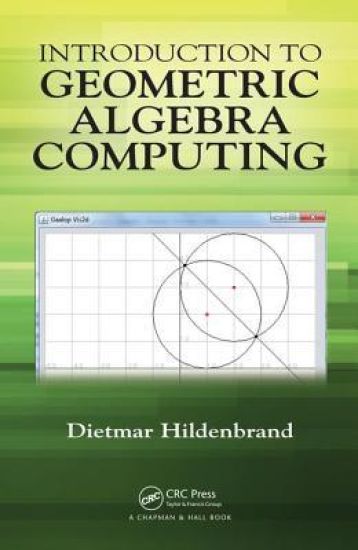
Introduction to Geometric Algebra Computing

Introduction to Geometric Algebra Computing

Dietmar Hildenbrand

CRC Press
2020
nidottu
From the Foreword:"Dietmar Hildenbrand's new book, Introduction to Geometric Algebra Computing, in my view, fills an important gap in Clifford's geometric algebra literature…I can only congratulate the author for the daring simplicity of his novel educational approach taken in this book, consequently combined with hands on computer based exploration. Without noticing, the active reader will thus educate himself in elementary geometric algebra algorithm development, geometrically intuitive, highly comprehensible, and fully optimized."--Eckhard Hitzer, International Christian University, Tokyo, JapanGeometric Algebra is a very powerful mathematical system for an easy and intuitive treatment of geometry, but the community working with it is still very small. The main goal of this book is to close this gap with an introduction to Geometric Algebra from an engineering/computing perspective. This book is intended to give a rapid introduction to computing with Geometric Algebra and itspower for geometric modeling. From the geometric objects point of view, it focuses on the most basic ones, namely points, lines and circles. This algebra is called Compass Ruler Algebra, since it is comparable to working with a compass and ruler. The book explores how to compute with these geometric objects, and their geometric operations and transformations, in a very intuitive way. The book follows a top-down approach, and while it focuses on 2D, it is also easily expandable to 3D computations. Algebra in engineering applications such as computer graphics, computer vision and robotics are also covered.
The Power of Geometric Algebra Computing

The Power of Geometric Algebra Computing

Dietmar Hildenbrand

CRC Press
2021
sidottu
Geometric Algebra is a very powerful mathematical system for an easy and intuitive treatment of geometry, but the community working with it is still very small. The main goal of this book is to close this gap from a computing perspective in presenting the power of Geometric Algebra Computing for engineering applications and quantum computing.The Power of Geometric Algebra Computing is based on GAALOPWeb, a new user-friendly, web-based tool for the generation of optimized code for different programming languages as well as for the visualization of Geometric Algebra algorithms for a wide range of engineering applications.Key Features: Introduces a new web-based optimizer for Geometric Algebra algorithms Supports many programming languages as well as hardware Covers the advantages of high-dimensional algebras Includes geometrically intuitive support of quantum computingThis book includes applications from the fields of computer graphics, robotics and quantum computing and will help students, engineers and researchers interested in really computing with Geometric Algebra.
The Power of Geometric Algebra Computing

The Power of Geometric Algebra Computing

Dietmar Hildenbrand

TAYLOR FRANCIS LTD
2023
nidottu
Geometric Algebra is a very powerful mathematical system for an easy and intuitive treatment of geometry, but the community working with it is still very small. The main goal of this book is to close this gap from a computing perspective in presenting the power of Geometric Algebra Computing for engineering applications and quantum computing.The Power of Geometric Algebra Computing is based on GAALOPWeb, a new user-friendly, web-based tool for the generation of optimized code for different programming languages as well as for the visualization of Geometric Algebra algorithms for a wide range of engineering applications.Key Features: Introduces a new web-based optimizer for Geometric Algebra algorithms Supports many programming languages as well as hardware Covers the advantages of high-dimensional algebras Includes geometrically intuitive support of quantum computingThis book includes applications from the fields of computer graphics, robotics and quantum computing and will help students, engineers and researchers interested in really computing with Geometric Algebra.
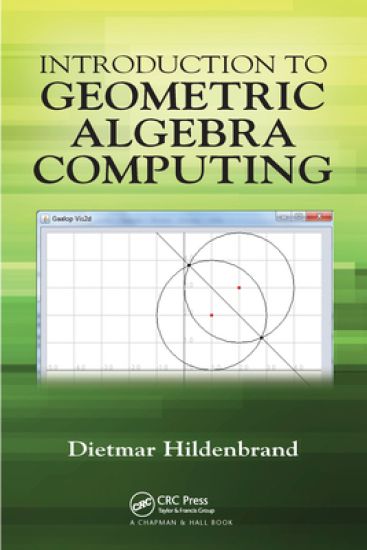
Introduction to Geometric Algebra Computing

Introduction to Geometric Algebra Computing

Dietmar Hildenbrand

Productivity Press
2018
sidottu
From the Foreword:"Dietmar Hildenbrand's new book, Introduction to Geometric Algebra Computing, in my view, fills an important gap in Clifford's geometric algebra literature…I can only congratulate the author for the daring simplicity of his novel educational approach taken in this book, consequently combined with hands on computer based exploration. Without noticing, the active reader will thus educate himself in elementary geometric algebra algorithm development, geometrically intuitive, highly comprehensible, and fully optimized."--Eckhard Hitzer, International Christian University, Tokyo, JapanGeometric Algebra is a very powerful mathematical system for an easy and intuitive treatment of geometry, but the community working with it is still very small. The main goal of this book is to close this gap with an introduction to Geometric Algebra from an engineering/computing perspective. This book is intended to give a rapid introduction to computing with Geometric Algebra and itspower for geometric modeling. From the geometric objects point of view, it focuses on the most basic ones, namely points, lines and circles. This algebra is called Compass Ruler Algebra, since it is comparable to working with a compass and ruler. The book explores how to compute with these geometric objects, and their geometric operations and transformations, in a very intuitive way. The book follows a top-down approach, and while it focuses on 2D, it is also easily expandable to 3D computations. Algebra in engineering applications such as computer graphics, computer vision and robotics are also covered.
Foundations of Geometric Algebra Computing

Foundations of Geometric Algebra Computing

Dietmar Hildenbrand

Springer-Verlag Berlin and Heidelberg GmbH Co. K
2012
sidottu
The author defines “Geometric Algebra Computing” as the geometrically intuitive development of algorithms using geometric algebra with a focus on their efficient implementation, and the goal of this book is to lay the foundations for the widespread use of geometric algebra as a powerful, intuitive mathematical language for engineering applications in academia and industry. The related technology is driven by the invention of conformal geometric algebra as a 5D extension of the 4D projective geometric algebra and by the recent progress in parallel processing, and with the specific conformal geometric algebra there is a growing community in recent years applying geometric algebra to applications in computer vision, computer graphics, and robotics.This book is organized into three parts: in Part I the author focuses on the mathematical foundations; in Part II he explains the interactive handling of geometric algebra; and in Part III he deals with computing technology for high-performance implementations based on geometric algebra as a domain-specific language in standard programming languages such as C++ and OpenCL. The book is written in a tutorial style and readers should gain experience with the associated freely available software packages and applications.The book is suitable for students, engineers, and researchers in computer science, computational engineering, and mathematics.
Foundations of Geometric Algebra Computing

Foundations of Geometric Algebra Computing

Dietmar Hildenbrand

Springer-Verlag Berlin and Heidelberg GmbH Co. K
2015
nidottu
The author defines “Geometric Algebra Computing” as the geometrically intuitive development of algorithms using geometric algebra with a focus on their efficient implementation, and the goal of this book is to lay the foundations for the widespread use of geometric algebra as a powerful, intuitive mathematical language for engineering applications in academia and industry. The related technology is driven by the invention of conformal geometric algebra as a 5D extension of the 4D projective geometric algebra and by the recent progress in parallel processing, and with the specific conformal geometric algebra there is a growing community in recent years applying geometric algebra to applications in computer vision, computer graphics, and robotics.This book is organized into three parts: in Part I the author focuses on the mathematical foundations; in Part II he explains the interactive handling of geometric algebra; and in Part III he deals with computing technology for high-performance implementations based on geometric algebra as a domain-specific language in standard programming languages such as C++ and OpenCL. The book is written in a tutorial style and readers should gain experience with the associated freely available software packages and applications.The book is suitable for students, engineers, and researchers in computer science, computational engineering, and mathematics.