Kirjojen hintavertailu. Mukana 12 016 292 kirjaa ja 12 kauppaa.

Kirjahaku

Etsi kirjoja tekijän nimen, kirjan nimen tai ISBN:n perusteella.

12 kirjaa tekijältä Dimitri Ginev

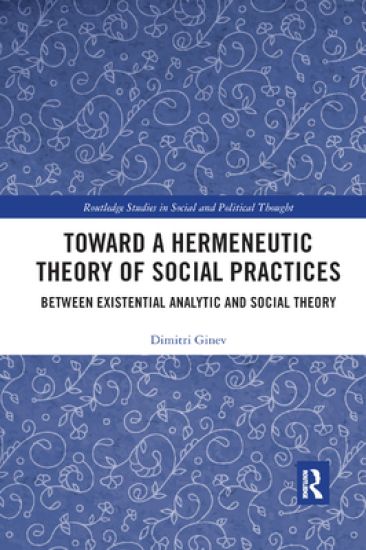
Toward a Hermeneutic Theory of Social Practices
Recent methodological debates have shown that practice theory can either be developed by combining and slightly extending established theoretical concepts of inter-subjectivity, social normativity, collective behavior, interaction between agents and environment, habits, learning, collective intentionality, and human agency; or by following a strategy that promotes the quest for completely autonomous concepts. In the latter case, one defends a thesis of irreducibility.Toward a Hermeneutic Theory of Social Practices advocates this thesis by approaching the interrelational dynamic of social practices in terms of existential analytic. Indeed, this insightful volume outlines a methodology of the double hermeneutics that allows the study of the entanglement of agential plans, beliefs, and intentions with configured practices; while also demonstrating how interrelated social practices with which agency is entangled articulate cultural forms of life.Suggesting a framework for studying the cultural forms of life within the scope of practice theory, this book will appeal to postgraduate students and postdoctoral researchers interested in fields such as Social Theory, Philosophy of Social Science, and Research Methods for Social and Behavioral Sciences.
The Tenets of Cognitive Existentialism

The Tenets of Cognitive Existentialism

Dimitri Ginev

Ohio University Press
2011
sidottu
In The Tenets of Cognitive Existentialism, Dimitri Ginev draws on developments in hermeneutic phenomenology and other programs in hermeneutic philosophy to inform an interpretative approach to scientific practices. At stake is the question of whether it is possible to integrate forms of reflection upon the ontological difference in the cognitive structure of scientific research. A positive answer would have implied a proof that (pace Heidegger) "science is able to think." This book is an extended version of such a proof. Against those who claim that modern science is doomed to be exclusively committed to the nexus of objectivism and instrumental rationality, the interpretative theory of scientific practices reveals science's potentiality of hermeneutic self-reflection. Scientific research that takes into consideration the ontological difference has resources to enter into a dialogue with Nature. Ginev offers a critique of postmodern tendencies in the philosophy of science, and sets out arguments for a feminist hermeneutics of scientific research.
Toward a Hermeneutic Theory of Social Practices
Recent methodological debates have shown that practice theory can either be developed by combining and slightly extending established theoretical concepts of inter-subjectivity, social normativity, collective behavior, interaction between agents and environment, habits, learning, collective intentionality, and human agency; or by following a strategy that promotes the quest for completely autonomous concepts. In the latter case, one defends a thesis of irreducibility.Toward a Hermeneutic Theory of Social Practices advocates this thesis by approaching the interrelational dynamic of social practices in terms of existential analytic. Indeed, this insightful volume outlines a methodology of the double hermeneutics that allows the study of the entanglement of agential plans, beliefs, and intentions with configured practices; while also demonstrating how interrelated social practices with which agency is entangled articulate cultural forms of life.Suggesting a framework for studying the cultural forms of life within the scope of practice theory, this book will appeal to postgraduate students and postdoctoral researchers interested in fields such as Social Theory, Philosophy of Social Science, and Research Methods for Social and Behavioral Sciences.
Essays in the Hermeneutics of Science
Published in 1997, this volume is written from a hermenutico-phenomenological point of view. The essays cover a spectrum of relevant issues: the essential interpretation of science; the possibility of a "strong hermeneutics of science" that takes into consideration science's cognitive structure; the implications of existential-ontological interpretations of science for the post-metaphysical dialogue between hermeneutics and epistomology; the place of rhetorical tools in the human sciences; and the strategies of overcoming the legitimation crisis of the human sciences. Because of its commitment to the radical universalization of the hermeneutic problem, the strong programme of hermeneutics of science, suggested in this book, avoids both objectivism and relativism. In this regard, the essays must be read in relation to the search for a middle way between defending epistemic rationality as a basis for futher development of the "project of modernity" and the postmodern deconstruction of all cognitive identities of modernity.
Essays in the Hermeneutics of Science
Published in 1997, this volume is written from a hermenutico-phenomenological point of view. The essays cover a spectrum of relevant issues: the essential interpretation of science; the possibility of a "strong hermeneutics of science" that takes into consideration science's cognitive structure; the implications of existential-ontological interpretations of science for the post-metaphysical dialogue between hermeneutics and epistomology; the place of rhetorical tools in the human sciences; and the strategies of overcoming the legitimation crisis of the human sciences. Because of its commitment to the radical universalization of the hermeneutic problem, the strong programme of hermeneutics of science, suggested in this book, avoids both objectivism and relativism. In this regard, the essays must be read in relation to the search for a middle way between defending epistemic rationality as a basis for futher development of the "project of modernity" and the postmodern deconstruction of all cognitive identities of modernity.
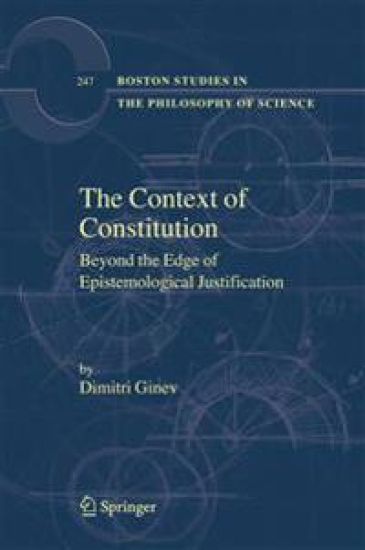
The Context of Constitution

The Context of Constitution

Dimitri Ginev

Springer-Verlag New York Inc.
2006
sidottu
This study brings together ideas developed over many years in various lectures in an endeavour to clarify the concept of hermeneutic fore-structure of scientific research. The starting point of my investigations was the outline of an interp- tative approach to the constitution of science’s cognitive content. In the late 1970s I was preoccupied with a question that nowadays should be formulated as follows: Is it possible to claim a validity of the hermeneutic view of the “situatedness in a tradition” also for the natural sciences? I was convinced that the negative answer implies a self-defeating position. It states that in order to champion the (cultural) universality of hermeneutics, one has to profess the non-hermeneutic nature of the natural sciences. Paradoxically enough, this a- wer presupposes a sharp dividing line (between dialogical experience and monological research) in culture in order to stress the universality of hermeneutics. Long before the period of perestroika in my corner, I learned from Joseph Kockelmans, Patrick Heelan, and Theodore Kisiel how the universalization of hermeneutics can include the natural sciences without ignoring their cognitive specificity. Somewhat later, in the aftermath of the discussions over the “finalization of science”, I began to confront the view that it would be a kind of trivializing the struggle for a philosophical hermeneutics if the theory-observation nexus is treated as a specific hermeneutic circle. No doubt, the view is correct. I was, however, dissatisfied with the way of arguing for it.
Scientific Conceptualization and Ontological Difference
Ginev works out a conception of the constitution of scientific objects in terms of hermeneutic phenomenology. Recently there has been a revival of interest in hermeneutic theories of scientific inquiry. The present study is furthering this interest by shifting the focus from interpretive methods and procedures to the kinds of reflexivity operating in scientific conceptualization. According to the book's central thesis, a reflexive conceptualization enables one to take into consideartion the role which the ontic-ontological difference plays in the constitution of scientific objects. The book argues for this thesis by analyzing the formation of objects of inquiry in a range of scientific domains stretching from highly formalized domains where the quest for objects' identities is carried out in terms of objects' emancipation from structures to linguistic and historiographic programs that avoid procedural objectification in their modes of conceptualization. The book sets up a new strategy for the dialogue between (the theories of) scientifc inquiry and hermeneutic phenomenology.
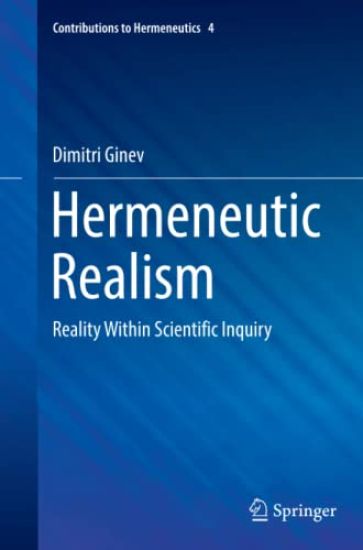
Hermeneutic Realism

Hermeneutic Realism

Dimitri Ginev

Springer International Publishing AG
2016
sidottu
This study recapitulates basic developments in the tradition of hermeneutic and phenomenological studies of science. It focuses on the ways in which scientific research is committed to the universe of interpretative phenomena. It treats scientific research by addressing its characteristic hermeneutic situations, and uses the following basic argument in this treatment: By demonstrating that science’s epistemological identity is not to be spelled out in terms of objectivism, mathematical essentialism, representationalism, and foundationalism, one undermines scientism without succumbing scientific research to “procedures of normative-democratic control” that threaten science’s cognitive autonomy. The study shows that in contrast to social constructivism, hermeneutic phenomenology of scientific research makes the case that overcoming scientism does not imply restrictive policies regarding the constitution of scientific objects.
Hermeneutic Realism

Hermeneutic Realism

Dimitri Ginev

Springer International Publishing AG
2018
nidottu
This study recapitulates basic developments in the tradition of hermeneutic and phenomenological studies of science. It focuses on the ways in which scientific research is committed to the universe of interpretative phenomena. It treats scientific research by addressing its characteristic hermeneutic situations, and uses the following basic argument in this treatment: By demonstrating that science’s epistemological identity is not to be spelled out in terms of objectivism, mathematical essentialism, representationalism, and foundationalism, one undermines scientism without succumbing scientific research to “procedures of normative-democratic control” that threaten science’s cognitive autonomy. The study shows that in contrast to social constructivism, hermeneutic phenomenology of scientific research makes the case that overcoming scientism does not imply restrictive policies regarding the constitution of scientific objects.
The Context of Constitution

The Context of Constitution

Dimitri Ginev

Springer
2011
nidottu
This study brings together ideas developed over many years in various lectures in an endeavour to clarify the concept of hermeneutic fore-structure of scientific research. The starting point of my investigations was the outline of an interp- tative approach to the constitution of science’s cognitive content. In the late 1970s I was preoccupied with a question that nowadays should be formulated as follows: Is it possible to claim a validity of the hermeneutic view of the “situatedness in a tradition” also for the natural sciences? I was convinced that the negative answer implies a self-defeating position. It states that in order to champion the (cultural) universality of hermeneutics, one has to profess the non-hermeneutic nature of the natural sciences. Paradoxically enough, this a- wer presupposes a sharp dividing line (between dialogical experience and monological research) in culture in order to stress the universality of hermeneutics. Long before the period of perestroika in my corner, I learned from Joseph Kockelmans, Patrick Heelan, and Theodore Kisiel how the universalization of hermeneutics can include the natural sciences without ignoring their cognitive specificity. Somewhat later, in the aftermath of the discussions over the “finalization of science”, I began to confront the view that it would be a kind of trivializing the struggle for a philosophical hermeneutics if the theory-observation nexus is treated as a specific hermeneutic circle. No doubt, the view is correct. I was, however, dissatisfied with the way of arguing for it.
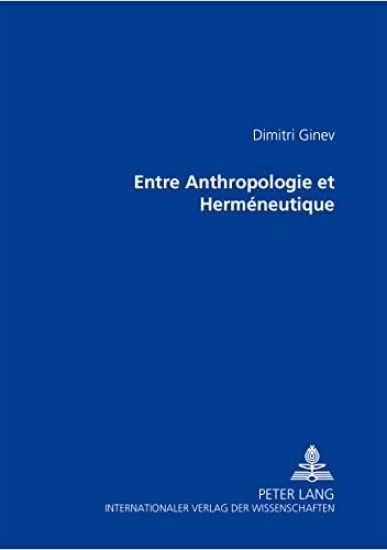
Entre Anthropologie Et Herméneutique

Entre Anthropologie Et Herméneutique

Dimitri Ginev

Peter Lang AG
2004
nidottu
Entre l'ontologie hermeneutique de Heidegger et l'anthropologie philosophique de Plessner se situe l'espace des possibilites de la pensee post-metaphysique. L'interet primordial des etudes recueillies dans la collection est cet espace de possibilites. Le point commun des recherches est ce que le mythe de l'emancipation ignore: la finitude et la transcendance immanente de l'experience humaine. Le prefixe post se refere non seulement a un mode specialise de philosopher comme metaphysique, mais plutot a l'identite metaphysique de la modernite. L'hermeneutique philosophique et l'anthropologie philosophique sont des discours post-metaphysiques qui detiennent le potentiel critique necessaire pour la realisation d'une identite post-metaphysique.