Kirjojen hintavertailu. Mukana 12 016 292 kirjaa ja 12 kauppaa.

Kirjahaku

Etsi kirjoja tekijän nimen, kirjan nimen tai ISBN:n perusteella.

3 kirjaa tekijältä Dimitri Mortelmans

Divorce in Europe

Divorce in Europe

Dimitri Mortelmans

Saint Philip Street Press
2020
pokkari
This open access book collects the major discussions in divorce research in Europe. It starts with an understanding of divorce trends. Why was divorce increasing so rapidly throughout the US and Europe and do we see signs of a turn? Do cohabitation breakups influence divorce trends or is there a renewed stability on the partner market? In terms of divorce risks, the book contains new insights on Eastern European countries. These post socialist countries have evolved dramatically since the fall of the Wall and at present they show the highest divorce figures in Europe. Also the influence of gender, and more specifically women's education as a risk in divorce is examined cross nationally. The book also provides explanations for the negative gradient in female education effects on divorce. It devotes three separate parts to new insights in the post-divorce effects of the life course event by among others looking at consequences for adults and children but also taking the larger family network into account. As such the book is of interest to demographers, sociologists, psychologists, family therapists, NGOs, and politicians. "This wide-ranging volume details important trends in divorce in Europe that hold implications for understanding family dissolution causes and consequences throughout the world. Highly recommended for researchers and students everywhere." This work was published by Saint Philip Street Press pursuant to a Creative Commons license permitting commercial use. All rights not granted by the work's license are retained by the author or authors.
Divorce in Europe

Divorce in Europe

Dimitri Mortelmans

Saint Philip Street Press
2020
sidottu
This open access book collects the major discussions in divorce research in Europe. It starts with an understanding of divorce trends. Why was divorce increasing so rapidly throughout the US and Europe and do we see signs of a turn? Do cohabitation breakups influence divorce trends or is there a renewed stability on the partner market? In terms of divorce risks, the book contains new insights on Eastern European countries. These post socialist countries have evolved dramatically since the fall of the Wall and at present they show the highest divorce figures in Europe. Also the influence of gender, and more specifically women's education as a risk in divorce is examined cross nationally. The book also provides explanations for the negative gradient in female education effects on divorce. It devotes three separate parts to new insights in the post-divorce effects of the life course event by among others looking at consequences for adults and children but also taking the larger family network into account. As such the book is of interest to demographers, sociologists, psychologists, family therapists, NGOs, and politicians. "This wide-ranging volume details important trends in divorce in Europe that hold implications for understanding family dissolution causes and consequences throughout the world. Highly recommended for researchers and students everywhere." This work was published by Saint Philip Street Press pursuant to a Creative Commons license permitting commercial use. All rights not granted by the work's license are retained by the author or authors.
Doing Qualitative Data Analysis with NVivo

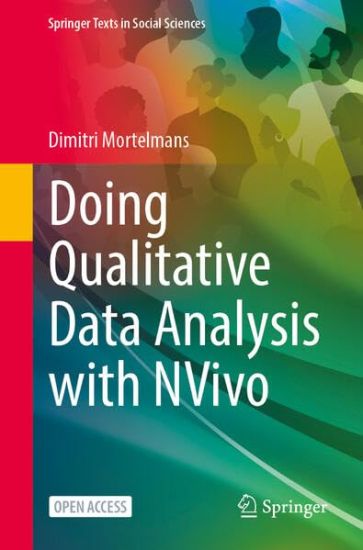
Doing Qualitative Data Analysis with NVivo

Dimitri Mortelmans

Springer International Publishing AG
2024
nidottu
This open access textbook provides an introduction to the software program NVivo, the most widely used qualitative analysis program. It is a versatile program with an extensive range of accessible analysis tools, flexibly deployable in the diversity of qualitative analysis approaches. Qualitative analysis is almost standard practice today with the help of a software program. Yet there are many misunderstandings about qualitative software. They support the qualitative researcher but never take over their manual and theoretical work. An in-depth understanding of the possibilities of a qualitative software program helps to free up time for the analysis itself. The possibilities of NVivo in this book are approached from a researcher's perspective. That is precisely why gaining efficiency in using the software tools gets a prominent place in the chapters. The author examines basic skills, such as managing data, working with memos and coding qualitative data. This includes textual data (such as transcripts from interviews and focus groups) and audiovisual material (sound, video and images). The book also discusses more advanced analysis tools, such as case coding, queries, AI tools, matrices and models (maps). This textbook is intended for all users of NVivo, both early career researchers and more advanced analysts, who want to further discover the secrets of this software package along the way.