First published in 1973 Professor Akenson’s book traces the series of religious and political controversies which have battered the state schools of Northern Ireland. After the government’s admirably intentioned, but muddled, attempt to create a non-sectarian school system in the early 1920s, the educational system was progressively manipulated by sectarianism. The way in which the author describes how children are schooled reveals a great deal about the attitudes and values of the parental generation and also helps to explain the actions of later generations.
First published in 1975, Donald Akenson’s book was at the forefront of a radically new approach to the study of Irish educational history. Instead of investigating the evolution of the schools as an isolated process, he explores the complex interrelations of Irish education, institutions and society, treating the schools as cultural litmus paper. By presenting Ireland’s schools as a reflection of the society that produced them, Professor Akenson demonstrates that they are, in truth, "a mirror to the face of Kathleen ni Houlihan".
First published in 1975, Donald Akenson’s book was at the forefront of a radically new approach to the study of Irish educational history. Instead of investigating the evolution of the schools as an isolated process, he explores the complex interrelations of Irish education, institutions and society, treating the schools as cultural litmus paper. By presenting Ireland’s schools as a reflection of the society that produced them, Professor Akenson demonstrates that they are, in truth, "a mirror to the face of Kathleen ni Houlihan".
First published in 1973 Professor Akenson’s book traces the series of religious and political controversies which have battered the state schools of Northern Ireland. After the government’s admirably intentioned, but muddled, attempt to create a non-sectarian school system in the early 1920s, the educational system was progressively manipulated by sectarianism. The way in which the author describes how children are schooled reveals a great deal about the attitudes and values of the parental generation and also helps to explain the actions of later generations.
This volume focuses on the creation, structure and evolution of the Irish national system of education. It illustrates how the system was shaped by the religious, social and political realities of nineteenth century Ireland and discusses the effects that the system had upon the Irish nation: namely that it was the chief means by which the country was transformed from one in which illiteracy predominated to one in which most people, even the poorest, could read and write.
This volume focuses on the creation, structure and evolution of the Irish national system of education. It illustrates how the system was shaped by the religious, social and political realities of nineteenth century Ireland and discusses the effects that the system had upon the Irish nation: namely that it was the chief means by which the country was transformed from one in which illiteracy predominated to one in which most people, even the poorest, could read and write.
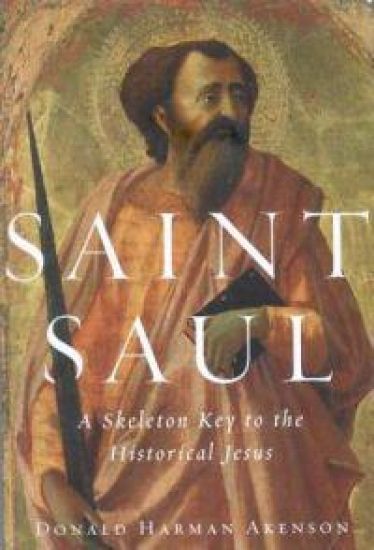
In this follow-up to his acclaimed Surpassing Wonder, Akenson recreates the world of Christ, a time rich with ideas, prophets, factions, priests, savants, and god-drunk fanatics. Saint Saul sheds light on Yeshua's birth and his relationship to his family, clarifies Yeshua's views on issues such as divorce and resurrection, and examines his sense of himself as Messiah. Throughout Saint Saul Akenson insistently stresses the Jewishness of Yeshua. He dismisses the traditional way of searching for facts about him by looking for parallels among the four gospels, arguing that the gospels were handed down as a unit by a later generation. In contrast Saul, although he did not know Yeshua personally, knew his most important followers and wrote immediately after his death. Saul's teachings were approved, though sometimes reluctantly, by Yeshua's brothers and other early leaders. Akenson sifts and probes the evidence for and against the historical status of Saul and Yeshua, a mystery as fascinating as a good detective story and one where readers must come to their own conclusions about the circumstances and texts that gave rise to two great world-faiths, Christianity and Rabbinic Judaism.