Kirjojen hintavertailu. Mukana 11 342 296 kirjaa ja 12 kauppaa.

Kirjahaku

Etsi kirjoja tekijän nimen, kirjan nimen tai ISBN:n perusteella.

8 kirjaa tekijältä Donald B. Cole

Martin van Buren and the American Political System

Martin van Buren and the American Political System

Donald B. Cole

Princeton University Press
2014
pokkari
Donald Cole analyzes the political skills that brought Van Buren the nickname Little Magician," describing how he built the Albany Regency (which became a model for political party machines) and how he created the Democratic party of Andrew Jackson. Originally published in 1984. The Princeton Legacy Library uses the latest print-on-demand technology to again make available previously out-of-print books from the distinguished backlist of Princeton University Press. These editions preserve the original texts of these important books while presenting them in durable paperback and hardcover editions. The goal of the Princeton Legacy Library is to vastly increase access to the rich scholarly heritage found in the thousands of books published by Princeton University Press since its founding in 1905.

Martin van Buren and the American Political System

Martin van Buren and the American Political System

Donald B. Cole

Princeton University Press
2016
sidottu
Donald Cole analyzes the political skills that brought Van Buren the nickname Little Magician," describing how he built the Albany Regency (which became a model for political party machines) and how he created the Democratic party of Andrew Jackson. Originally published in 1984. The Princeton Legacy Library uses the latest print-on-demand technology to again make available previously out-of-print books from the distinguished backlist of Princeton University Press. These editions preserve the original texts of these important books while presenting them in durable paperback and hardcover editions. The goal of the Princeton Legacy Library is to vastly increase access to the rich scholarly heritage found in the thousands of books published by Princeton University Press since its founding in 1905.

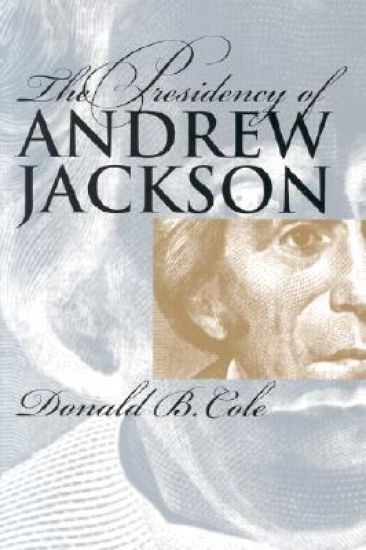
The Presidency of Andrew Jackson

The Presidency of Andrew Jackson

Donald B. Cole

University Press of Kansas
1993
sidottu
In 1829 Andrew Jackson arrived in Washington in a carriage. Eight years and two turbulent presidential terms later, he left on a train. Those years, among the most prosperous in American history, saw America transformed not only by growth in transportation but by the expansion of the market economy and the formation of the mass political party. Jackson's ambivalence - and that of his followers - toward the new politics and the new economy is the story of this book. Historians have often depicted the Old Hero (or Old Hickory) as bigger than life - so prominent that his name was wed to an era. Donald Cole presents a different Jackson, one not always sure of himself and more controlled by, than in control of, the political and economic forces of his age. He portrays Jackson as a leader who yearned for the agrarian past but was also entranced by the future of a growing market economy. The dominant theme of Jackson's presidency, Cole argues, was his inconsistent and unsuccessful battle to resist the market revolution. Elected by a broad coalition of interest groups, Jackson battled constantly not only with his opponents but also his supporters. He spent most of his time rearranging his administration and contending with Congress. His accomplishments were mostly negative - relocating Indians, vetoing road bills and the Bank bill, and opposing nullification. The greatest achievement of his administration, the rise of the mass political party, was more the work of advisers than of Jackson himself. He did, however, make a lasting imprint, Cole contends. Through his strength, passions, and especially his anxiety, Jackson symbolised the ambivalence of his fellow Americans at a decisive moment - a time when the country was struggling with the conflict between the ideals of the Revolution and the realities of 19th century capitalism.
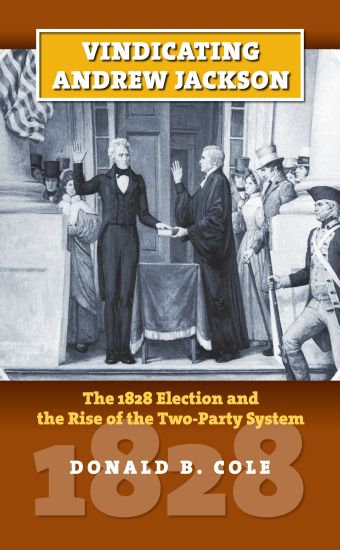
Vindicating Andrew Jackson

Vindicating Andrew Jackson

Donald B. Cole

University Press of Kansas
2009
sidottu
The presidential election of 1828 is one of the most compelling stories in American history: Andrew Jackson, hero of the Battle of New Orleans and man of the people, bounced back from his controversial loss four years earlier to unseat John Quincy Adams in a campaign notorious for its mudslinging. With his victory, the torch was effectively passed from the founding fathers to the people. This study of Jackson's election separates myth from reality to explain why it had such an impact on present-day American politics. Featuring parades and public participation to a greater degree than had previously been seen, the campaign itself first centered on two key policy issues: tariffs and republicanism. But as Donald Cole shows, the major theme turned out to be what Adams scornfully called 'electioneering': the rise of mass political parties and the origins of a two-party system, built from the top down, whose leaders were willing to spend unprecedented time and money to achieve victory. Cole's innovative study examines the election at the local and state, as well as the national, levels, focusing on New Hampshire, New York, Pennsylvania, Ohio, Kentucky, and Virginia to provide a social, economic, and political cross section of 1828 America. He describes how the Jacksonians were better organized, paid more attention to detail, and recruited a broader range of workers - especially state-level party leaders and newspaper editors who were invaluable for raising funds, publicizing party dogma, and smearing the opposition. The Jacksonians also outdid the Adams supporters in zealotry, violence of language, and the overwhelming force of their campaigning and succeeded in painting their opponents as aristocratic, class conscious, and undemocratic. Tracing interpretations of this election from James Parton's classic 1860 biography of Jackson to recent revisionist accounts attacking Old Hickory for his undemocratic treatment of blacks, Indians, and women, Cole argues that this famous election did not really bring democracy to America as touted - because it was democracy that enabled Jackson to win. By offering a more charismatic candidate, a more vigorous campaign, a more acceptable recipe for preserving the past, and a more forthright acceptance of a new political system, Jackson's Democrats dominated an election in which campaigning outweighed issues and presaged the presidential election of 2008.
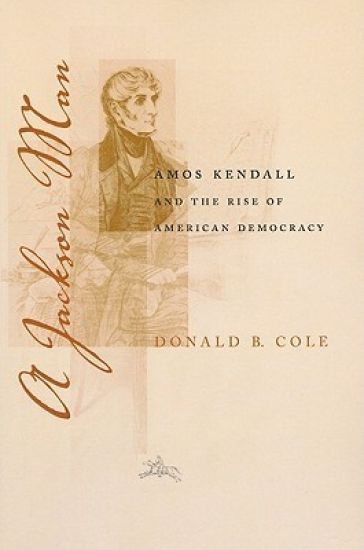
A Jackson Man

A Jackson Man

Donald B. Cole

Louisiana State University Press
2010
nidottu
Well researched... and well written, this work gives us Kendall, warts and all. We see the avarice, the ambition, and the contradictions of his subject.... This is biography at its best."" - Journal of American HistoryA rare, fascinating personality emerges in Donald B. Cole's biography of Amos Kendall (1789-1869), the reputed intellectual engine behind Andrew Jackson's administration and an influential figure in the transformation of young America from an agrarian republic to a capitalist democracy. Born on a small Massachusetts farm and educated at Dartmouth, Kendall moved to Kentucky as a young man to seek his fortune and eventually became one of the few nationally prominent antebellum politicians who successfully combined northern origins and southern experience. Kendall's role in democratizing American politics is shown in a compelling narrative of his evolution from a republican idealist to a democratic individualist who contributed greatly to the rise of the Democratic Party. The first biography of Kendall, this superbly written and researched volume charts the progression of American democracy and the culture that created it. ""Donald B. Cole's splendid book is carefully researched, detailed yet boldly interpretive, and gracefully written."" - Civil War History ""[T]his biography is both enjoyable and an indispensable read for those interested in understanding the development of Jacksonian democracy."" - Journal of the Early Republic
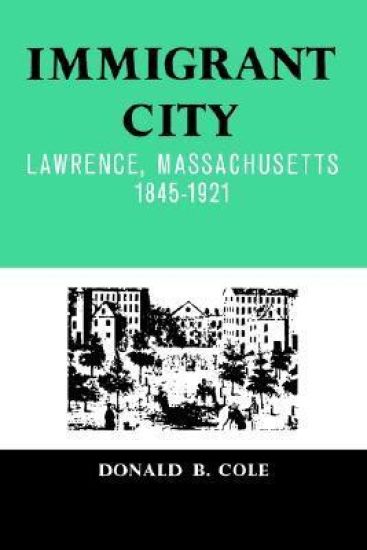
Immigrant City

Immigrant City

Donald B. Cole

The University of North Carolina Press
2002
nidottu
The violence and radicalism connected with the Industrial Workers of the World textile strike of 1912 in Lawrence, Massachusetts, left the popular impression that Lawrence was a slum-ridden city inhabited by un-American revolutionaries. Immigrant City is a study of Lawrence which reveals that the city was far different. The book opens with an account of the strike of 1912. It then traces the development of Lawrence from the founding of the city in 1845, when its builders hoped to establish a model mill town, through its years of immigration and growth of 1912. Donald Cole puts the strike in its proper perspective by examining the history of the city, and he emphasizes the immigrant's constant search for security and explores the very important question of whether the immigrant, from his own point of view, found security. The population of Lawrence was almost completely immigrant in nature; in 1910, 90 per cent of its people were either first or second generation Americans, and they represented nearly every nation in the world. The period covered by the book--1845 through 1921--is the great middle period of American immigration, which began with the Irish Famine and ended with the Quota Law of 1921. While Immigrant City concentrates on one American city, it reveals much about American immigration in general and demonstrates clearly that, in spite of the poverty that most immigrants fought, life for the foreign-born in America was not as grim as some writers have suggested.