Kirjojen hintavertailu. Mukana 11 468 703 kirjaa ja 12 kauppaa.

Kirjahaku

Etsi kirjoja tekijän nimen, kirjan nimen tai ISBN:n perusteella.

3 kirjaa tekijältä Donald E. Chipman

Moctezuma's Children

Moctezuma's Children

Donald E. Chipman

University of Texas Press
2005
pokkari
Though the Aztec Empire fell to Spain in 1521, three principal heirs of the last emperor, Moctezuma II, survived the conquest and were later acknowledged by the Spanish victors as reyes naturales (natural kings or monarchs) who possessed certain inalienable rights as Indian royalty. For their part, the descendants of Moctezuma II used Spanish law and customs to maintain and enhance their status throughout the colonial period, achieving titles of knighthood and nobility in Mexico and Spain. So respected were they that a Moctezuma descendant by marriage became Viceroy of New Spain (colonial Mexico's highest governmental office) in 1696. This authoritative history follows the fortunes of the principal heirs of Moctezuma II across nearly two centuries. Drawing on extensive research in both Mexican and Spanish archives, Donald E. Chipman shows how daughters Isabel and Mariana and son Pedro and their offspring used lawsuits, strategic marriages, and political maneuvers and alliances to gain pensions, rights of entailment, admission to military orders, and titles of nobility from the Spanish government. Chipman also discusses how the Moctezuma family history illuminates several larger issues in colonial Latin American history, including women's status and opportunities and trans-Atlantic relations between Spain and its New World colonies.
Heaven's Messengers and the Conquest of Mexico

Heaven's Messengers and the Conquest of Mexico

Donald E. Chipman

Stephen F. Austin State University Press
2014
nidottu
Heaven's Messengers begins with the death of six young people—three in Mexico, two in the United States, and one in Spain.All are admitted to heaven by St. Peter and given special assignments to interview six important personages in the conquest of Mexico: Hernando Cortés, Pedro de Alvarado, and Martín López (the last far less well known, but he was a master carpenter and boat builder who constructed thirteen small vessels that were launched on Lake Texcoco and provided a naval component that proved vitally important to the success of the conquest); Doña Marina and Isabel Moctezuma, both Aztec women); and Leonor Cortés Moctezuma. The six messengers are miraculously returned to life and placed in the century of conquest with specific assignments—to illustrate how three men steeped in Roman Catholicism and three pagan women become worthy.
Sword of Empire

Sword of Empire

Donald E. Chipman

State House Press
2021
sidottu
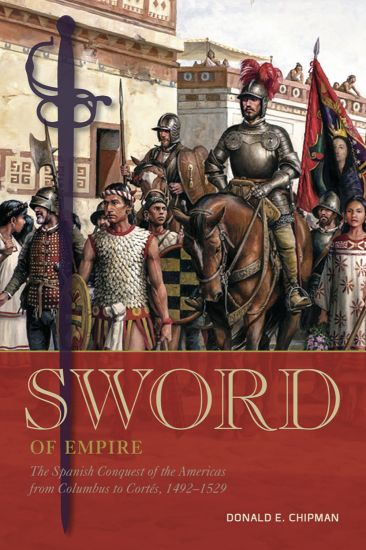
Sword of Empire: The Spanish Conquest of the Americas from Columbus to CortÉs, 1492-1529 is, by design, an approachable and accessible history of some of the most life-altering events in the story of man. Chipman examines the contributions of Christopher Columbus and Hernando Cortes in creating the foundations of the Spanish Empire in North America. Chipman has produced a readable and accurate narrative for students and the reading public, although some information presented on Cortes cannot be found elsewhere in print and is therefore of interest to specialists in the history of Spain in America. Exclusive material from Professor France V. Scholes and the author share insights into the multi layered complexities of a man born in 1484 and named at birth Fernando Cortes. As for Columbus, born in Genoa on the Italian peninsula in 1451 and given the name Cristobal de Colon, he is a more transformative man than Cortes in bringing Western Civilization to the major Caribbean islands in the Spanish West Indies and beyond. Historians strive to present a 'usable past' and the post-Columbian world is, of course, the modern world. Columbus's discoveries, those of other mariners who followed to the south in America, and still other eastward to the Asia placed the world on the path of global interdependence-both good and ill-for peoples of the world. There are no footnotes in Sword of Empire-this is narrative at its finest-but there are extensive bibliographies for each chapter that will prove useful for readers of every background.