Kirjojen hintavertailu. Mukana 11 244 527 kirjaa ja 12 kauppaa.

Kirjahaku

Etsi kirjoja tekijän nimen, kirjan nimen tai ISBN:n perusteella.

5 kirjaa tekijältä Donald Judd

Donald Judd Interviews

Donald Judd Interviews

Donald Judd

David Zwirner
2019
nidottu
Donald Judd Interviews presents more than sixty interviews with the artist over the course of four decades, and is the first compilation of its kind. It is the companion volume to the critically acclaimed and bestselling Donald Judd Writings.This collection of interviews engages a diverse range of topics, from philosophy and politics to Judd’s insightful critiques of his own work and the work of others such as Mark di Suvero, Edward Hopper, Yayoi Kusama, Barnett Newman, and Jackson Pollock. The opening discussion of the volume between Judd, Dan Flavin, and Frank Stella provides the foundation for many of the succeeding conversations, focusing on the nature and material conditions of the new art developing in the 1960s. The publication also gathers a substantial body of unpublished material across a range of mediums including extensive interviews with art historians Lucy R. Lippard and Barbara Rose.Judd’s contributions in interviews, panels, and extemporaneous conversations are marked by his forthright manner and rigorous thinking, whether in dialogue with art critics, art historians, or his contemporaries. In one of the last interviews, he was asked, “What kind of advice do you have for young artists and architects based on all the things you thought all these years?” Judd responded, “To remember that art and architecture are both real activities with their own integrity and that they are not basically commercial activities and you have to partly live with that. Certainly, it’s not hard to maintain the difference ... I think both activities, to repeat myself, have an integrity. They are each a particular activity, and if you don’t like that activity, don’t do it. Go do something else. If you really want to make a lot of money, go sell cars or something.”Donald Judd Interviews is co-published by Judd Foundation and David Zwirner Books. The interviews expand upon the artist’s thinking present in Donald Judd Writings (Judd Foundation/David Zwirner Books, 2016).
Donald Judd: Artworks 1970–1994

Donald Judd: Artworks 1970–1994

Donald Judd

David Zwirner
2022
sidottu
A sweeping selection of Donald Judd’s iconic and ambitious works alongside a diverse collection of newly commissioned writings. "One of the most significant American artists of the postwar period, Donald Judd rigorously experimented with color, form, material, and space. The works in this catalogue range from the artist’s expansive installations to self-contained single units, yielding valuable new insights into his process and approach. The survey includes one of the artist’s largest and most intricate installations of sixty-three wall-mounted plywood boxes, conceived in 1986. Other works include variations on some of Judd’s most recognizable forms, executed in materials such as Cor-ten steel, plexiglass, copper, plywood, brushed aluminum, and enameled aluminum. Brilliant and exacting reproductions bring these works to life on the page. Following the artist’s major retrospective at The Museum of Modern Art, New York, in 2020, this book serves as a companion volume. With contributions from a wide range of voices—art historians, critics, writers, and performers— this publication includes rich new writings on Judd’s oeuvre, art criticism, and enduring influence. Artworks: 1970–1994 is published on the occasion of the eponymous 2020 exhibition at David Zwirner, New York."
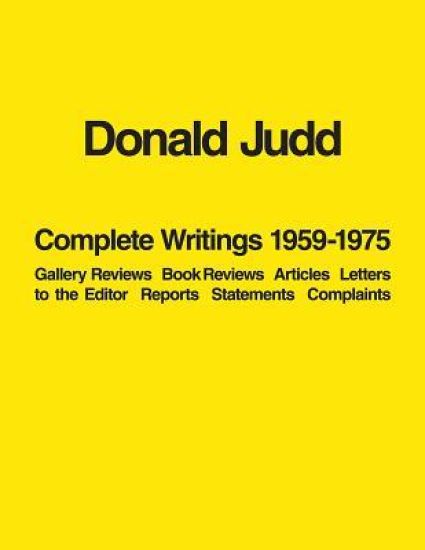
Donald Judd: Complete Writings 1959-1975

Donald Judd: Complete Writings 1959-1975

Donald Judd

Distributed Art Publishers
2016
nidottu
Originally published in 1975, reprinted in 2005 and out of print for many years, this collection of Donald Judd’s writings is now a sought after classic. His uncompromising reviews avoid the familiar generalizations so often associated with artistic styles emerging during the 1950s and 60s. Here, Judd discusses in detail the work of more than 500 artists showing in New York at that time, and provides a critical account of this significant era in American art. While addressing the social and political ramifications of art production, the writings focus on the work of Jackson Pollock, Kazimir Malevich, Barnett Newman, Ad Reinhardt, John Chamberlain, Larry Poons, Kenneth Noland and Claes Oldenburg. His classic 1965 ‘Specific Objects’ essay, a discussion of sculptural thought in the 1960s, is included alongside the notorious polemical essay ‘Imperialism, Nationalism, Regionalism’ and much else.
Critical Realism and Composition Theory
The field of composition theory has emerged as part of the intellectual turmoil and set of pedagogical debates which have beset higher education for the last four decades and is now revolutionizing the theory and praxis of higher education. This volume examines three of the dominant pedagogical theories within composition theory: expressivist, cognitivist, and social-constructivist and builds its critique on the fact that much of modern composition theory has focused on epistemological concerns while neglecting the ontological foundations of that which is being discussed. Critical Realism and Composition Theory offers an alternative approach to teaching composition. This problem-oriented alternative is designed to lead students beyond the abstract, contemplative description of a problem to an expanded understanding that shows that concerns for justice cannot be addressed intellectually without at the same time confronting the practical constraints that limiting powers of social institutions play in both defining a problem and its social solution.
Critical Realism and Composition Theory
The field of composition theory has emerged as part of the intellectual turmoil and set of pedagogical debates which have beset higher education for the last four decades and is now revolutionizing the theory and praxis of higher education. This volume examines three of the dominant pedagogical theories within composition theory: expressivist, cognitivist, and social-constructivist and builds its critique on the fact that much of modern composition theory has focused on epistemological concerns while neglecting the ontological foundations of that which is being discussed. Critical Realism and Composition Theory offers an alternative approach to teaching composition. This problem-oriented alternative is designed to lead students beyond the abstract, contemplative description of a problem to an expanded understanding that shows that concerns for justice cannot be addressed intellectually without at the same time confronting the practical constraints that limiting powers of social institutions play in both defining a problem and its social solution.